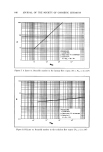
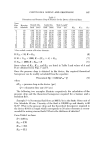
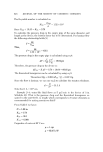
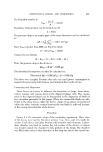
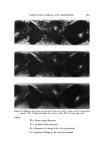
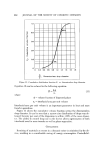
1. Soc. Cosmet. Chem., 24, 639-653 (September 16, 1973) In-Line, Continuous Mixing and Processing of Cosmetic Products S. J. CHEN, Ph.D.* Presented December 11, 1972, New York City Synopsis-Controllable and predictable MIXING can be achieved in the in-line, no- moving-part device. Main mixing mechanisms in the device are flow division and radial mixing. Energy consumption is sinall for both laminar and turbulent flow PROCESSING. A very narrow drop size distribution was obtained using the device for DISPERSION applications. The DROP SIZE can be controlled by changing the flow rate in the device. Seventy per cent of the dispersion is within ñ20% of the mean drop size. INTRODUCTION Mixing and contacting play important roles in the production of cosmetic and toiletries products. Batch and continuous operations are two main opera- tions used in the industry. This paper deals with the study of an in-line, con- tinuous, no-moving-part mixing and processing device. This device is used in the processing of liquid-liquid, liquid-gas, liquid-solid, solid-solid, solid-gas, and gas-gas systems. Applications include mixing, dispersion, chemical reac- tion, heat and mass transfer, residence time control, and thermal homogeniza- tion. This paper is concerned only with mixing and contacting operations other applications have been reported elsewhere (1-7). Mixing or blending is an operation used to reduce nonuniformities in con- centration, temperature, velocity, and properties of bulk material. When a chemical reaction is involved, conversion is promoted if thorough mixing be- tween reagents is provided. Thorough mixing also enhances heat and mass transfer. Contacting may be considered as the mixing of two or more immiscible liquids, solids and liquids, or liquids and gases. This paper deals only with low-viscosity liquid contacting which is frequently encountered in the cos- merle and toiletries industry. Applications of contacting include extraction, *Kenics Corp., Danvers, Mass. 01923. 639

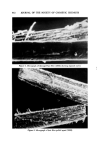
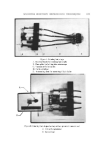
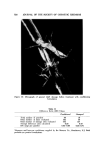
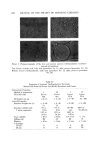
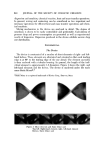
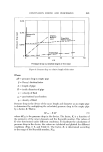
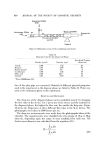
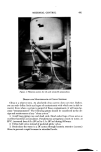
640 jOUBNAL OF THE SOCIETY OF COSMETIC CHEMISTS dispersion and emulsion, chemical reaction, heat and mass transfer operations. In general, mixing and contacting can be considered as two important and necessary operations for cfflcicnt heat and mass transfer operations and chem- ical reactions. Mixing mechanisms in the device are analyzed in detail. The degree of mixedhess is shown to be easily controllable and predictable. Calculations of pressure drop and power consumption are presented as well as experimental results of dispersion. Dispersion produced in the device exhibits narrow drop size distribution. EXPERIMENTAL The Device The device is constructed of a number of short elements of right- and left- hand helices. These elements are alternated and oriented so that each leading edge is at 90 ø to the trailing edge of the one ahead. The element assembly is then enclosed with a tubular housing. In general, the length of the indi- vidual element is approximately 1.5 diameters. Figure I shows the right- and left-hand elements and the device. The device is marketed under the trade name Static Mixer©.* *Static Mixer is a registered trademark of Kenics Corp., Danvers, Mass. Figure I. Mixer elements and Static Mixer unit Top left. Right-hand element right, left-hand element Bottom. Static Mixer unit
Purchased for the exclusive use of nofirst nolast (unknown)
From: SCC Media Library & Resource Center (library.scconline.org)