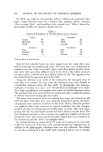
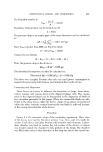
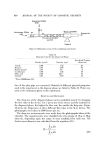
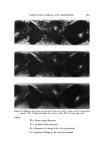
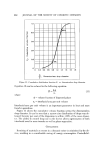
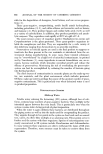
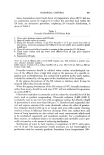
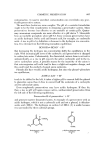
666 JOURNAL OF THE SOCIETY OF COSMETIC CHEMISTS The general formula for parabens (II) is also shown. The different para- ben members differ only in the alkyl group of the ester: R is methyl in methyl paraben, propyl in propyl paraben, and so forth. Since the earboxylie acid ester is neutral and not acidic, parabens do not have the same pH dependence as benzoie acid. However, parabens are also phenolie, and phenols are •veak acids. Table I Per Cent Undissociated Preservative at Different pH's pH Preservative 4 5 6 7 Sorbic acid 86 37 6 0.6 Benzoic acid 60 13 1.5 0.15 Dehydroacetic acid 95 65 16 2 Methyl paraben 77 63 Table I indicates the percentage of active preservative molecules at several pH's. Even at pH 4, sorbic acid is only 86% in its undissociated, active form. The other 14% is carboxylate anion, which is inactive. It does not matter whether sorbic acid or potassium sorbate is added to a cosmetic. If the cos- metic is at pH 4, the equilibrium of 86% undissociated sorbic acid and 14% ionized sorbate will be established. At pH 6, only 6% of any sorbic acid added is active antimicrobially, and at pH 7, less than 1% is undissociated. At higher pH's the amount of undissociated sorbic acid is negligible. Benzoic acid is a slightly stronger acid than sorbic acid, and the percentages in Table I bear this out. At pH 5, benzoic acid is only of marginal value for preservation since only 13% is in the active undissociated form. Dehydroacetic acid (I) is a weaker .acid than sorbic or benzoic acid, but it is stronger than most phenols. At pH 6, dehydroacetic acid has more active form present than benzoic .acid does at pH 5. At pH 7, where carboxylic acid preservatives contribute almost no antimicrobial action, dehydroacetic acid retains some limited activity. Since the dehydroacetate anion itself is weakly antimicrobial, some cosmetics containing DHA exhibit slight antimicrobial activity even at pH 7. Even though the parabens are not as dramatically affected by pH as are stronger acids, the same principles apply. At pH 7 only two-thirds of the methyl paraben has effective antimicrobial activity at pH 8.5 only about half of the methyl paraben is undissociated and active. The other parabens behave in a similar fashion. Preservative action is also dependent upon the solubility of the preservative in the aqueous phase, and its partition between water and oil phases. Micro- organisms grow in the water phase or at the water-oil interface. Therefore, the preservative should be in the water phase if it is to be effective. In an emul- sion, a preservative will partition itself depending on its relative solubility in

COSMETIC PRESERVATION 667 the phases. In any specfic emulsion, the equilibrium distribution of a stable prese. rvative in the different phases will depend on the nature of the phases (i.e.,: on the partition coefilcient), the solubility limits of the preservative, the volumes of the different phases, and the pH. Methyl paraben, for example, is soluble in water to the extent of about 0.25% at room temperature. It is possi- ble to make up an aqueous phase containing 0.25% methyl paraben, but if that phase comes into contact with an equal volume of vegetable oil, the methyl paraben will gradually migrate into the oil phase. Eventually, the methyl paraben will partition approximately 10 to i in favor of the oil phase. The aqueous phase now contains not 0.25% methyl paraben, but only about 0.02 or 0.03%. The emulsion is probably not adequately protected against micro- bial attack. Migration of preservatives is a complex phenomenon, and attempts to pre- dict final distributions in actual emulsions are made difficult by the diverse nature of each phase. Each ingredient of a phase affects the solubility of the preservative in that phase. Since a preservative system must be able to protect a cosmetic product throughout the period of its storage and use, the migration of a preservative out of the water phase can be as serious a problem as the loss of the preservative by evaporation, reaction with other components, or chemical breakdown. Only microbiological challenge testing over extended periods of product storage can prove that migration of preservatives is not a problem. Although the presence of water is essential for microbial growth, anhydrous cosmetics should also be protected by a preservative system. If anhydrous oils or powders are kept completely water-free, preservation problems are minor. Unfortunately, a film of water can form on such a product just by exposure to moist air, and in the high local concentrations of water, microorganisms will grow. It is a wise precaution, therefore, to have a water-soluble preservative in an anhydrous powder or oil, so that when water does condense onto the prod- uct, the preservative can dissolve in the water and prevent microbial growth. The final factor, which is probably the most common source of preservative failure, is the effect of other components of the formulation. The components of a• cosmetic may interfere with or may help the antimicrobial action of a preservative. For this reason, s,creening experiments (serial dilutions, mini- mum inhibitory doses, etc.) in laboratory media are practically worthless to the cosmetic chemist. It is essential that preservative testing be carried out on the cosmetic itself. A preservative that functions well in a screening experi- ment with microbiological growth media may be usless in the actual cosmetic because of interference by some component of the cosmetic. Conversely, a compound that behaves poorly in a screening test with microbiological media can have high antimicrobial activity in the cosmetic, not only because of en- hancement of the preservative action by other components, but also because the cosmetic is usually not an ideal culture medium for microorganisms. The
Purchased for the exclusive use of nofirst nolast (unknown)
From: SCC Media Library & Resource Center (library.scconline.org)