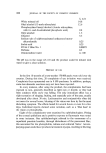
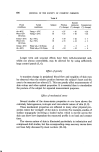
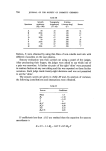
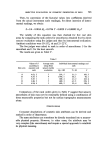
694 JOURNAL OF THE SOCIETY OF COSMETIC CHEMISTS have made great contributions in establishing in vitro and in vivo evaluation techniques, including some for assessing the effects of products aimed at smoothing the skin. However, in vivo techniques require great care in understanding and controlling the many variables that can affect the property being evaluated. Such variables can be controlled to give reproducible, standardized pro- cedures fulfilling the spirit of objective evaluation stated elsewhere (3, 4). A major difficulty in evaluation often lies in the physical interpretation of an important consumer attribute. Very complex terms may not be uniquely defined by one property only. For example 'feels smooth' is not reflected in mere measurements of surface topography change. On the other hand some attributes may be readily interpreted. Thus, 'sweating' may be evaluated by measuring skin water loss. MAJOR COSMETIC PROPERTIES AND ATTRIBUTES OF SKIN There are three sources of descriptors--those of the dermatologist, beautician and consumer. All three are concerned with the characteristics of normal, healthy skin to serve as reference points but, in general, cosmetic interests become those of the dermatologist only when the magnitude of effect passes into the pathological region. From interviewing consumers we have obtained the following ranking of importance of attributes as components of perfect skin. These descriptors apply to the skin itself and the negative signs in the first column imply 'absence of'. There will be additional descriptors where there exists a deposit of the product on the skin (e.g. a 'sticky' film), and Table I Attribute Female judges Male judges Blemishes (-) 1 1 Hirsu teness (-) 2 2 Evenness of colour 3 3 Smoothness 4 4 Flakiness (-) 5 6 Texture 6 9 Oil content 7 8 Tension 8 7 Softness 9 5 Basic colour 10 10 Thickness 11 11

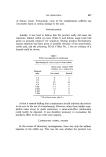
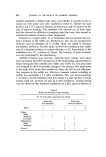
OBJECTIVE EVALUATION OF COSMETIC PROPERTIES OF SKIN 695 for specific products like antiperspirants where one may be concerned with 'wetness'. With any given situation there will usually be overlap and interaction of these descriptors which can complicate their individual physical inter- pretation for instrumental measuring purposes. The example of 'smoothness' mentioned earlier will be analysed in detail later in the paper. THE VARIABILITY OF SKIN in vivo In comparative product testing there can be many major sources of variability in skin properties caused by, for example, changes in air tem- perature, relative humidity, wind velocity, gravity, mechanical stress, effect of probe pressure during contact with the skin, preparation of the skin surface, a psycho-physiological effect of operator on the subject, site-to-site variation, and with repeated exposure to a given product there may arise an accommodation period. The need to control as many of these factors as possible is emphasized in the following sections because in most cases their effects can be significant under conventional test conditions. Ideally a steady physiological state should be established and this can be monitored by observing for example the respiratory pattern or more directly by readings using the evaluation instrument taken over a period of time from a control area. Effect of environmental temperature, relative humidity and wind velocity The importance of these variables is illustrated in Table H for some of our measurements of friction, scratch resistance and surface temperature (details of the first two instruments will be given later). In all cases the subjects A and B were measured during exposure to the two varied con- ditions given. The results are expressed as a percentage change from the initial measured value. In general, measurements were steady after about 30 min exposure to the particular condition. Before measurement the skin of each was cleaned as described later in the footnote on p. 698. The effects given in Table II serve to show the need to control the climate for critical evaluation work, involving especially those skin properties affected by the water content of the stratum corneum.
Purchased for the exclusive use of nofirst nolast (unknown)
From: SCC Media Library & Resource Center (library.scconline.org)