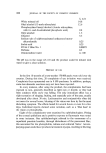
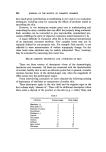
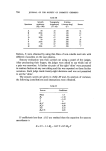
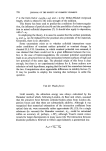
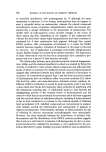
704 JOURNAL OF THE SOCIETY OF COSMETIC CHEMISTS Table III Scratch Topography Friction Specimen resistance (roughness) (viscous drag) Scores (firs) 100) (T) 10) (F) A 70 25 150 34 B 2834 25 150 19 C 70 67 150 17 D 2834 67 150 0 E 70 25 550 28 F 2834 25 550 22 G 70 67 550 13 H 2834 67 550 7 friction, F, were obtained by using thin films of non-volatile inert oils with different viscosities on the cast plastics. Sensory evaluation was then carried out using a panel of five judges. After precleaning their fingers, the judges were asked to say which one of a pair was smoother. A further six pairs of the eight 'skins' were presented in random fashion at any one sitting and this was repeated on three further occasions. Each judge made twenty-eight decisions and was not permitted to see the 'skins'. The sensory scores are given in Table III and, by analysis of variance, the following contributions and interactions were obtained. Table IV Source Coefficient Mean 3.5 firs -13o T -- 1.65 F 0 HvT -0.05 Hs.F 0.50 T.F. 0.15 Hs.T.F. 0.05 If coefficients less than 4-0.5 are omitted then the equation for sensory smoothness is $= 3.5-1.1 H s - 1.65 T+0.5 Hs.F

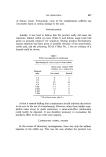
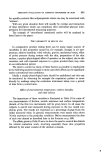
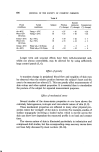
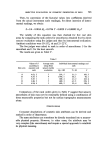
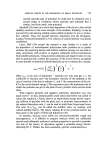
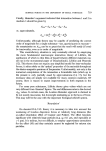
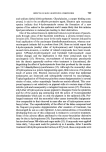
OBJECTIVE EVALUATION OF COSMETIC PROPERTIES OF SKIN 705 Then, by conversion of the factorial values into coefficients (derived from the actual instrument scale readings), for direct insertion of instru- mental readings, we obtain S = 9.4 - 0.0014 H s - 0.0786 T- 0.0029 F+ 0.00002 Hs.F The validity of this equation was then checked for five real skin areas by comparing the rank orders for smoothness obtained first by direct sensory evaluation using five judges and then by instrumental evaluation. Ambient conditions were 50-55•o rh and 21-22øC. The five judges were asked to rank in order of smoothness: 5 for the smoothest and 1 for the least smooth. The results are given in Table V. Table V Skin area Values of $ Average rank Individual instrumental readings and according to using direct rank equation and sensory tactile rank evaluation HsX 100 TX 10 F A 4.62 2 2 259 5 51 3 168 5 B 4.57 3 4 1748 1 30 1 76 1 C 5.37 1 1 300 4 41 2 162 4 D 3.38 5 5 409 2 65 5 155 3 E 4.24 4 3 409 2 55 4 120 2 Comparison of the rank orders given in Table V suggest that sensory smoothness of skin may now be reasonably defined using a combination of three measurable properties but not by surface topography measurements alone. CONCLUSIONS Consumer descriptions of cosmetic skin attributes can be derived and ranked in order of importance. The same attributes can sometimes be directly translated into a measur- able physical property. However, in other cases, the attribute may be very complex (like smoothness) and require a special approach to establish its physical meaning.
Purchased for the exclusive use of nofirst nolast (unknown)
From: SCC Media Library & Resource Center (library.scconline.org)