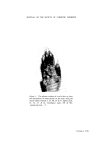
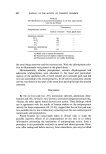
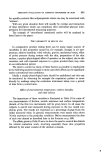
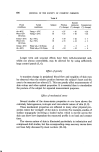
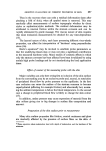
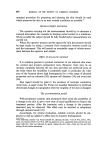
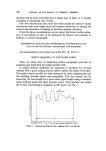
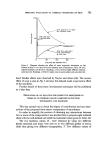
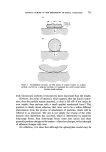
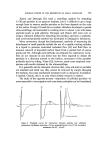
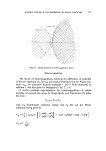
SURFACE FORCES IN THE DEPOSITION OF SMALL PARTICLES 713 Zimon and Deryagin (21) tried a centrifuge method for detaching 5-120 pm particles in an aqueous medium, but it is difficult to get a large enough force to remove smaller particles as the force depends on the cube of the radius. Krupp (19) and his co-workers therefore developed a special ultra-centrifuge, and succeeded in working down to about !pm with dense particles (such as gold spheres). Deryagin and Zimon (22) went over to using a vibration method for detaching dry powders and later a sophistic- ated anvil-and-projectile method was developed in Derjaguin's laboratory. More convenient, though less fundamental, methods of measuring the detachment of small particles include the use of a rapidly rotating cylinder in a liquid to generate controlled turbulent flow (23) and fluid flow to measure removal of deposited carbon black from a packed bed of coarse grains (24, 25). Although such methods are adequate for exploratory work, they do not measure in any direct way the force required to detach the particles in a direction normal to the surface movement of the particles probably starts by rolling. Visser (23), however, made some empirical com- parison with results obtained by the ultracentrifuge. It is generally said by detergent chemists that, once sub-micron particles are attached and dried out, they cannot be removed by simply changing the medium, but some mechanical treatment such as ultrasonic irradiation is needed. Clearly, this is an area where further research is needed. The study of the opposite process--deposition of colloidal partides--is more amenable to investigation and some basic principles can be formulated, (a) (b) i /../ (c) I1• ii I •/-'-Primary minimum minimum Figure 2. Potential curves for interaction between particle and substrate (schematic). (a) Simple attraction (b) low potential barrier E•, kT (c) secondary minimum E k T,

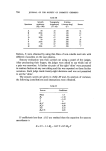
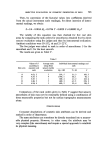
714 JOURNAL OF THE SOCIETY OF COSMETIC CHEMISTS though even here a number of distinct types of surface force must be taken into account. To eliminate gravitational and inertial effects from consideration, it is convenient to limit the discussion to particles smaller than about 1 gm radius. With such particles, the kinetic energy of Brownian motion (•kT) is far greater than, say, the kinetic energy of settling of the particles. Such particles can deposit either if they are attracted to a surface (Fig. 2a) or if there exists only a moderately high energy barrier opposing contact (Fig. 2b) (e.g. with a 5kT barrier 0.7•o of collisions will have sufficient energy for sticking). Under certain conditions (see below) particles which are kept firmly off the surface itself may yet be held weakly in a 'secondary minimum' (Fig. 2c). DEPOSITION FROM DISPERSIONS Experimental methods When J. K. Marshall (33) started his pioneering study of deposition by immersing coated glass plates in suspensions of carbon black, some essential conditions for obtaining meaningful results at once became apparent. (a) The initial state of the dispersion must be precisely defined. (b) The mass transport conditions must be controlled. (c) The deposit must be examined--not merely its quantity measured. Without these controls, deposition is liable to be irregular and aggregates settle on upwards-facing surfaces. These problems were overcome (a) by working with a dilute mono- disperse suspension of measured particle concentration, (b) by controlling transport to the deposition surface by use of the rotating disc principle, and (c) by examining the deposit by ultra-microscopy. With this technique, Marshall (33) was able to distinguish three rather distinct conditions, according to the surface-chemical properties of the materials employed. (1) At one extreme, no deposition occurred. This corresponded to high zeta-potentials, of the same sign, on substrate and particles. (2) At the other extreme, massive deposition of aggregates of all sizes occurred, but the deposit was irregular and large aggregates stream- ing across the plate swept off particles that lay in their path. These effects occurred if the surfaces carried very low zeta-potentials. (3) Over a narrow range of conditions, random deposition of single particles occurred. This happened when the particles and plate
Purchased for the exclusive use of nofirst nolast (unknown)
From: SCC Media Library & Resource Center (library.scconline.org)