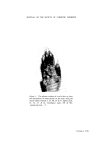
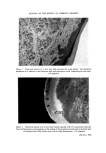
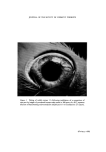
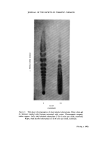
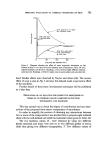
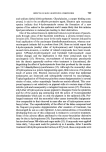
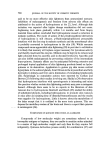
JOURNAL OF THE SOCIETY OF COSMETIC CHEMISTS Figure 2. Transverse section of a rat's foot pad showing the sweat glands. The glandular epithelium is of medium to tall columnar cells with prominent nuclei. Haemotoxylin and eosin. X 10 objective. Ftgure 3 Transverse section of a rat foot pad treated topically with 25 •o aluminium chloride. Note the fluorescence of aluminium on the surface of the keratin (arrowed) and in the distal part of the gland duct (SD). Morin stain with uv light illumination. X 10 objective. (Facing p. 682)

RAT FOOT PAD AS A MODEL FOR EXAMINING ANTIPERSPIRANTS 683 and foot pads excised for histological and histochemical examination. Although the compounds tested in the present study did not elicit changes of either type in the sweat glands of the rat's foot pad, it is conceivable that they may have exerted an effect on the physiological state of the gland as has been suggested with reference to aluminium compounds (32). In the present work, the observation that fluorescent 'plugs' were present in the orifices of sweat ducts exposed to aluminium chloride may partially explain the antiperspirant action of this compound. The lack of 'plugs' in the sweat ducts of animals treated with aluminium chlorhydrate leads to the con- clusion that the antiperspirant action of aluminium salts is more complex than a mere occlusion of the sweat ducts. It is conceivable that the secretion of sweat on the skin surface is reduced by the sweat being resorbed through the walls of the sweat ducts, as suggested by Papa (32) on the results of methylene blue iontophoresis, but the mechanism by which this resorption may occur is obscure. Also no information is available at present to show whether other antiperspirants act by a similar mechanism. (Received: 5th December 1972) REFERENCES (1) Richter, C. P. & Whelan, F. Sweat gland responses to sympathetic studies by the galvano- metric skin reflex method. J. Neurophysiol. 6 191 (1943). (2) Alpbin, R. S., Saunders, D. and Ward, J. W. Method for the evaluation of anhydrotic substances in the anaesthetized cat. J. ?harm. $ci. 56 449 (1967). (3) Alphin, R. S., ¾ocac, J. A., Saunders, D. and Ward, J. W. Effects of some lignosulphonates on sweat gland activity. J. Pharm. Sci. 58 902 (1969). (4) Collins, G. F. and Christian, J. E. The study of the effect of certain chemicals on perspi- ration flow. J. Amer. Pharm. Ass. Sci. Ed. 47 25 (1958). (5) Jenkinson, D. McE. and Robertshaw, D. Studies on the nature of sweat gland 'fatigue' in the goat. J. Physiol. 212 455 (1971). (6) Sivadjian, J., Vautrin, M. and ¾autrin-Matge, H. Action anhydrotique locale compar•e de deux amicholinergiques. Thdrapie 22 1015 (1967). (7) Ring, J. R. and Randall, W. C. The distribution and histologic structure of sweat glands in the albino rat and their response to prolonged nervous stimulation Anat. Rec. 99 7 (1947). (8) Hayashi, H. and Nakagawa, T. Functional activity of the sweat glands of the albino rat. J. Invest. DermatoL 41 365 (1963). (9) Wechsler, H. L. and Fisher, E. R. Eccrine glands of the rat, response to induced sweating, hypertension, uremia and alterations in the sodium state. Arch. Dermatol. 97 189 (1968). (10) Quatrale, R. P. and Speir, E. H. The effect of ADH on eccrine sweating in the rat. J. Invest. Dermatol. 55 344 (1970). (11) Munger, E. L. and Brusilow, S. W. The histophysiology of the rat plantar sweat glands. Anat. Rec. 169 1 (1971). (12) Weiner, J. S. and Hellman, K. The sweat glands. Biol. Rev. Cambridge Phil. Soc. 35141 (1960). (13) Quatrale, R. P. and Laden, K. Solute and water secretion by the eccrine glands of the rat. J. Invest. Dermatol. 51 502 (1968).
Purchased for the exclusive use of nofirst nolast (unknown)
From: SCC Media Library & Resource Center (library.scconline.org)