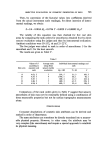
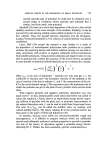
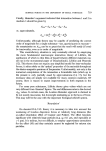
SURFACE FORCES IN THE DEPOSITION OF SMALL PARTICLES 719 Finally, Hamaker's argument indicated that interaction between 1 and 2 in medium 3 should be given by or, approximately, Am = A• + Aaa - Axa - A•a Unfortunately, although theory may be capable of predicting the correct order of magnitude for a single substance--say, quartz/quartz in vacuum-- the uncertainties on Ala• can be so great that the result will rarely (if ever) be trustworthy, even as to order of magnitude. This unsatisfactory situation is only nominally relieved by employing the more fundamental macroscopic interaction theory of Lifshitz, the application of which to thin films of liquid between different materials was set out in the monumental paper of Dzyaloshinskii, Lifshitz and Pitaevski (12). This theory does not require any simplified model for inter-molecular forces it relies solely on the 'optical' properties of the materials throughout the electro-magnetic spectrum of frequencies. Unfortunately, not only is the numerical computation of the interaction a formidable task (which up to the present is only partially eased by approximations (14, 17), but the necessary data are simply not available for many common materials. Of course, there is reason to expect improvements in both respects in the future. For some pure substances, Lifshitz theory gives values which are not very different from 'classical' figures. The real differences arise in the derived Ala9. values. In certain cases, the London-Hamaker approach is claimed to be not merely inaccurate, but downright misleading as to the laws of force. This may well be the case with the important biological cell/cell system. 'Retardation' On classical D.L.V.O. theory it is necessary to take into account the weakening of London dispersion forces at relatively long distances (the so-called retardation effect of Casimir and Polder). The effect becomes significant with relatively large particles (e.g. ax0.1 !•m, and especially at 1 gm). It is tedious, but not difficult, to employ approximate corrections for the effect (10) and they certainly cannot be neglected for micron size particles.

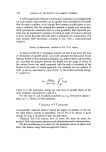
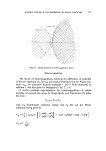
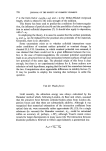
720 JOURNAL OF THE SOCIETY OF COSMETIC CHEMISTS 'Retardation' is not separately allowed for in Lifshitz theory, as the physical effect is an integral part of this comprehensive treatment. The 'secondary minimum' Verwey and Overbeek pointed out that combination of double-layer repulsion forces with London-Hamaker attraction would always predict a net attraction at large separations, and that this so-called secondary minimum would become deep enough with particles larger than a few micrometres to cause association of particles. Several examples of this effect have been identified. The effect is obviously more marked with flat particles than with spherical ones. One curious consequence is that although the potential barrier against coagulation (or deposition) rises approximately proportionally to increase of particle radius, the depth of the minimum is also proportional to radius. Therefore larger particles will be firmly pre- vented from depositing into the primary minimum but are likely to deposit in the secondary minimum of the interaction curve. Such particles are held, at least temporarily, at a certain distance from the surface, with a water film between. They may diffuse out again, whereas the primary minimum for large particles would be too deep to permit escape. Particles trapped in the secondary minimum may show rotational and lateral BrownJan motion. The hydrodynamic correction In any fundamental investigation of the kinetics of coagulation or deposition, allowance should be made for the fact that when a particle approaches another particle or a plate its diffusion is hindered by very proximity of the other by a purely hydrodynamic drag effect, not any hypothetical influence of the solids on the local viscosity of the medium. The magnitude of the effect, which can only retard collisions--not bestow stability if attractive forces are present--has been calculated. It reduces the rate by approximately a factor of 2 (8). Adsorbed layers Many practical colloids carry adsorbed substances such as surfactants, polymers, proteins, gums, etc. their presence can, of course, have a pro- found effect on stability against coagulation or deposition.
Purchased for the exclusive use of nofirst nolast (unknown)
From: SCC Media Library & Resource Center (library.scconline.org)