J. Sec. Cosmet. Chem. 24 709-725 (1973) ¸ 1973 Society of Cosmetic Chemists of Great Britain Surface forces small particles in the deposition of J. A. KITCHENER* Presented on the 12th February 1973 in London, at the Symposium on 'Some surface chemical aspects of cosmetic and toiletry products', organized by the Society of Chemical Industry and the Society of Cosmetic Chemists of Great Britain. Synopsis--The paper reviews the SURFACE FORCES which control the properties of DIS- PERSIONS of PARTICLES smaller than about 11.tm in diameter. Distinction must be made between processes of DEPOSITION of such particles on to solid substrates and their subsequent removal the latter is a more complicated problem because of deformation of the materials at points of contact, the extreme closeness of the surfaces there, and the possible formation of chemical bonds. The theory of deposition is closely similar to the theory of colloid stability, with allowance being made for 'HETEROCOAGULATION'. The only modifications required are for (a) the shape factor, and (b) the kinetics of collision, both of which are readily treated. The principal surface forces recognized in colloidal systems include: (i) the London-van der Waals 'body forces' (generally attractive) (ii) electrical double layer forces these may be attractive or repulsive, depending on the signs of the potentials on particles and substrate, and are often of relatively long range (iii) 'Steric hindrance' by simple surfactants (iv) 'protective colloid' action of adsorbed, solvated, macromolecules (v) adhesive 'bridging' by adsorbed macromolecules at low surface coverage (as with polymeric flocculants). Explicit formulae for (i) and (ii) are employed in the Derjaguin-Landau-Verwey-Overbeek theory and several significant developments have been made recently. Schematic formulae for (iii) and (iv) have been given, but (v) has not yet been treated quantitatively. Experimental testing of the theory of deposition requires control of the flux of particles up to a surface, and means of studying deposition and coagulation. The rotating disc technique provides a definitive method. INTRODUCTION: DEPOSITION AND ADHESION The purpose of this paper is to review modern developments in the theory of interaction between colloidal particles and macroscopic solid * Department of Mining and Mineral Technology, Imperial College, London, S.W.7. 709

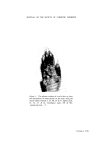
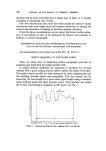
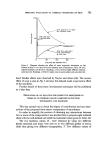
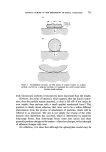
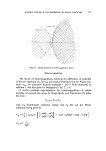
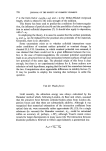
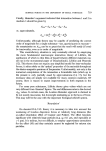
710 JOURNAL OF THE SOCIETY OF COSMETIC CHEMISTS surfaces. Despite the title, this theme is relevant to a surprising number of systems of practical importance, amongst them .the following: (1) The 'redeposition' of particulate solid dirt in detergency. (2) Attachment of china clay particles to cellulose fibres in papermaking. (3) Removal of colloidal matter from water by sand filters. (4) Capture of dust particles by fibre filters. (5) The 'slime-coating' of mineral grains by colloidal particles, which can sometimes be deleterious in the froth-flotation separation of minerals (but which has also been exploited as a method of removing coloured slimes to improve the brightness of china clay). (6) The adhesion of 'wear' fragments in engines. (7) Deliberate deposition to change the properties of a surface (such as the 'de-lustring' of rayon with titanium dioxide). The basic phenomena implicated in these effects are equally diverse and a thorough discussion of all of these would run to a treatise on dispersion science. To narrow the field at the outset, a number of well-known effects (besides the obviously irrelevant coating by paint layers) will be mentioned only to exclude them: (a) electrostatic and thermophoretic deposition of dust particles (b) deposition by inertial forces ('impaction') (c) deposition of suspensions by electrophoresis (e.g. from non-aqueous dispersions) or magnetophoresis (d) attachment of small particles under the influence of the surface tension forces of a liquid wetting film. This last mechanism is not without interest, though the 'surface forces' concerned are of the well-known type, covered by the classical theory of capillarity, whereas the effects to be discussed below are classified by Russian authors as 'capillary effects of the second kind', being the result of close approach of two interfaces. The effect of surface tension in a wetting film depositing solid particles has been well analysed recently by Uno and Tanaka (29). The maximum force is experienced if both the particle and the substrate are lyophilic (contact angle zero). The calculation of such forces for bodies of different shape is reviewed by Princen (30). In the case of a flat particle, the Laplace pressure due to surface tension is simply ?/r (Fig. la) and the total force F= •rR •' (y/r), 3' being the surface tension of the liquid. In the case of a sphere on a plate (Fig. lb), as the liquid evaporates, the radius of curvature decreases this increases the Laplace pressure, but at the same time the area subject to this pressure decreases. Theory shows that the force goes through a maximum, given by F= 4•rR¾. According to this idealized model, for particles smaller than about 0.5 mm diam. the force of surface tension can exceed the weight of the particle, and, of course, with
Purchased for the exclusive use of nofirst nolast (unknown)
From: SCC Media Library & Resource Center (library.scconline.org)