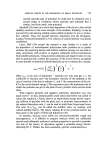
SURFACE FORCES IN THE DEPOSITION OF SMALL PARTICLES 715 carried opposite sign of potential. It could also be obtained over a certain range of conditions where particles and substrate had a similar, but fairly small, zeta-potential. Marshall (33) went on to show that deposition of this kind is, like colloid stability, sensitive to the ionic strength of the medium. Similarly, it can be prevented by introducing suitable water-soluble polymers to act as 'protec- tive' colloids. Thus, the parallel between deposition and the Derjaguin- Landau-Verwey-Overbeek (D.L.V.O.) theory of colloid stability was clearly established. Later, Hull (34) carried the research a step further in a study of the deposition of monodisperse polystyrene latex particles on to plastic surfaces. By preparing latexes with built-in sulphate groups, he was able to study interaction with positive or negative substrates without interference from soluble surfactants. Using positive substrates and negative latex, he was able to quantitatively confirm the accuracy of the Levich theory, as applied to mass transfer of spherical colloidal particles up to a rotating disc, namely, ( Jmax = 0.62 6nqa co C. (Here Jmax is the rate of deposition - particles per unit area per s, q the coefficient of viscosity and v the kinematic viscosity of the medium, co the rate of rotation of the disc in radians s -•, and C the concentration of the sol: kT is the usual thermal energy.) This expression gives the maximum rate at which the particles can get to the plate if every particle which arrives sticks there. With negative particles and negative substrates, deposition was very much slower--in fact, immeasurably small unless electrolyte was added to reduce the repulsion. Clearly, there is an electrostatic energy barrier oppos- ing collision of particles with the plate, and, in principle, measurements of the reduced deposition rate, j', can be used to study these long-range forces. The ratio W=j'/jma , can be called the stability ratio, by analogy with colloid stability theory. The theory relating W to the potential barrier has been given in the paper of Hull and Kitchener (34). In practice, because most solids are sub-microscopically rough and heterogeneous, it is difficult to prepare surfaces which are sufficiently smooth and sufficiently uniform in surface properties to provide a quantita- tive test of the theory of deposition against a potential energy barrier. (Recently Dr T. Walker has been successful--private communication.)

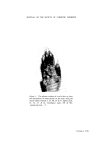
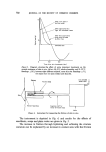
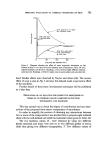
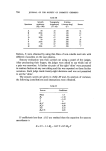
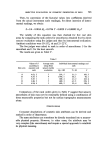
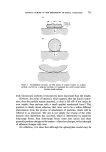
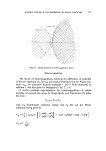
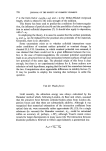
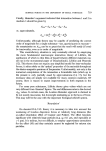
716 JOURNAL OF THE SOCIETY OF COSMETIC CHEMISTS It will be appreciated that the rotating disc technique is not indispensible for such studies mass transfer can be equally well controlled by Poiseuille flow through a capillary, or by laminar flow between parallel plates or con- centric cylinders. But the rotating disc method is simple and convenient. With hydrophobic substrates there is some possibility that deposited par- ticles may be displaced if a meniscus forming an angle of contact is allowed to move across the plate when the latter is withdrawn for examination. For such systems Hull introduced counting in situ, with a water-immersed objective. Theory of deposition relation to D.L.V.O. theory As early as 1934, B. V. Derjaguin pointed out that if one knew the laws of interaction of parallel plates, one could calculate the interaction forces between bodies of other geometrical shapes, e.g. sphere/sphere, sphere/plate, etc., provided the distance between the bodies and the range of action of the surface forces was small compared with the radii of curvature of the bodies at the point of closest approach. For example, for two spheres of radii, ax and a2, separated by a gap H (Fig. 3), the mutual potential energy, V, is given by V• 2nala2 (a• + az) Vhdh where Vh is the interaction energy per unit area of parallel plates of the same materials, separated by a gap of h. For the case of a sol of spherical particles ax = a•, whereas for sphere + plate, a•. = •o. Hence, for like materials, V sphere/plate • 2 V sphere/sphere Consequently, whatever factors control the degree of stability of the sol, the same factors operate in deposition. And if D.L.V.O. theory is good enough for sols, it should serve also for deposition. 'Classical' D.L.V.O. theory, now 25 years old, must be taken for granted. Only subsequent extensions and refinements need be discussed here. The first modification is to allow for the dissimilar nature of sphere and plate this implies using 'heterocoagulation' theory.
Purchased for the exclusive use of nofirst nolast (unknown)
From: SCC Media Library & Resource Center (library.scconline.org)