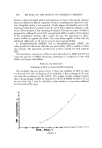
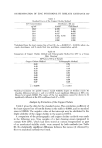
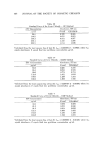
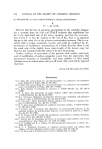
454 JOURNAL OF THE SOCIETY OF COSMETIC CHEMISTS veloped for this purpose, are based on ehelate exchange. In one inethod, ZPT is dissolved in an ethylenediaminetetraaeetate (EDTA) solution. The pyrith- ione is then precipitated as the copper ehelate, which is dissolved in ehloro- forin and read in a speetrophotometer. The other methods are based on de- veloping a color •vith fer14e ion, which is also read in a speetrophotometer. EXPERIMENTAL Reagents and Equipment 0.0625 M EDTA: To 900 ml of distilled water, 23.3 g of the disodium salt of EDTA are added. The pH is adjusted to 7.0 with 50% sodium hydroxide while the salt is dissolving. The resulting solution is diluted with water to 11300 ml. Copper sul[ate solution: This consists of a 10% aqueous solution of the an- hydrous salt or the equivalent concentration of the pentahydrate. Ferric chloride solution: In this solution, 9.0 g of FeCla'6HsO and 5.0 ml of concentrated HC1 are diluted with water to 200 ml. Fiberglass filter paper: This consists of Reeve Angle 934* 4.25 cm. ZPT?: This is standardized by iodometr_ c titration (2). METHODS Polarography in Alkaline Solution In this method, a sample equivalent to 50 mg of ZPT is extracted with 20 ml of concentrated HC1 and sufficient water in several portions to make the vol- ume of extract 2130 ml to a 10.0-ml aliquot of this extract, sufficient N/10 sodi- um hydroxide is added to neutralize the solution to the methyl red end point and to fi•rnish 2.0 ml excess ooe base. Aoeter dilution to 25.0 ml and deaeration with nitrogen, the solution is anodically polarographed between 0 and -1 V (EV2 = -0.26 V versus the standard calomel electrode). Solubility of Zinc Pyrithione in Neutral EDTA Solution The solubility in EDTA at a pH of 7.0 was investigated by shaking an ex- cess of solid ZPT for about 3 hours with several concentrations of the d sodi- um salt adjusted to a pH of 7.0 with sodium hydroxide. The suspensions were filtered, diluted, and read at 278 nm against the appropriate bIanks. The con- centration of pyrithione in solution was obtained by comparison of the absorb- ance with that of standard ZPT completely dissolved in EDTA at the same pH. •'Greiner Scientific Corp., 22 N. Moore St., New York, N.Y. 10013. ?Olin Chemicals Group, 275 Winchester Ave., Nexv Haven, Conn. 06504.

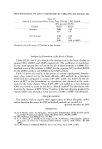
DETERMINATION OF ZINC PYBITHIONE BY CHELATE EXCHANGE 455 ANAI,YSiS BY FOitMATION OF TIlE COPlqqll (JIIEI,ATi5 An amount of product equivalent to 10 mg of ZPT is xveighcd into a 300-ml Erlenmeyer flask equipped •vith a ground glass stopper. To this flask are then added 50.0 ml of neutral 0.0625 M EDTA solution of 50.0 nil of dichloroeth- ane. After vigorous mechanical shaking for 1 hour, the aqueous phase is centrifuged at 15,000 rpm for 10 min. Then 10.0 nil of the centrifuged aqueous phase is transferred to a 50-ml beaker. While s•virling the contents of the beaker, 1.0 nil of 10% copper sulfate is added. Complete precipitation of the copper chelate is obtained in g hours. At the end of this time, the precipitate is collected on a 4.gS-cm fiberglass filter paper in a Buchner funnel of suitable size. This may be done by transferring the precipitate to the center of the fil- ter paper from the beaker by means of a Pasteur pipette. In no case should the precipitate be allo•ved to creep over the side of the filter paper. The beaker, pipette, and filter paper are •vashed xvith a total of 5 ml of cold distilled •vater. The presence of some residual copper sulfate on the filter paper does not in- terfere xvith the assay. The filter paper containing the precipitate is trans- ferred back to the beaker •vith the aid of foreeeps. By means of the Pasteur pipette, the sides of the beaker and the entire filter paper are •vet •vith 10.0 nil of methanol. Care is taken to prevent detaching the precipitate from the filter paper. The methanol is permitted to remain in contact •vith the precipitate for 5 min., after •vhich it is transferred to a 100-ml volumetric flask. The Pasteur pipette, beaker, and filter paper are then •vashed •vith g0 to 25 nil of chloro- form. Too vigorous agitation •vill detach fibers from the filter paper. After the precipitate of copper chelate is dissolved, the chloroform is transferred to the volmetric flask. The Pasteur p!pette, beaker, and its contents are •vashed care- fully several times xvith chloroform, transferring the solvent to the volumetric flash •vhich makes a total quantity of about 90 ml of the solvent in the flask. It is preferable to dilute to volume just before reading fl•e absorbance because of the volume changes produced by temperature fluctuations. Approximately 10 mg of reference standard ZPT are treated in an identical fashion. The standard and sample chloroform solutions are read in a 1-cni cell at 320 nm. Dichloroethane is used in this method to remove lipid materials, •vhich in- terfere •vith the precipitation of the copper chelate. Menthanol is used to dis- place the •vater from the precipitate before dissolving it in the chloroform. The copper pyrithione is not readily soluble in chloroform •vhen it is •vet with •vater. Since the chelate is slightly soluble in methanol, flqe methanol •vash is retained and incorporated into the final chloroform solution. ANALYSIS BY FOB/VIATION OF THE FERRIC CHELATE A sample containing from 10 to 100 mg of ZPT in a cream or lotion is shaken •vith 15 ml of concentrated HC1 to dissolve the metal chelate. The
Purchased for the exclusive use of nofirst nolast (unknown)
From: SCC Media Library & Resource Center (library.scconline.org)