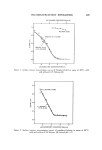
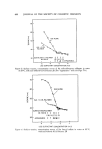
J. Soc. Cosmet. Chem., 26, 461-475 (Septeinber 1975) Water Soluble Polymer-Surfactant interaction--Part I. E. DESMOND GODDARD, PH.D., THOMAS S. PHILLIPS, and BOY B. HANNAN, BS.* Presented December 2, 1974, Annual Scientific Meeting, Society o[ Cosmetic Chemists, New York, N.Y. Synopsis-The interaction of a cationic substituted cellulose ether (Polymer JR) with a number of SURFACTANTS has been examined using surface tension measurements and a study of precipitation patterns. A NONIONIC SURFACTANT and an ALKYL BE- TAINE gave no evidence of any INTERACTION by these two techniques. On the other hand, the polymer led to pronounced lowering of the surface tension in the low con- centration range of the three anionic surfactants tested, namely, SODIUM LAURYL SUL- FATE, SODIUM TRIDECYLBENZENESULFONATE, and POTASSIUM LAURATE. Precipitation studies showed that maximum precipitation tends to occur at ratios of polymer to surfactant at which the charge of the polymer is balanced by that of the sur- factant. As the surfactant level is increased above this ratio, solubilization of the precipitate occurs. INTRODUCTION In recent years, several papers have been published, which dealt with the properties of aqueous solutions of polymer and surfactant mixtures (1-5). Measurements of surface tension (4, 5), electrical conductivity (4, 5), viscosity (1, 2, 3, 4, 6) and dye solubilization (1, 2, 3, 6, 7) have shown that unionized polymers such as polyethylene glycol, polyvinylpyrrolidone, and polyvinyl alcohol, form association complexes with anionic surfactants in a process akin to (pre)micellization. Viscosity measurements reveal that the polymers acquire the properties of a polyelectrolyte (8) and association with an anionic surfactant has been found to solubilize sparingly soluble poly- vinyl acetate (8). Studies by Schwuger (5) showed that association also takes *Union Carbide Corporation, Tarrytown Technical Center, Tarrytown, N.Y. 10591. 461

462 JOURNAL OF THE SOCIETY OF COSMETIC CHEMISTS place between cationic surfactants and a nonionized polymer (polyethylene glycol) but that the association is weaker in this case. No evidence of com- plex formation between polyvinyl pyrrolidone and a nonionic surfactant was found by Saito (3). The properties of ionic polymers in the presence of surfactants have been less widely studied. The work that is presented in this paper is concerned with the properties of a high-molecular weight water-soluble cationic poly- mer in the presence of various surfactants. Considerable interest has de- veloped in the adsorption of this polymer onto keratinous substrates from aqueous media containing surfactants. Therefore, to provide a more com- plete understanding of these adsorption characteristics, studies of the prop- erties of various surfactant/polymer mixtures were undertaken using sur- face tension measurements of their aqueous solutions. This technique has been widely used in recent years to study interactions, but has been re- stricted largely to unionized polymers. To complement the surface tension measurements, the interactions have also been followed by observation of the precipitation patterns of the aqueous surfactant/polymer mixtures. The latter studies represent, in some respects, an extension of the early work by Putnam and Neurath (9) and others (10, 11), which was concerned with association reactions between serum albumin and sodium lauryl sulfate, and also with gelatin alkyl sulfate systems by Pankhurst (12). EXPERIMENTAL The materials included the following: Sodium lauryl sul[ate (SaLS):* a high purity specimen Standapol T©:* triethanolamine lauryl sulfate (TEALS) 38% active Tetradecylbetaine: (N tetradecyl, N. N dimethylglycine) a very pure sam- ple $ Potassium laurate (KL): prepared by neutralization of pure laurie acidõ, with ethanolic KOH Sodium tridecylbenzene sul[onate (average C•a alkyl benzene sulfon•te (LAS)): a crude Ucane© 13'* sulfonate paste was desalted by treatment with hot 80% ethanol and filtering, extracting the solution with petroleum ether and then evaporating to dryness. *BDH, Poole, England. tHenkel, Inc., Teaneck, N.J. atDr. James Swarbrick, Sterling-Winthrop Research Institute, Rensse]ear, N.Y. õMatheson, Coleman, and Bell, East Rutherford, N.J. **Union Carbide Corp., New York, N.Y.
Purchased for the exclusive use of nofirst nolast (unknown)
From: SCC Media Library & Resource Center (library.scconline.org)