POLYMER-SURFACTANT INTERACTION 463 Calsoft© L-60, sodium LAS:* Tergitol© 15-S-9:* secondary alcohol ethoxylate, alkyl chain length aver- age 11 to 15 carbons EO content 9 Polymer JR-400:* a quaternary nitrogen substituted cellulose ether (13) Cellosize© QP-300: * hydroxyethylcellulose. METHODS Surface Tension Measurements were carried out by the Wilhemy plate technique. The ap- paratus consisted of a 2.5-cm wide platinum blade, sand-blasted to achieve good wetting and used in conjunction with a Rosano tensiometer torsion bal- ance. The water used was twice distilled the second distillation was from alkaline permanganate in a still, which employed a 1-m Vigreaux column. Although surface aging effects were generally not marked, this was not the case for the solutions of the secondary alcohol ethoxylate, Tergitol 15-S-9, which possesses a very low critical micelle concentration (cmc). For this reason, a standard waiting time of 30 rain was adopted for both the sur- factant alone and also for the surfactant/polymer systems, after the solution in a crystallizing dish had come to temperature equilibrium and its surface renewed by brief application of a fine capillary suctioning tube. For very dilute solutions of Tergitol ( 10 '5 M), a waiting time of 60 min was neces- sary. To render the surface tension method useful for surface studies, it is desir- able that surfactants be "surface chemically pure," the usual criterion for this is the absence, or virtual absence, of a minimum in the surface tension, con- centration plot, which is generally caused by the presence of small amounts of relatively high surface active contaminants. For this reason, the measure- ments were restricted to the laurylsulfate, betainc, nonionic, laurate, and LAS specimens the latter four materials had no surface tension minimum, while the first one displayed a small minthum, corresponding to the presence of a very small amount of surface active contaminant. This was further veri- fied by the disappearance of the surface tension minimum when the speci- men was dissolved in salt solution. The polymer was dissolved to form either a 1 or 2% preconcentrate by magnetically stirring solid and water at room temperature and then filtering it through glass wool. *Pilot Chemical Co., Los Angeles, Calif. pUnion Carbide Co., New York, N.Y.

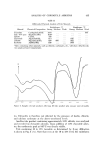
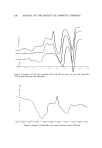
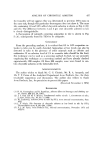
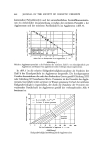
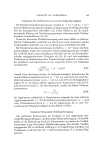
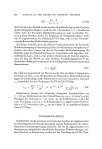
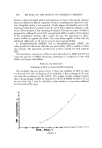
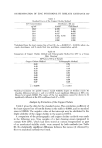
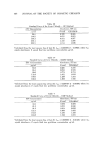
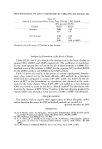
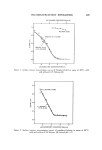
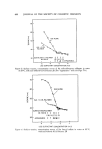
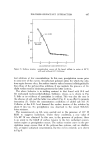
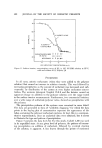
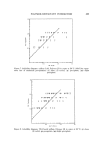
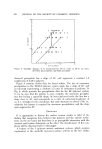
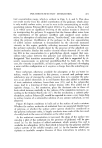
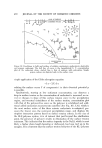
464 JOURNAL OF THE SOCIETY OF COSMETIC CHEMISTS Precipitation Studies The procedure as used for the surface tension studies) was to add the surfactant concentrate to the polymer concentrate to which the appro- priate amount of water had already been added. At the higher values of polymer (---1%) concentration very viscous liquid systems were encoun- tered, and precipitation ratings were made after 3 days of standing. I•ESULTS Surface Tension Measurements on solutions of Polymer JR, which is alone in water, show that the polymer is weakly surface active. At a level of 0.1%, which repre- sents the concentration used in the surface tension studies reported here, the polymer reduced the surface tension of water by ca. 4 dyn/cm (Fig. 1 ). Figure i also presents surface tension data for the nonionic detergent Tergitol 15-S-9. The surface tension, logarithm of concentration plot shows the cmc of Tergitol 15-S-9 to be slightly less than 10 -4 M. In the presence of 0.1% of the polymer, the y-log c curve of Tergitol 15-S-9 is scarcely al- tered. Despite the somewhat increased scatter of the points about the smooth curve in the presence of the polymer, it is clear that there is little evidence of interaction between the polymer and the surfactant from the surface ten- sion plot. A similar situation prevails for the C•4 betainc, which when it is alone in water has a very well-defined cmc of 1.8 X 10 -4 M (14) as can be seen in Fig. 2. The addition of the polymer has only a minor effect on the y-log c characteristic. As with the Tergitol 15-S-9 system, all the C•4 betainc-poly- mer mixed solutions were clear. Markedly different behavior was obtained with the LAS system. Figure 3 shows that LAS alone has a cmc value of 6x 10 4 M. In the presence of the polymer, there is a substantial drop in the surface tension value at low LAS concentrations. The resulting y-log c plot has a much lower slope in this region, crosses the curve for LAS alone, and levels to a plateau re- gion during which precipitation occurs before dropping again at a con- centration of 1.5 x 10 -a M to rejoin the LAS alone curve. Strong evidence of interaction is thus obtained from both the surface tension curve and the observed precipitation. Surface tension data for SLS are presented in Fig. 4. The cmc value de- rived from the position of the slight minimum, namely 7 x 10 -a M, agrees well with the published values. As was observed for the LAS system, addi- tion of polymer caused a marked decrease in surface tension of the surfac-
Purchased for the exclusive use of nofirst nolast (unknown)
From: SCC Media Library & Resource Center (library.scconline.org)