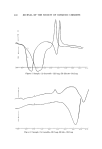
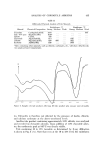
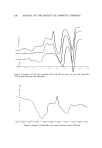
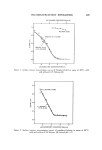
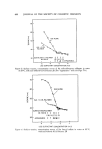
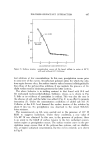
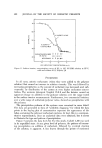
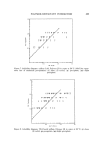
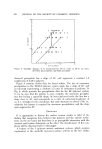
ANALYSIS OF CHRYSOTILE ASBESTOS 437 for tremolite will not appear this was determined in previous DTA runs on the same talc, though this particular thermogram does not show it. The same talc containing 1.0 and 3.0% added chrysotile asbestos is shown in Fig. 4 (B) and (C). The difference between i and 3 per cent chrysotile asbestos in talc is clearly distinguishable. A thermogram of naturally occurring serpentine in talc is shown in Fig. 5 (A), subsequently found by TEM to be antigorite. CONCLUSION From the preceding analysis, it is evident that 0.5 to 1.0% serpentine as- bestos in talcs can be easily detected. Serpentine at low levels can also be detected in talcs in the presence of other minerals such as chlorite and carbonates. If an asbestos level of 1% in cosmetic talcs should be the limit, this technique can be used as a screening method. In fact, we are presently employing this technique as a screening method and have already checked approximately 9,00 samples. Of these 200 samples, none were found to con- tain chrysotile asbestos at the detectable level. ACKNOWLEDGMENTS The author wishes to thank Mr. C. G. Christie, Mr. R. A. Arzapola, and Mr. T. P. Cotsis of the Analytical Department Avon Products, Inc., for their invaluable suggestions and discussions. The author also wishes to thank Avon Products, Inc., for permission to present this paper. (Received November 1, 1974) 19tEFEI1ENCES (1) H. M. Cunningham and R. Pontefract, Asbestos fibers in beverages and drinking wa- ter, Nature, 232 (lul. 30, 1971). (2) J. A. Pask and M. F. Warner, Fundamental studies o[ talc: 1, Constitution of talcs, J. Amer. Ceram. Soc., 37, No. 3 (1954). (3) W. Luckewicz, Asbestos [orms in talcs by DTA, Avon internal communication, Sept. 1972. (4) J.P. Schelz, The detection o[ chr[tsotile asbestos at low levels in talc by DTA, Thermochimica Acta, 8, 197-204, (1974). (5) P. J. M. Ypma, Avon Products Inc., internal communication, November 1971 and 1972-73.

1. Soc. Cosmet. Chem., 26, 439-452 (September 1975) Zur Stabilitat von Suspensionen BERND KOGLIN* Nach einem Vortrag anl•ifllich der Tatung der Gesellschafl Deutscher Kosmetik-Chemiker e. V., Baden-Baden, 14. his 1•. M•irz 1•74 Synopsis-- The stability of suspensions. -- The STABILITY OF SUSPENSIONS is discussed by viewing AGGLOMERATION as a process of MICROSCOPIC SEGREGATION and SEDIMENTATION as a process of MACROSCOPIC SEGREGATION. The PHYSICO- CHEMICAL INTERACTIONS OF PARTICLES in suspension are discussed on the basis of the DERJAGUIN-LANDAU-VERWEY-OVERBEEK-THEORY and of recent on VAN DER WAALS ATTRACTION and ELECTROSTATIC REPULSION. The influence of SIZE and POROSITY OF AGGLOMERATES on the RATE OF SETTLING is demon- strated with the aid of theoretical and experimental results. In addition, the influence of particle concentration on the speed of settling of single particles and agglomerates is discussed. BROWNIAN MOVEMENT suppresses sedimentation for a limited time. This period de- creases considerably with increasing agglomeration. ,,Die Tfiigheit, mit der ein kolloides System sich gegentiber Einfltissen ver- h•ilt, welche in gri5tlerer Intensifiit seinen Dispersit•itsgrad sowie die Homo- genidit seiner diumlichen Zusammensetzung •indern, bezeichnet man als Sta- bilifiit." Diese Definition gab Wolfgang Ostwald (1). Die gri5tltm/Sgliche Homo- genitSt der r•iumlichen Zusammensetzung hat eine Suspension dann, wenn die Partikeln mir dem gesamten Volumen der Suspensionsfitissigkeit gleichm•itlig durchmischt sind. Die Instabilit•it einer Suspension kann sich in zwei unter- schiedlichen Entmischungsvorg•ingen •iutlern: Einerseits kiSnnen die suspen- dierten Partikeln aufgrund gegenseitiger Anziehungskr•ifte Agglomerate bil- den. Dabei wird die Homogenit•it der r•iumlichen Zusammensetzung in Teil- bereichen mir Ausdehnungen yon einigen Einzelpartikeldurchmessern zerstiSrt andererseits ktSnnen die Partikeln im Schwerefeld (bzw. in Zentrifugen) sedi- mentieren. Dabei wird die Homogenit•it der diumlichen Zusammensetzung Institut ftir Mechanische Verfahrenstechnik der Universidit Karlsruhe (TH), D-75 Karls- ruhe 1, Postfach 6380. 439
Purchased for the exclusive use of nofirst nolast (unknown)
From: SCC Media Library & Resource Center (library.scconline.org)