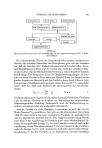
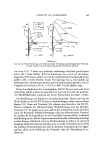
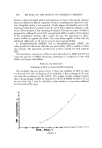
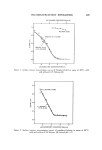
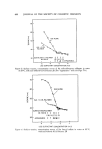
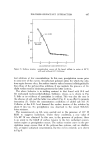
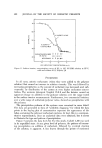
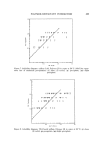
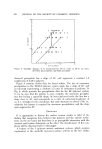
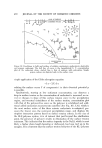
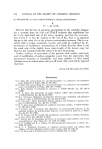
POLYMER-SURFACTANT INTERACTION 471 rant concentration range, which is evident in Figs. 3, 4, and 5. This does not result merely h'om the added contribution of the polymer, which alone is only weakly surface active, as can be seen in thc nonassociating or weakly associating systems Polymer JR/Tergitol 15-S-9 or C•4 betainc in Figs. 1 and 2, in which cases no significant lowering of the surface tension is observed on incorporating the polymer. It suggests that the former effect arises from the contribution of the polymer modified, and rendered more surface active, by adsorption of surfactant anions, "head-to-head," onto cationic sites along the polymer. Modification of the polymer in the low concentration of added anionic surfactant is demonstrated by the observed increased viscosity in this region, probably reflecting increased association between the polymer molecules brought about by the presence of the adsorbed sur- factant molecules. Similar but smaller viscosity effects observed (4) on add- ing SLS in low concentration to a polyethylene glycol, suggest that asso- ciation takes place between this polymer and surfactant even below the designated "first transition concentration" (4), and this is supported by vi- scosity measurements on polyvinyl pyrrolidone-SLS by Saito (3). In this case, the viscosity is ascribable, at least in part, to the polymer's developing a more rod-like configuration as it acquires a charge from the adsorbing sur- factant. Since surfactant, otherwise available for adsorption at the air/water in- terface, would be consumed in this process, a second and perhaps more satisfactory way of viewing the surface tension data is to consider the poly- mer as an added electrolyte. It is well known that salts added to solutions of ionic surfactant solutions, lower their cmc (15), and in the submicellar range, lead to a lowering of their surface tension (16). The added ion of opposite charge, lee., the counterion, plays the dominant role in these ef- fects which increase markedly as the valence of the counterion increases, ac- cording to the Schulze-Hardy rule (17). On this mechanism, a cationic poly- electrolyte, such as Polymer JR, would be expected to cause a very large drop in surface tension of a submicellar solution of any anionic surfactant, as was observed. Figure 10 depicts conditions in bulk and at the surface of such a mixture. Whether the surface molecules of surfactant have an associated double layer of po]yions, or whether the surface active species should be considered as the polyion/surfactant entity, is largely academic since each of the two mod- els really leads to the same net situation as the other model. As the surfactant concentration is increased, the slope .of the surface ten- sion-log c plot of the surfactant (in the presence of polymer) will be gov- erned (a) by the fraction of added surfactant, which remains free and is available for adsorption (b) by that which is bound by the polymer and the surface activity of the soluble complex and (c) by the fraction which pre- cipitates as insoluble complex. Because of these interactions in solution, no

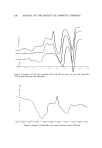
472 JOURNAL OF THE SOCIETY OF COSMETIC CHEMISTS PRECIPITATION ZONE m •/g•m 10. Co•t•o•s • hu]• • su•ce o• so]ut•o• co•t•g • Do]7c•Uo•c e]ect•o]7te •mt •io•c su•{•c•m. •he tiff] ]•e o• curve is the •]ot o{ the su•ct•t •]o• d•shed ]• •s •h•t o• gege•--c•fio•s •e •eD•cte• o•]7 i• the su•ce zone sSmplc application of the Gibbs adsorption equation -d y = E F• d • relating the surface excess F of components i to their chemical potential • is possible. Qualitatively, starting at low surfactant concentration, one observes a drop in surface tension as the concentration of surfactant is increased, an ar- rest or changes in slope of this surface tension curve in the precipitation region, and eventual coincidence of the surface tension, concentration plot with that of the polymer-free curve as the polymer is solubilized and addi- tional added surfaetant associates into mieelles (See Fig. 10). LAS, which is the most surface active of the three anionie surfaetants investigated, pos- sesses the lowest eme, the narrowest precipitation range, and displays the simplest interaction pattern based on surface tension criteria. In the ease of the SLS/polymer system, it is of interest that just beyond the clarification point, the presence of polymer results in elimination of the surface tension minimum. This indicates that the surface impurity in the NaLS, which is most likely a higher chain length homolog or dodeeanol, has been tied up in the complex. It is of interest that the surface tension behavior of the KL/polymer
Purchased for the exclusive use of nofirst nolast (unknown)
From: SCC Media Library & Resource Center (library.scconline.org)