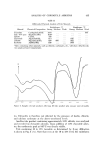
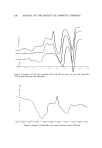
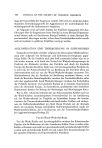
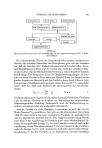
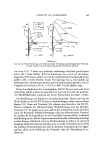
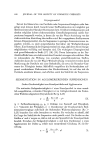
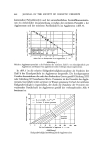
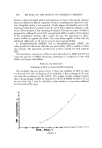
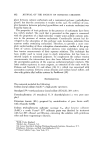
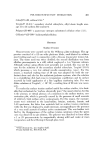
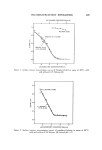
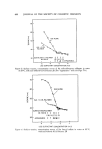
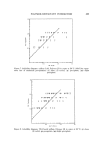
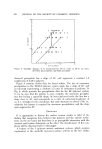
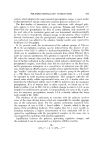
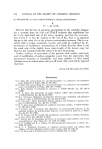
?OLYMER-SURFACTANT INTERACTION 467 7O 60 • s ALONE • 50 • SLS + 0.1'/o • POLYMER 40 30- -4 -3 -2 -1 LOG SURFACTANT CONCENTRATION (m/I) Figure 5. Surface tension, concentration curves of Na lauryl surfate in water at 25cC, with and without 0.1% Cellosize tant solutions at low concentrations. In this case, precipitation occurs prior to cross-over of the curves. At surfactant polymer ratios for which the solu- tions again become clear, the surface tension values become indistinguishable from those of the polymer-free solutions, if one neglects the presence of the slight surface tension minimum present in the latter systems. The above behavior is in striking contrast to that found with SLS and the uncharged hydroxyethylcellulose, Cellosize, where, as is shown in Fig. 5, litfie or no evidence of association is evident. This was also the case in the absence of salt, and the latter was added (Fig. 5) in an effort to promote interaction (5). Under the concentration conditions of added salt (0.1 N) Cellosize at the 0.1% level lowered the surface tension of the solution by about 6 dyn/cm. No precipitation was observed in the mixed SLS-Ce]- ]osize mixtures. The measurements on KL were earfled out in the presence of 10 -a M KOH to suppress hydrolysis. Under these conditions, a emc value of 1.2 x 10 -2 M was obtained. In this ease, in the presence of polymer, there is an arrest in the falloff of surface tension in the low surfaetant concen- tration region as precipitation occurs. The surface tension curve in the pre- cipitation range crosses that of the polymer-free systems, and on daftflea- tion, at higher surfaetant concentration, the two curves coincide, as is shown in Fig. 6.

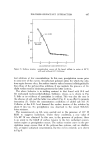
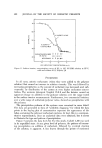
468 JOURNAL OF THE SOCIETY OF COSMETIC CHEMISTS 7O 6O 5O 4O - ß RATE ALON E - K LAURATE +• _ 0.1% POLYMER • SURFACTANT/POLYMER I l Wt. RATIO 1:2 1:1 2:1 4:1 APPEARANCE C t p pC I I I -4 -3 -2 LOG SURFACTANT CONCENTRATION (m/I) Figure G. Surface tension, concentration curves of KL in 10 -a M KOH solution at 95øC, with and without 0.1% Polymer JR Precipitation In all eases, anionie surfaetants (when they were added to the polymer solution) first caused an increase in solution viscosity. This was followed by increasing precipitation as the mnount of surfaetant was increased, and, sub- sequently, by clarification of the system at even higher surfaetant concen- tration. The nonionic detergent Tergitol 15-S-9 and the betaine caused no apparent change on addition to the polymer solution over the range tested in the surface tension measurements. Furthermore, two commercial betaines, over a wide range of surfaetant/polymer ratios, showed no precipitation with the polymer. The precipitation patterns of the systems were examined in more detail. The data are presented in form of "solubility diagrams," for which the data points in the log-log plot of concentration represent the appearance of the tubes containing the polymer/surfaetant mixtures. At best, this is a semiquan- titative representation, since no analytical data were obtained, but it serves to illustrate the type and pattern of precipitation, Figure 7 presents the data for LAS. For this study, Calsoft L-C0 was used in its unpurified state. At any given level of polymer, the pattern of increas- ing precipitation on addition of surfaetant, followed by eventual clearing of the solution, is apparent. A line drawn through the points of maximum
Purchased for the exclusive use of nofirst nolast (unknown)
From: SCC Media Library & Resource Center (library.scconline.org)