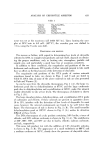
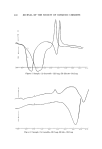
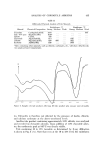
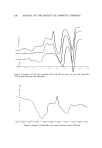
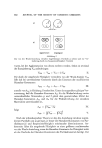
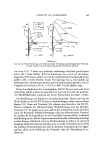
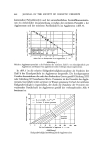
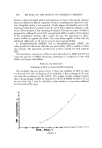
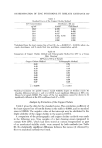
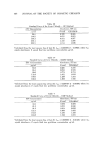
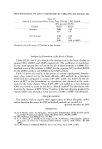
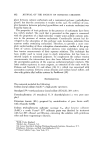
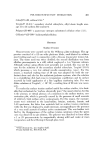
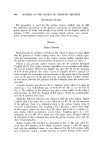
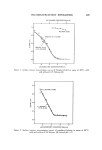
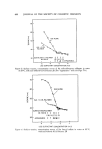
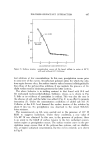
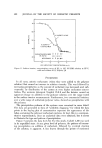
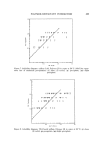
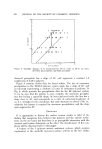
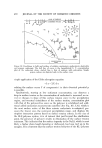
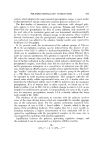
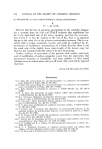
ANALYSIS OF CHRYSOTILE ASBESTOS Table I 433 Chlorite Mg•..SisO.(OH)• Calcite CaCO• Dolomite CaMg(CO•)_• Magnesite MgCOa Tremolite Ca2Mg•SisO•o•(OH),_, merit xvas set at the maximum (AT 0.004 MV/in.). Upon heating the sam- ples at 30øC/min to 4.0 mVt (457øC), the recorder pen was shifted to -5 in. using the T-scale zero shift. DISCUSSION AND RESULTS The success or failure, with regard to determining low levels of chrysotile asbestos by DTA in complex talc products and talc itself, depends on obtain- ing the proper conditions, such as heating rate, atmosphere, particle and sample size, and particularly a good base line at maximum sensitivity. In addition to these conditions, the magnitudes and positions of the dothermit and exothermie DTA peaks of other minerals present in talc could have an effect on the final success of the detection of chrysotile. The magnitudes and positions of the DTA peaks of various minerals sometimes found in talcs, are shown in Figs. 1 and 9, and are listed in Table II. DTA data of some of the above minerals in talc are also presented in Pask and Warner (9,). As can be seen from the ehrysotile thermogram, Fig. 1 (A), the large en- dothermit peak due to dehydroxylation at 673øC and the large exothermie peak due to dehydroxylation and crystallization at 845øC, make this mineral readily detectable in talc at low levels. The thermogram of chlorite is shown in Fig. i (B). The large decarboxy]ation, dehydroxylation, and crystallization DTA peaks of carbonates and ehlorite, if these minerals are present in quantities above 10 to 15%, interfere with the detection of low levels of chrysotile. In most cases, however, the mineral contaminants are found to be well below this figure. The thermogram of talc is shown in Fig. 9, (B). The small tremolite dehydroxylation peak at 1075øC shown in Fig. 9, (A) makes its detection difficult at these levels. The DTA thermogram of a talc product containing 3.0% kaolin, a trace of ohiorite, and 8.0% calcium carbonate is shown in Fig. 3 (A). The endotherms at 530 ø, 600 ø, 790 ø, and 970 ø are due to kaolSn, ohiorite, calcium carbonate, and tale, respectively. This same talc product but with the addition of 1.0% chrysotile asbestos, is shown in Fig. 3 (B). The appearance of a small endotherm at 660øC and a medium exotherm at S45øC, clearly show the presence of chrysotile asbes-

434 JOURNAL OF THE SOCIETY OF COSMETIC CHEMISTS Figure 1. Sample: (A) chrysotile-12.8 mg (B) chlorite-10.2 mg 2225 ø i 530 ø 600 ø 675 ø 740 ø 805 ø 870 ø 935 ø 995 ø Fig'tre 2. Sample: (A) tremolite-32.5 rag (B) talc-30.0 mg 2055
Purchased for the exclusive use of nofirst nolast (unknown)
From: SCC Media Library & Resource Center (library.scconline.org)