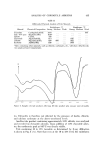
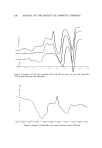
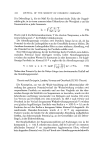
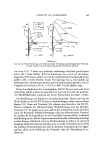
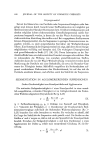
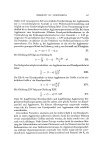
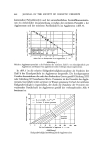
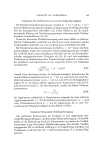
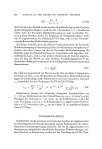
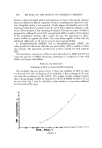
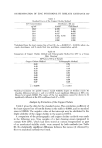
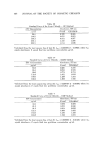
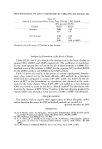
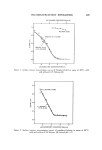
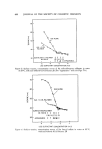
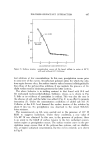
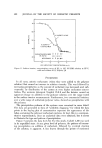
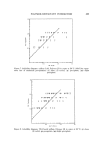
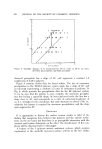
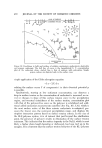
POLYMER-SURFACTANT INTERACTION 473 system, which displays the most extended precipitation range, is most similar to that reported for anionic surfactant/nonionic polymer systems (5). The first studies of interaction of ionic surfactants with charged poly- mers appear to have been studies on proteins. Putnam and Neurath (9) found that the precipitation by SLS of serum albumin only occurred on the acid side of its isoelectric point and was determined stoichiometrically by the numb.•r of positively charged groups on the protein. These workers showed, furthermore, that the precipitated complex was resolub!lized if ex- cess surfactant •vas added to the solution. Similar results were reported by Pankhurst (12) for gelatin. In the present work, the involvement of the cationic groups of Polymer JR in the precipitation reactions can be inferred from the absence of pre- cipitation when SLS is added to hydroxyethylcellulose, Cellosize QP-300, which can be considered as the parent molecule from which Polymer JR is made by cationic substitution. Precipitation is expected to be maximal (Fig. 10) when the cationic sites each have an associated surfactant anion. Addi- tion of further surfactant to the solution, which initiates solubilization of the precipitated complex, most like]y does this by nucleation on the first layer, and by progressive adsorption, of a second layer of surfactant onto the poly- mer, which then in effect becomes a soluble anionic polyelectrolyte. The aver- age "residue" molecular weight expressed per cationic group of the polymer is ~ 700. Hence, for NaLAS of tool wt 360, a weight ratio of ~ 1:2 would be expected to yie]d maximum percipitation. This compares with the ob- served value which, within experimental error, was 1:2. A similar value was found for the TEA lauryl sulfate (mol wt 406) to polymer ratio for maximum precipitation. It is of interest that, in other research, we found use of Na- dodecyl sulfate (tool wt 288) led to a definite change in ratio to 1:2-3, as an- ticipated on stoichiometric grounds. Correspondingly, the ratio of KL to poly- mer for maximum precipitation, namely 1:3-4, evidently reflects the lower mole weight of KL (238). The tendency of the surfactants to associate with the polymer involves some of the same driving forces which are responsible for micellar aggrega- tion of the surfactants alone. For the anionic surfactants examined here, the sequence of cmc is LAS lauryl sulfate laurate, which is the op- posite of the micellizing tendency. This implies that, for a more weakly as- sociating surfactant, a higher concentration of free surfactant wil] be re- quired for equilibrium with the precipitated complex, in the same way as it is required for equilibrim •vith micellar aggregates. Equilibrium between the polymer, possessing n-positive charges, and the surfactant S can be represented as a stepwise addition reaction Ki (PSi) n-i .q_ S •(PSi +1 )n-i-1

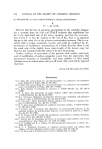
474 JOURNAL OF THE SOCIETY OF COSMETIC CHEMISTS or, alternatively, as a net reaction leading to charge neutralization K pl, 4 q_ nS- --,• PSn The fact that the line of maximum precipitation in the solubility diagram has a constant slope for LAS and TEALS indicates that equilibrium lies far to the right-hand side of the above equation, and that the concentra- tion of free S- is low. By contrast, in the case of KL, there is an apparent change in the value of n as the polymer concentration increases. This is con- sistent with a weaker association reaction and could be confirmed by de- term/nation of equilibrium concentrations. It is likely that this effect is not the result only of the slightly lower chain length of the laurate soap, but that it is also connected with the nature of its ionic head group. Further evidence of association of the polymer with anionic surfactants and of modification of surface properties comes from the observation that pronounced increases in foamability and foam stability of their mixed solutions occur at certain ratios and over-all levels. This work will be reported elsewhere. ( Received December 13, 1974) (9) (lO) (11) (12) (13) I:•EFERENCES (1) S. Saito, Die untersuchung der adsorptionskomplexe von polymeren mir netzmittel- ionen, Kolloid-Z. Z. Polym., 154, 19-29 (1957). (2) S. Saito, Die untersuchung der adsorptionskomplexe von polymeren mit netzmittel- ioinen (11), Kolloid-Z. Z. Polyrn., 158, 120-9 (1958). (3) S. Saito, Binding of surfactants by polymers, J. Colloid Interfac. Sci., 15, 283-6 (1960). (4) M. N. Jones, The interaction of sodium dodecyl sulfate with polyethylene-oxide, J. Colloid Interfac. Sci., 23, 36-42 (1967). (5) M. J. Schwuger, Mechanism of interaction betxveen ionic surfactants and polyglycol ethers in water, I. Colloid Interfac. Sc•., 43, 491-8 (1973). (6) H. Arai and S. Horin, Interaction between polymer and detergent in aqueous solu- tion, I. Colloid Interfac. Sci., 30, 372-7 (1969). (7) M. N. Jones, Dye solubilization by a polymer-surfactant complex, J. Colloid Interfac. Sci., 26, 532-3 (1968). (8) T. Isemura and A. Imanishi, The dissolution of •vater-insoluble polymers in the surfactant solution, the polyelectrolyte behavior of the dissolved polymers, I. Polyrn. Sci., 33, 337-52 (1958). F. W. Putnam and H. Neurath, The precipitation of proteins by synthetic detergents, I. Amer. Chem. Soc., 66, 692-7 (194d). F. Karush and M. Sonenberg, Interaction of homologous alkyl sulfates with bovine serumalbumin, J. Amer. Chem. Soc., 71, 1369-76 (1949). E. D. Goddard and B. A. Pethica, On detergent-protein interactions, I. Chem. Soc., 2659-63 (1951). K. G. A. Pankhurst, Formation of complexes between gelatin and sodium alkyl sulfates, in Surface Chemistrs, Butterworths, London, 19d9, Pp. 109--18. F. W. Stone and J. M. Rutherford, U.S. Pat. 3,472,840 (Oct. ld, 1969).
Purchased for the exclusive use of nofirst nolast (unknown)
From: SCC Media Library & Resource Center (library.scconline.org)