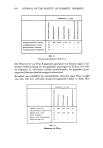
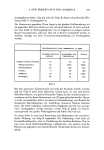
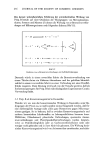
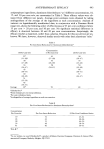
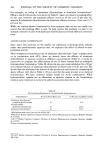
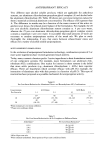
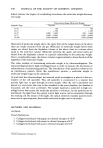
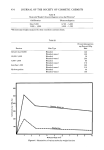
446 JOURNAL OF THE SOCIETY OF COSMETIC CHEMISTS For example, the maximum reaction of aluminum chloride withskin protein occurs at a pH of 3.51, with the binding of aluminum falling off sharply on either side of the pH. At low pH levels, skin protein exhibits a decreased activity for aluminum ions due to the existence of its carboxyl groups predominantly as the undissociated --COOH species. At high pH levels, the carboxyl groups are ionized to the wCOO--state. Consequently, their interaction with aluminum would be expected to be enhanced. In light of the foregoing, it seems reasonable that sweat reduction mediated via the use of antiperspirants could be a function ofpH, assuming that the mechanism of such activity is controlled by the precipitation of skin protein with the basic aluminum species. Table IV compares efficacy results for aluminum chloro- and bromohydrate "types" with Al:halide ratios of 2:1 and 1:1. No significant difference between these lower and higher ratio products is evident for these aqueous formulations. It is, of course, possi- ble that the more acidic species are skin irritants and, therefore, act antagonistically (i.e., as "properspirants"), thereby attenuating the properties of the aluminum com- plex. In the search for new and effective antiperspirants, aluminum-zirconium combinations have aroused interest. We will only be concerned with nonaerosol aqueous formula- tions. Table V lists the efficacy for AI-Zr products, with AI:Zr ratios varying from 0.5:1 to 6:1. No significant differences in efficacy from product to product are evident. In general, it appears as if the effectiveness of these systems is comparable with 15 per cent aluminum chlorohydrate. It is believed, however, that these AI-Zr systems, once formulated, retain a higher proportion of their activity than aluminum systems that is to say, their effectiveness appears less influenced by the chemical environment represented by the formulation medium. SUMMARY To summarize, we believe that, based on our data, the efficacy of some antiperspirant materials peaks at a particular concentration rather than reaching a plateau. Reasons for this effect are unknown. Vehicle also plays a role in controlling efficacy. For example, anhydrous systems have a lower efficacy than aqueous or hydroalcoholic formulations. Our data regarding the relationship between efficacy and vehicle are limited. We plan to fill in this gap, in the near future, by studying the relationship between ingredient efficacy and vehicle as well as variations in AI:CI ratio and concentration. Finally, we have found that the efficacy of aluminum-zirconium complexes is independent of AI:Zr ratio. REFERENCES (1) P. A. Majors and J. E. Wild, The evaluation of antiperspirant efficacy--influence of certain variable, J. Soc. Cosmet. Chem., 25, 139-52 (1974). (2) M. W. Steed, Evaluation of antiperspirant preparations under normal conditions of use, J. Soc. Cosmet. Chem., 26, 17-28 (1975). (3) W. M. Wooding and P. Finkelstein, A critical comparison of two procedures for antiperspirant evalua- tion, J. Soc. Cosmet. Chem., 26, 255-75 (1975). (4) T. Govett and M. G. de Navarre, Aluminum chlorohydrate, new antiperspirant ingredient, Amer. Perfum., 49, 365-8 (1947). (5) I. Lyon and I. M. Klotz, The interaction of epidermal protein with aluminum salts, J. Pharm. Ass., 47, 509-12 (1958).

•J. Soc. Cosmet. Chem., 28, 447-455 (August 1977) Studies on the molecular weight distribution of cosmetic protein hydrolysates ELAINE S. STERN and VERNON L. JOHNSEN Personal Care Division, Inolex Corporation, Chicago, IL. Received July 15, 1976. Presented Ninth IFSCC Congress, June 1976, Boston, MA. Synopsis MOLECULAR WEIGHT has been thought to be an important feature of COSMETIC GRADE PROTEINS and to be a critical factor affecting PROTEIN SUBSTANTIVITY to HAIR. The study reported in this paper was undertaken to show the relationship of molecular weight to protein substantivity. Using gel filtra- tion and ultracentrifugation data were obtained that indicate peptides in the range of molecular weight 1000 are more substantive than the very high molecular weight molecules. INTRODUCTION Cosmetic grade protein hydrolysates are complex mixtures of various molecular weight polypeptides. Only approximate number average molecular weights have been pre- viously reported. This study was undertaken to provide additional information about the distribution of molecular weights of collagen hydrolyzed by several methods, and to show if there is a relationship between molecular size and hair substantivity. Two techniques were used for investigating the molecular weight distribution of cos- metic grade protein hydrolysates, gel filtration and ultracentrifugation. Gel filtration is an established chromatographic method for the separation of molecules according'to their size. The use of Sephadex •, a bead-formed dextran gel, for gel filtration was introduced in 1959, and since has become a well-established method for fractionation and separation of molecules according to their size. Sephadex is cross- *Sephadex ©, Pharmacia Fine Chemical Inc., 800 Centennial Avenue, Piscataway, NJ. 447
Purchased for the exclusive use of nofirst nolast (unknown)
From: SCC Media Library & Resource Center (library.scconline.org)