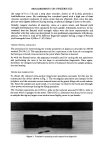
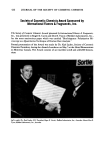
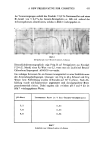
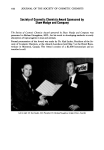
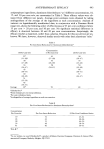
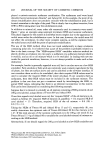
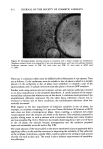
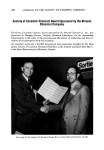
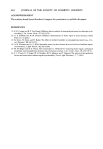
456 JOURNAL OF THE SOCIETY OF COSMETIC CHEMISTS Society of Cosmetic Chemists Award Sponsored by Perry Brothers Fragrances, Div. of Mallinckrodt, Inc. The Society of Cosmetic Chemists Award sponsored by Perry Brothers Fragrances, Div. of Mallinckrodt, Inc., was presented by Dr. S. Mark Henry, Bristol-Myers Products, for his outstanding contributions to cosmetic science and technology in the field of mi- crobiology during ! 976. An inscribed scroll and a $2,000 honorarium were presented formally by Dr. Karl Laden, Society of Cosmetic Chemists President, at the Awards Luncheon held May 5 at the Hotel Bonaventure in Montreal, Canada. Left to right: Dr. Karl Laden, SCC President Dr. S. Mark Henry, Bristol-Myers Products, Awardee

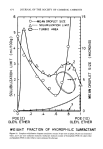
J. Soc. Cosmet. Chem, 28, 457-479 (August 1977) Prediction of optimum O/W emulsification via solubilization measurements T. J. LIN 628 Enchanted Way, Pacific Palisades, CA 902 72 HARUKI KURIHARA and HIDEAKI OHTA Takasago Perfumery Co., Ltd., Tokyo Central P. O. Box 1033, Tokyo, Japan. Received August 6, 1976. Presented Ninth IFSCC Congress, June 1976, Boston, MA. Synopsis In the course of investigating the effects of SURFACTANT LOCATION on O/W EMULSIFICATION, it was discovered that there existed a useful correlation between the maximum amount of aqueous phase that could be solubilized in the oil phase containing the emulsifier and the average droplet size of the emulsion subsequently formed. Experiments were carried out with liquid hydrocarbons and many other oils frequently used in cosmetic emulsions. The emulsifiers used included various nonionic, anionic, cationic surfactants, and their mixtures. Analysis of the solubilization measurements and microphotographically obtained emul- sion droplet size distribution data clearly indicated that the point of optimum O/W emulsification, i.e., the point where the finest O/W emulsion was formed in emulsifying with a series of surfactant mixture, cor- responded to the point of maximum solubilization provided that the latter fell in a region where O/W emul- sion formation was possible. In some systems studied, the maximum solubilization points were found in the region where only W/O emulsions could be formed under }he experimental conditions. In such a case, the optimum O/W emulsions were generally found near the W/O-O/W transition point. The correlation held quite well in spite of the differences in the type and ionic nature of the surfactants employed. INTRODUCTION In spite of the recent advances in colloid and surface chemistry, the technique of emul- sion formulation and manufacturing remains very much an art. Although, it has been 27 years since Griffin (1,2) first proposed the HLB (hydrophile-lipophile balance) method, the selection of an emulsifier system for a practical cosmetic emulsion still re- quires a tedious trial-and-error procedure. This is chiefly due to the extremely complex nature of emulsions, which often defies systematic scientific treatment. Fundamentally, HLB is a very useful system in classifying surfactants according to their hydrophilic/lipophilic characteristics. It is, also, recommended as a tool for selecting efficient emulsifiers for preparing emulsions nevertheless, in this respect, there are many shortcomings which hinder its practical applications. First of all, to use HLB method for emulsification, one needs not only the "HLB" values of the surfactants but also the "required HLB" values of all the oil phase components to be used in the emulsion. Unlike the HLB values of the surfactants, the 457
Purchased for the exclusive use of nofirst nolast (unknown)
From: SCC Media Library & Resource Center (library.scconline.org)