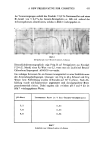
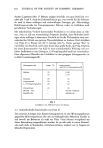
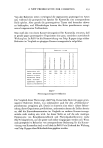
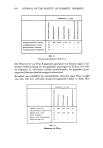
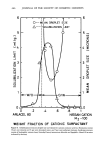
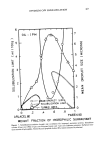
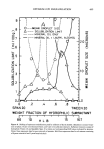
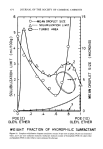
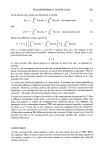
478 JOURNAL OF THE SOCIETY OF COSMETIC CHEMISTS For example, solubilization data obtained at various temperatures are useful in finding an optimum emulsification temperature. If the emulsification is done by the surfactant- in-oil method, it is well to study the oil phase containing various amounts of solubilized water at various temperatures. As it was pointed out earlier, the oil-surfactant mixture containing some water may not be stable and a separation into surfactant-rich and surfactant-poor phases can result in an emulsion with extremely nonuniform droplet size distribution. Therefore, consideration as to when and how rapidly to add the aqueous phase to the oil phase may become a very important factor in preventing manufacturing difficulties. The method of solubilization measurements used in this w•ork relied upon visual observations and the solubilization limit was defined as the point beyond which a permanent turbidity would develop upon addition of more water. This method is very simple to use, but it does have some disadvantages. In some systems, turbidity does not develop sharply, resulting in a difficulty in determining the endpoint. Another problem is that if the mixture is not completely transparent at the temperature of measure- ments, it would be very difficult or impossible to judge the endpoint. This would rule out the application of the method to oil mixtures containing two immiscible oils (e.g., mineral oil and silicone fluids) or to the mixture containing a solid suspension. However, it is believed that such difficulties can be overcome by using other means of determining solubilization. One promising method is the use of vapor pressure measurements which has been successfully used in measuring solubilization of water in nonaqueous systems (14, 15). The vapor pressure of an oil containing solubilized water generally shows an increase with increasing amount of solubilized water until the maximum point is reached. Since the method is not dependent upon a visual observa- tion, the previously mentioned difficulties would not occur. Unlike emulsion stability which is extremely difficult to define, solubilization is a bet- ter-defined phenomenon and can be related to the physical and chemical properties of the materials involved. Therefore, it is believed •hat the correlation presented here can be a very valuable basis for developing a useful tool for emulsifier selection, which is more accurate and reliable than other existing methods. ACKNOWLEDGMENT The authors gratefully acknowledge many valuable suggestions given by Dr. T. Moroe of Takasago Perfumery Co., Ltd. REFERENCES (1) W. C. Griffin, Classification of surface-active agents by"HLB", J. Soc. Cosmet. Chem., 1, 311-26 (1949). (2) W. C. Griffin, Calculation of HLB values of nonionic surfactants, J. Soc. Cosmet. Chem., 5, 249-55 (1954). (3) W. C. Griffin, H. J. Ranauto, and A.D. Adams, Further studies on emulsion systems, Amer. Perfum, Cosmet., 81, 31-42 (1966). (4) N. Ohba, Required hydrophile-lipophile balance values of the oil mixture, Bull. Chem. Soc. Jap., 35• 1021 (1962). (5) P. Sherman, Emulsion Science, Academic Press, New York, 1968, Pp. 140-53.

OPTIMUM O/W EMULSIFICATION 479 (6) (7) (8) (9) (10) (11) (12) (13) (14) (15) K. Shinoda, Comparison between the phase-inversion-temperature system and the hydrophile- lipophile balance-value system for emulsifier selection, Nippon Kagaku ZasshL 89, 1-8 (1968). T. J. Lin and J. C. Lambrechts, Effect of initial surfactant location on emulsion phase inversion, J. Soc. Cosmet. Chem., 20, 185-98 (1969). P. Becher, Emulsions.' Theory and Practice, 2nd ed., Reinhold Publishing Corp., New York, 1965, p. 249. T.J. Lin, H. Kurihara, and H. Ohta, Effects of phase inversion and surfactant location on the formation of O/W emulsions, J. Soc. Cosmet. Chem., 26, 121-39 (1975). P. Becher, Emulsions.' Theory and Practice, 2nd ed., Reinhold Publishing Corp., New York, 1965, Pp. 155-69. K. Shinoda and H. Arai, The correlation between phase inversion temperature in emulsion and cloud point in solution of nonionic emulsifier,J. Phys. Chem., 68, 3489-90 (1964). K. Shinoda, The correlation between the dissolution state of nonionic surfactant and the type of disper- sion stabilized with the surfactants,J. Colloid Interfac. Sci., 24, 4-9 (1967). T. J. Lin, H. Kurihara, and H. Ohta, Effect of surfactant migration on the stability of emulsion, J. Soc. Cosmet. Chem., 24, 797-814 (197:•). A. Kitahara, Properties of oil-soluble surfactants in nonaqueous media, Yukagaku, 17, 140-47 (1968). A. Kitahara and T. Ishikawa, A study of the interaction between surfactants and hydrocarbon liquids by measurement of vapor pressure,J. Colloidlnterfac. Sci., 24, 189-92 (1967).
Purchased for the exclusive use of nofirst nolast (unknown)
From: SCC Media Library & Resource Center (library.scconline.org)