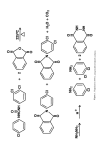
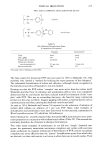
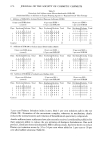
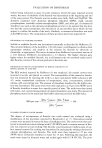
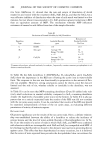
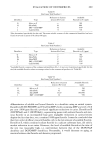
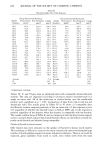
J. Soc. Cosmet. Chem., 28, 659-666 (November 1977) Antimicrobials: identification of 3,4,4'-trichlorocarbanilide and 4,4'-dichloro-3-(trifluoromethyl) carbanilide in deodorant bars FRANCOIS X. DEMERS and RONALD L. YATES, Divhion of Cosmetics Technology, Food and Drug Administration, Washington, D.C. 20204. Received December 9, 1976. Presented October 18, 1976, Association of Official Analytical Chem ists-Society of C osm etic C hem ists Meeting, Washington, D.C. Synopsis: The ANTIMICROBIALS 3,4,4'-TRICHLOROCARBANILIDE and 4,4'-DICHLORO-3-(TRIFLUO- ROMETHYL) CARBANILIDE were IDENTIFIED in DEODORANT BARS by analysis of their degrada- tion products. The antimicrobial(s) were first concentrated by solvent extraction of the deodorant bar. The extract was fused with phthalic anhydride to form mixed phthalimides, which were then hydrolyzed with hydrazine to yield a mixture of aromatic amines. Gas-liquid chromatographic analysis of the amine mixture was used to identify the antimicrobial(s) originally present in the deodorant bar. 3,4,4'-Trichlorocarbanilide when degraded yielded a mixture of 4-chloroaniline and 3,4-dichloroaniline. 4~Chloroaniline and 4~chloro- 3-(trifluoromethyl) aniline were the products obtained from 4,4'-dichloro-3-(trifluoromethyl) carbanilide. The procedure was then evaluated as a method for the determination of the antimicrobials, using 3,5- dichloroaniline as the internal standard. Recoveries of added antimicrobials were 85 to 90 per cent of theoretical. INTRODUCTION Deodorant bars are composed of soaps and/or detergents and fragrance oils to which antimicrobial compounds have been added to retard the growth of skin bacteria that may give rise to body odor. For many years hexachlorophene was the principal active antimicrobial agent in deodorant bar formulations. A regulation restricting the use of hexachlorophene has resulted in the use of a number of substitute antimicrobials in these preparations. Two antimicrobial compounds that are frequently used in deodorant bars are 3,4,4'-trichlorocarbanilide (TCC) and 4,4'-dichloro-3-(trifluoro- methyl) carbanilide (DCTFMC). Deodorant bars commonly contain mixtures of these two compounds, making their identification by chromatographic methods difficult. Wilson (1) was unable to separate TCC and DCTFMC by thin-layer chromatography. Sheppard and Wilson (2) reported that TCC and DCTFMC were eluted in the same fraction, using partition chromatography. The ultraviolet spectra of TCC and DCTFMC are nearly identical and the compounds, therefore, cannot be characterized 659

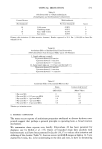
o + o o o o Z---Z -I- z • o=zo
Purchased for the exclusive use of nofirst nolast (unknown)
From: SCC Media Library & Resource Center (library.scconline.org)