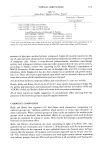
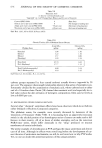
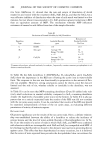
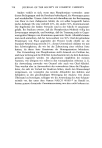
696 JOURNAL OF THE SOCIETY OF COSMETIC CHEMISTS Recently, we have obtained experimental data suggesting that, indeed, this might be the case. The present communication reports these findings. II. EXPERIMENTAL A. MATERIALS Intact hair was obtained from the DeMeo Company.* Before use, it was shampooed once with an anionic shampoo-pH 4.3,t rinsed and dried in air. Reagent grade 1-pro- panol was used for preparing the solutions. The buffers used were pH 7.0, pH 7.4 phosphate buffers (0.05 M), and pH 2 HC1 solution, respectively. B. METHODS One-in. long hair fibers were mounted onto plastic tabs using an epoxy glue:• and soaked overnight in pH 7.0 buffer. First, a reference stress-strain curve was obtained for each fiber i.e., the fiber was stretched to 20 per cent extension (at I in./min) while immersed in pH 7 buffer at 20øC (Reference curve No. 1). A table model Instron Extensometer was used with standard procedures being employed. Subsequently, the fiber was relaxed in pH 7.4 buffer for 24 h, equilibrated in the ap- propriate proponal-water mixture and the stress-strain isotherm measured while the fiber was immersed in the solution at the appropriate temperature. A 24-h period was allowed for equilibration of each fiber in the appropriate water-alcohol mixture, since previous work has ascertained that this time period was sufficient to reach equilibrium (5). After completion of the measurements, the fibers were again relaxed in pH 7 buf- fer at 20øC for 24 h and a second reference stress-strain curve obtained using identical experimental conditions to those employed during the determination of the first cali- bration curve (reference curve No. 2). iii. RESULTS Although ethanol is the most widely used alcohol in cosmetic and toiletry products, we chose 1-propanol for our investigations. Our choice was motivated by the finding of previous investigators who showed that immersion into 1-propanol/water mixtures have the largest effects, among the alcohols, on the properties of keratin fibers (1-4). In order to eliminate, as far as possible, errors which were due to fiber to fiber varia- tions, the forces were normalized, i.e., divided by the force obtained on the same fiber at the corresponding extension during the first reference cycle. The symbol f' denotes the normalized force (i.e., the ratio f/fo) where fand fo are the two forces measured on the same fiber at a given strain level under the given experimental conditions and dur- *DeMeo Brothers, New York©. q-Earth Born Green Apple Shampoo©, Personal Care Division, the Gillette Co., Boston, MA. :•Twoton glue©, Descon Corp., Danvets, Mass.

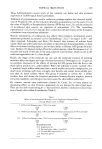
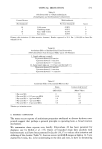
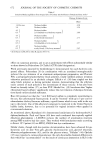
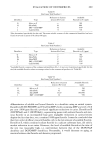
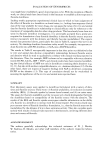
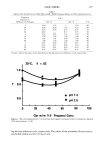
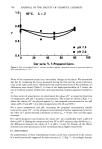
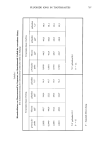
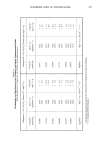
HAIR FIBERS 697 Table ! Ratios of the Tensile Forces of Hair Fibers in pH 7 Buffer Solutions Before and After the Experiments Treatme nt f0 '/f0* Exposure to W/W per cent Propanol pH 2.0 pH 7.4 TøC 0 0.89 0.92 -- 1.05 60 30 0.86 0.89 1.02 0.92 60 50 0.94 0.99 0.87 0.95 60 80 0.89 -- 0.97 0.93 60 0 0.94 0.98 1.03 1.02 40 30 1.00 1.04 1.00 1.00 40 50 1.03 1.05 0.98 1.00 40 80 1.00 1.00 1.00 1.00 40 0 0.98 0.90 0.95 0.93 20 30 0.93 0.97 0.93 0.93 20 50 0.93 0.95 0.89 0.94 20 80 0.95 0.96 0.92 0.93 20 •f0 and f0' denote the values of the elastic forces in the first and second reference cycles, respectively. 20øC, •. =.02 1.0 f' 0.8 0.6 "• , I I I I i i 0 20 40 60 100 pH 7.4 pH 2.0 I I 80 Cpr w/w %1- Propanol Conc. Figure 1. Plot of normalized force f' of intact hair fibers against 1-propanol content of immersion liquid at 20øC and extension ?, = 0.02 ing the first reference cycle, respectively. The values of the normalized forces were re- producible within an error of +4 per cent.
Purchased for the exclusive use of nofirst nolast (unknown)
From: SCC Media Library & Resource Center (library.scconline.org)