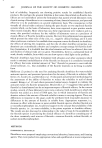
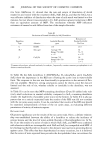
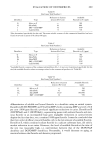
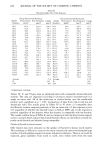
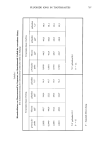
688 JOURNAL OF THE SOCIETY OF COSMETIC CHEMISTS tive form. Hefferren (3) showed that the rate and extent of dissolution of dental enamel in acid varied with the treatment (SnF.•, NaF, SnC10, and that the SnCI.• was a very effective inhibitor of dissolution when the time of acid attack was limited to a few minutes, but not when it was extended to 2 h. SnF.• produces greater reductions in RES than an equivalent amount of MFP. The mechanism whereby MFP influences resistance of enamel to acid differs from that of the simpler fluorides. Table III Reduction of Enamel Solubility by SnF2 Dentifrices Reduction of Dentifrice Available Fluoride Enamel Solubility Type Abrasive ppm Per Cent C DCPD 130 23.0 H• a Silica gel Average 790 64 Range 750-880 54-72 n=8 n=20 ja Ca2P•O7 Average 710 38 Range 640-750 14-60 n=8 n=4 aCommercial products, selected randomly for analysis. J reportedly contains stannous pyrophosphate in ad- dition to stannous fluoride. In Table III, the SnF.• dentifrices C (DCPD/SnF0, H, (silica/SnF0, and J (Ca.•P.•O7/ SnF0 show the importance in the RES test of having the active ions in water-soluble form. The response to the test was directionally in proportion to the amount of fluo- ride ion available. However, strong conclusions cannot be drawn, since the data are limited and the role of tin, whether soluble or insoluble in the dentifrice, was not assessed. In Table II it can be seen that MFP-containing dentifrices (D and F) yielded only rela- tively small reductions in enamel solubility compared to SnF2 containing dentifrices despite the high levels of available active ion(s) in the former. In Table II it is also ap- parent that on a strictly numerical basis the results of the RES test did not correlate with the rat caries assay results. It can be concluded that results of the RES test should be examined independently of those of the rat caries assay, as evaluating different parameters of activity of anticaries agents. Rat caries trials.' Of greatest significance are the results of the rat caries trials. Here, a definite relation- ship was established between the ability of a dentifrice to reduce the incidence of carious lesions and the level of water-soluble fluoride or fiuorophosphate ion. In Ta- ble II are the results of a series of trials in which NaF, SnF.•, and MFP were combined with abrasives which are incompatible with NaF and SnF.• but compatible with MFP. A key finding was that fluoride ion bound to the abrasive was inactive in protecting the rat against caries. This effect has been hypothesized on many occasions, but it is believed that the series of tests reported here provides the first published clear cut evidence for

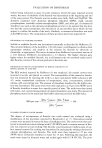
EVALUATION OF DENTRIFRICES Table IV Rat Caries Trial Number 1 689 Reduction in Carious Available Dentifrice Type Lesions (Per Cent) Fluoride (as F) (ppm) G Silica, no F -- Nil H Silica/SnF2 50 880 I IMP + DCP/MFP 70 950 a J Ca.•P.•O7/SnF.• 73 730 aNot determined specifically for this trial. The water-soluble content of this commercial dentifrice has been found on several occasions to be about 950 ppm. Table V Rat Caries Trial Number 2 Reduction in Carious Available Dentifrice Type Lesions (Per Cent) Fluoride (as F) (ppm) G Silica, no F -- Nil H• Silica/SnF= 37 790 • H= Silica/MFP 37 960 I IMP + DCP/MFP 31 950 • J Ca.,P.,O 7/S nF., 29 710 • •Available fluoride contents of the commercial dentifrices (Hi, I, J) were not determined specifically for this trial the available fluoride values are average values for the commercial products (cf. Table III). Table VI Rat Caries Trial Number 3 Reduction in Carious Available Fluoride Dentifrice Type Lesions (Per Cent) (ppm) G Silica, no F -- Nil H1 Silica/SnF=42 820 H=Silica/MFP 34,30 950,990 I IMP + DCP/MFP 36 950 differentiation of soluble and bound fluoride in a dentifrice using an animal system. Dentifrices D (DCPD/MFP) and F (CaCOa/MFP), both containing MFP at a level of 0.8 per cent (1000 ppm fluoride) produced significant reductions in caries. Dentifrices B (DCPD/NaF) and C (DCPD/SnF2), representing pastes with sodium fluoride and stan- nous fluoride in an incompatible base gave negligible reductions in carious lesions despite the fact that they, too, contained 1000 ppm fluoride. It must be concluded that their low order of efficacy was attributable only to the low amount of available fluoride. Dentifrice E, which contained sodium fluoride in a calcium carbonate base, did yield a modest reduction in rat caries. However, the level of available fluoride at the time of the test was reasonably high, i.e. intermediate between that of the DCPD/NaF dentifrice and DCPD/MFP dentifrices. Presumably, it would decrease on aging, as reaction between the fluoride and abrasive progressed.
Purchased for the exclusive use of nofirst nolast (unknown)
From: SCC Media Library & Resource Center (library.scconline.org)