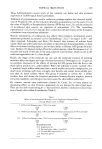
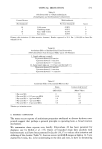
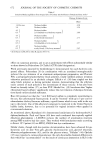
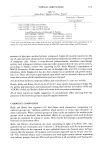
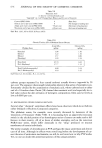
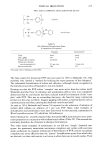
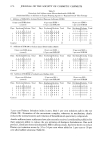
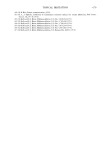
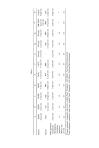
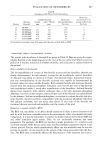
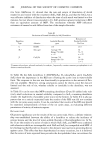
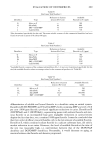
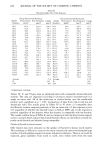
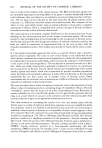
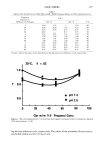
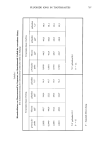
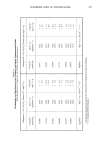
69O JOURNAL OF THE SOCIETY OF COSMETIC CHEMISTS Table VII Fluoride Uptake After 5 Min Exposure Group Treated with Product J Sample Pretreatment Post-Treatment Uptake Numbers ppm F ppm F ppm F Sample Numbers Group Treated with Product H• Pretreatment Post-Treatment Uptake ppm F ppm F ppm F III-1 147.4 253.8 106.4 IV-1 69.4 136.7 67.3 III-2 81.9 126.6 44.7 IV-2 51.5 181.0 129.5 III-3 98.4 142.8 44.4 IV-3 75.9 148.7 72.8 III-4 34.0 97.6 63.6 IV-4 75.5 167.5 92.0 III-5 62.0 162.0 100.0 IV-5 46.5 147.9 101.4 III-6 34.0 120.4 66.4 IV-6 87.2 241.5 154.3 III-7 56.2 152.4 96.2 IV-7 233.6 336.0 102.4 III-8 113.5 348.8 235.3 IV-8 195.6 460.3 244.7 III-9 37.7 158.1 120.4 IV-9 42.7 151.2 108.5 III-l•0 40.8 106.5 65.7 IV-10 79.7 171.4 91.7 III-11 79.5 176.6 97.1 IV-11 45.8 159.0 113.2 III-12 52.8 105.5 52.7 IV-12 118.3 225.7 107.4 III-13 53.4 75.0 21.6 IV-13 70.7 307.5 236.8 III-14 151.8 240.3 88.5 IV-14 103.0 261.4 158.4 III-15 69.7 121.3 51.6 IV-15 125.9 351.2 226.3 III-16 72.7 144.1 71.4 IV-16 67.7 230.9 163.2 III-17 80.0 123.0 43.0 IV-17 135.1 556.6 421.5 III-18 186.1 184.7 Nil IV-18 42.1 168.1 126.0 III-19 180.5 180.6 Nil IV-19 59.3 276.6 217.3 III-20 55.0 116.8 61.8 IV-20 45.2 767.3 722.1 III-22 83.5 165.6 82.1 IV-21 77.1 180.7 113.6 III-23 45.6 169.1 123.5 IV-22 328.1 339.8 11.7 III-24 132.9 221.6 88.7 IV-23 57.2 287.7 230.5 IV-24 63.3 154.3 91.0 Average 75.0 Average 171.0 N (23) N (24) S.D. 48.4 S.D. 144.2 "COMPATIBLE" SYSTEMS Tables IV, V, and VI give data on additional trials with compatible abrasive/fluoride systems. The data are organized according to products assayed simultaneously in a single rat caries trial. All of the reductions in carious lesions over the nonfluoride product were significant at p ( 0.05. Comparison of data from trial-to-trial was not statistically valid. The results given in Tables IV to VI show: (1) compatible abra- sive/fluoride systems respond positively in the rat caries test (2) the response is posi- tive regardless of whether the fluoride source is SnF2 or MFP and (3) the response is positive regardless of the abrasive when the abrasive is compatible with the fluoride. The results confirm those of Table II, and in conjunction with the latter results support current concepts which require that clinical fluoride efficacy in a dentifrice critically de- pends on the fluoride and abrasive being compatible. Uptake of fluoride by dental enamel.' Only limited data were obtained on the uptake of fluoride by human tooth enamel. This technique is difficult to carry out for many reasons, the major one being the large number of tooth samples required to assure statistical confidence. There is, as would be expected, great variability from tooth to tooth, even within teeth from the same

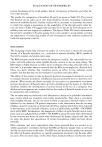
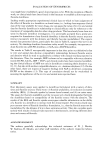
EVALUATION OF DENTRIFRICES 691 person. Soundness of the tooth surface, history of exposure to fluoride, and other fac- tors come into play. The results of a comparison of dentifrice H• and J are given in Table VII. They reveal that fluoride can be taken up in vitro from dentifrice slurties containing a substantial amount of available fluoride. Further studies will be necessary to determine the extent to which this uptake is dependent on the availability of the fluoride and/or other fac- tors the data in Table VII suggest that such may be so, but are far from adequate to es- tablish a case with any degree of confidence. The data in Table VII clearly demonstrate the extreme variability in fluoride uptake from tooth sample to tooth sample, and thus the importance of conducting studies of new formulations with sufficient numbers of teeth and appropriate controls. DISCUSSION The foregoing results help evaluate the utility of 3 tests used to assess the anticaries activity of a fluoride dentifrice, viz., reduction in enamel solubility (RES), uptake of fluoride by enamel, and animal caries assay. The RES test gave results which cannot be interpreted readily. The values failed to cor- relate well with either the water-soluble fluoride content or the rat assay values. The RES values in Table II seem to reflect more an abrasive effect than a fluoride effect. At this time, it is probably safest to conclude that the RES test as applied to a fluoride den- tifrice can show whether that dentifrice exerts an effect on the substrate (tooth enamel), but that this may not be translated to a positive anticaries effect. The ability of the enamel to take up fluoride has been investigated extensively as a tool to evaluate fluoride treatments. Insufficient data are presented here to draw firm con- clusions. What results are shown certainly do not point to a quantitative correlation between the amount of fluoride taken up from a dentifrice and the degree to which that dentifrice inhibits the development of carious lesions in the rat on a cariogenic diet. Additional investigations are required before the results of fluoride uptake in vitro can be interpreted with confidence. The rat caries assay as conducted in our laboratories (details to be published elsewhere) gave results which are consistent and readily interpretable. They show a correlation with available fluoride, and do not seem to show a response to fluoride which is inso- lubilized by the abrasive. Of greater importance is the observation that the rat assay exhibits a positive response to all fluoride dentifrice systems which have been reported in the literature to be clinically effective, such as Ca.,P.,O7/SnF., and IMP + DCP/MFP, and CaCO3/MFP. Furthermore, the magnitude of effect of such clinically tested denti- frices such as Ca2P.,OT/SnF2 and IMP + DCP/MFP is about the same when determined by the rat assay and about the same when determined by human clinical trial thus, the rat assay has shown the equivalence of certain formulations which has been shown clinically. More extensive and exact experiments than those reported here are needed to es- tablish quantitative correlation between the RES and fluoride uptake tests on one hand and the rat caries assay on the other. The RES test and the fluoride uptake test measure the effect of fluoride dentifrices on specific parameters involved in the fluoride effect on caries. The rat caries assay, on the other hand, measures efficacy of a fluoride denti-
Purchased for the exclusive use of nofirst nolast (unknown)
From: SCC Media Library & Resource Center (library.scconline.org)