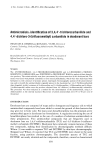
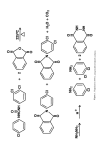
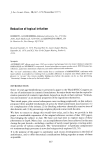
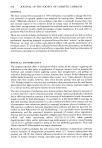
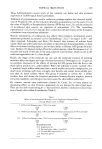
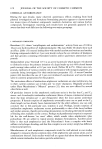
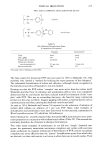
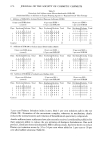
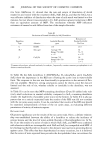
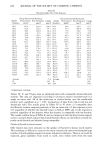
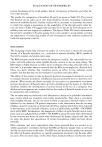
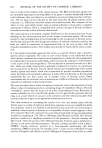
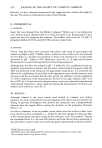
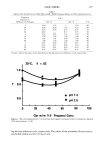
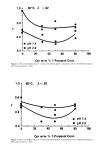
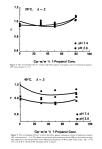
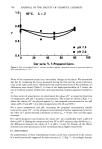
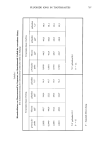
700 JOURNAL OF THE SOCIETY OF COSMETIC CHEMISTS 1'0 f 60øC, ,,k = .2 0.8 f' 0.6 ß ß 04 ' ' ' ' ' • ' ' ß 0 20 40 60 80 pH 7.4 pH 2.0 100 Cpr w/w % 1-Propanol Conc. Figure 6. Plot of normalized force f' of intact hair fibers against 1-propanol content of immersion liquid at 60øC and extension • = 0.2 None of the treatments caused any irreversible changes in the fibers. We ascertained this fact by comparing the forces measured during the first and the second reference cycle at the same strain level. Allowing for the experimental error of the technique, no differences were found (Table 1). In view of the high reproducibility of f' values, the use of a limited number of fibers for each experimental condition appeared justified to US. In three series of experiments, we determined the values of f' as respective functions of temperature, pH and 1-propanol concentration. The results are shown in Figs. 1-6, where the values of f' are plotted against Cpr, the propanol concentration for two pH values (pH 2.0 and pH 7.4) at three temperatures (20, 40, and 60øC). For a given temperature and pH, increasing the propanol concentration initially reduces the value of f'. As the propanol concentration is further augmented, however, the value of f' passes through a minimum (at about Cpr = 50 per cent) and then again increases. For a given propanol concentration, the values off' are considerably lower at pH 2.0 than at pH 7.4. Raising the temperature from 20 ø to 40øC enhances the pH effects, i.e., the differences between the values of f' at pH's 7.4 and 2.0. Finally, all the effects described are more pronounced at low extensions than at higher strain levels. IV. DISCUSSION An interpretation of these experimental results can be best considered in the context of a model previously suggested for hair structure (6, 7) (Fig. 7). Accordingly, keratin

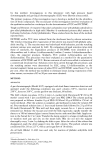
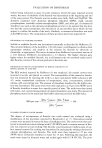
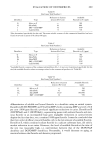
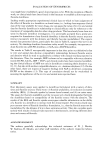
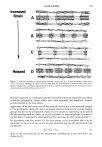
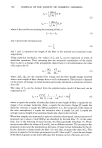
HAIR FIBERS 701 Increased Strain A B I I - Figure 7. A Keratin structure at various points of stress-strain curve. A--) C represent stages of fiber struc- ture at increasing strainings D shows situation after fiber has been allowed to relax to lower strain level. Spirals, "wiggly" lines, and fuzzy regions denote a-helices, unwound polypeptide chains and matrix, respec- tively (reproduced with permission from ref. 7) fibers are regarded as crosslinked polyelectrolyte gels consisting of partially crystalline (g-helical) polypeptide chains, which carry both positively and negatively charged groups attached to the main chains. Application of an axial stress extends the network, resulting in conformational changes of the polypeptide chains (8), and in increased distances between the various charged groups attached to the polypeptide chains. In most instances, depending on the pH of the surrounding medium, either an excess of positive or negative groups is present in the hair fiber. Consequently, straining of the fiber decreases its electrostatic energy (6). In accordance with this model, Gt the free energy of an unstrained fiber can be expressed as the sum of two terms: Gst the structural and Gos the electrostatic free energies (8). Gt = Gst + Go• (1) Since fsr the structural and fes the electrostatic contributions to the total force, are defined as (9)
Purchased for the exclusive use of nofirst nolast (unknown)
From: SCC Media Library & Resource Center (library.scconline.org)