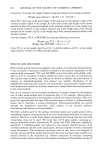
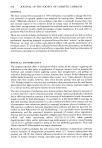
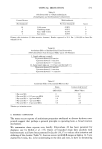
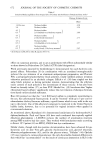
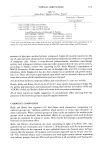
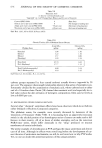
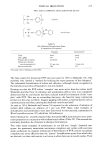
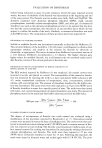
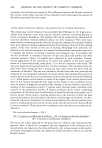
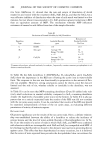
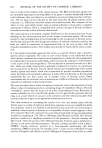
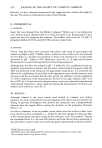
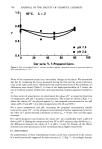
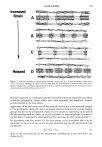
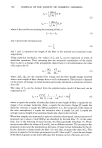
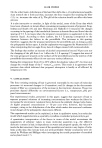
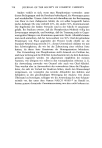
702 JOURNAL OF THE SOCIETY OF COSMETIC CHEMISTS fst = •k--•- ] ,P f•s = - •0 k•-] T, P where ft the total forces resisting the straining of hair, is ft = fst + res (2) (3) and ?, denotes the extension ratio 1 k - (4) 10 and 1 and 10 represent the length of the fiber in the strained and unstrained state, respectively. Using statistical mechanics, the values of fst and fes can be expressed in terms of molecular quantities. Thus, assuming that the structural contribution of the elastic force is due to a change of the polypeptide chains from c• to/3 conformation, the value of fst is given by (9) AGo kT fst - -- In r (5) AL0 AL0 where AGo, AL0 are the standard free energy and the fiber length change involved when a unit weight of fiber changes from • to fi conformation. The function r depends on the extent of change its value has been previously calculated as a function of exten- sion (10). The value of res can be derived from the polyelectrolyte model of hair and can be expressed as (9) •/2E2K[1 1 1 ln(l+?,A)] (6) •n -- D?, + ?•A ?•A where n equals the number of molecular chains in unit weight of fiber: T equals the net charge of an average molecular chain E equals the electronic charge D equals the dielectric constant K equals the Debye parameter (i.e., the reciprocal of the radius of the ionic atmosphere) k equals the extension ratio A equals 10K and l0 equals the average contour length of an unstrained molecular chain in the network. When hair samples are immersed in aqueous solutions ofpropanol, limited amounts of propanol (up to about 2 mol/1000 g) are absorbed by the hair fiber (5). At the same time, due to the lowering of water activity, the fibers gradually dehydrate (5). These two processes affect the values offst and res, but to different extents. The increase in the propanol content and the simultaneous decrease of water in hair diminishes D, the ef- fective dielectric constant inside the fiber (1 l) and, thus, increases the value of res. This process is expected to be more pronounced at pH 2 than at pH 7, since the net charge of the fibers is greater at the lower pH value (for titration curves ofkeratin, see (12)).

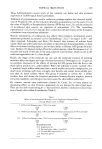
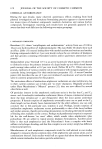
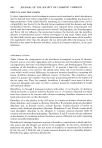
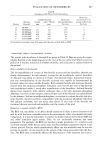
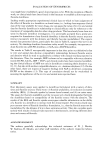
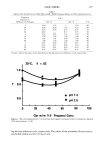
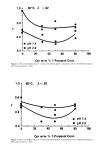
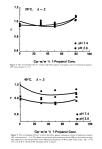
HAIR FIBERS 703 On the other hand, dehydration of the hair fiber shifts the c•-fi conformational equilib- rium towards the c• form and thus, increases the force required for straining the fiber (13), i.e., increases the value of fst. The pH of the solution should not affect this latter process. It is also instructive to consider, in light of this model, some of the X-ray data which have been obtained on keratin fibers containing increasing amounts ofpropanol. Feug- helman and Snaith (14) and later Heideman and Halboth (15) measured the changes occurring in the spacing of the interhelical distances in keratin fibers and found that the spacing of 9.3 fk increases when the propanol concentration is augmented in the im- mersion liquid. According to these authors, the 9.3 it spacing corresponds to the distances between the helices in the protofibrils. The increases in this spacing, therefore, suggests that the propanol penetrates the protofibrils and, in doing so, pries the polypeptide helices apart. A similar explanation was suggested by Nemetschek (16) when interpreting the low angle X-ray data of collagen treated with various alcohols. The findings that neither an increase of alcohol concentration beyond 50 per cent nor the changing of the pH from 6 to 1 affect the 9.3 fk spacing (15) suggest that most of the ionic groups are situated on the surfaces of the protofibrils and in the interior of the protofibrils electrostatic effects do not exert any serious influences. Raising the temperature from 20 to 60øC affects the absolute values off', but does not change the overall shape of the f' versus C•,r curves. This result is in agreement with previous data which indicated that propanol absorption is hardly at all affected by temperature (10). V. CONCLUSIONS The force resisting straining of hair is governed essentially by two types of molecular processes: (a) structural changes (c•-fi transition) and (b) changes in the electrostatic energy of fiber as a consequence of the increase in the interionic distances. These two processes depend differently on environmental factors (i.e., temperature, pH, pro- panol concentrations). Our experimental results, presented in this paper, suggest that exposure of hair to aqueous propanol solutions of increasing concentrations first weakens the fibers by increasing the electrostatic repulsion forces between the similarly charged side chains. At higher propanol concentrations ( 50 per cent w/w), however, hair becomes stronger, owing to the dehydration of the fiber which makes the structural conforma- tional changes of the polypeptide chains more difficult. The experimental results can be explained, at least in qualitative terms, by a molecular model which regards keratin as a partially crystalline crosslinked polyelectrolyte gel. A quantitative interpretation of the forces in terms of this model necessitates the assignments of arbitrary values to many molecular quantities (e.g., the effective dielectric constant in hair, its dependence on water and propanol uptake, the value of,c inside the hair structure). Since none of the quantities are known to any degree of relia- bility at this time, this exercise does not seem profitable. Similar conclusions were ob- tained by Wolfram and Milligan when investigating the tensile properties of esterified and acylated wool (17).
Purchased for the exclusive use of nofirst nolast (unknown)
From: SCC Media Library & Resource Center (library.scconline.org)