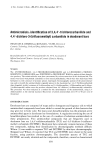
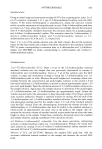
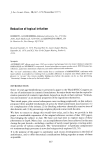
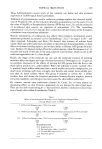
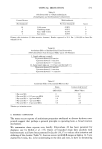
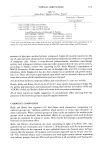
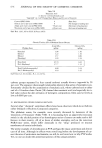
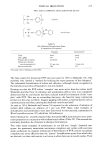
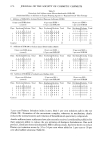
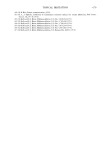
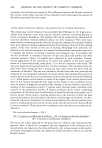
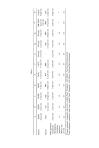
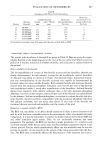
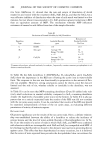
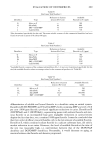
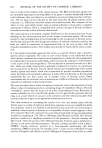
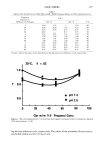
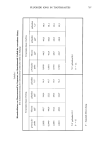
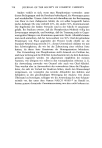
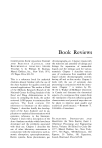
TOPICAL IRRITATION 671 Table II 1-Hydroxyethyl-4, 5-Diphenylimidazole (Antiphlogistic and Antihistaminic Composition) Control Scores With Imidazole (No Imidazole) Per Cent Imidazole' Score 10 Cold cream 0.08% 1 2 Vanishing cream 0.03% 0 10 Face "milk" lotion 0.10% 0 5 Face lotion 0.04% 0 Primary skin irritation (10 skin-sensitive humans). Results reported in U.S. Pat. 3,504,090 to Iwao Ka- wakami (1970). Table Ill Antiirritant Effect of Imidazolidinyl Urea Preservative (48 h Closed Patch Test of a Liquid Make-up on 100 Humans) I. Liquid make-up (control): 94 persons showed (0) reaction 4 persons showed (+) reaction 2 persons showed (+ +) reaction II. Same liquid make-up + 0.25 per cent Germall 115: 98 persons showed (0) reaction 2 persons showed (+) reaction 0 persons showed (+ +) reaction Table IV Antiirritant Effect of Acetamide MEA on SLS Ratio Conjunctival Scores • (MEA/SLS) (Mean Value) 3 Per cent SLS 3 Per cent SLS + 0.35 per cent MEA 3 Per cent SLS + 3 per cent MEA 3 Per cent SLS + 7 per cent MEA 3 Per cent SLS + 15 per cent MEA 0 14.7 0.16 11.3 1.0 8.7 2.5 9.3 5.0 2.6 •Draize eye irritation scores. II. HYDROXY COMPOUNDS The many recent reports of antiirritant properties attributed to diverse hydroxy com- pounds suggest that perhaps a general principle is operating here, a broad reaction mechanism. We summarize these reports very briefly: Polysorbate 20 has been patented for shampoo use by Bollch et al. (35). Esters of branched chain fatty alcohols with hydroxystearic acid have been patented by Jacobi (36,37) to reduce skin irritation and defatting of the dermis (Table V). Sucrose esters (with HLB ranges as high as 14.5) are claimed by Croda, Inc. to be nonirritating to the skin and eyes, to have no denaturing

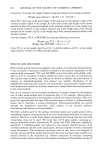
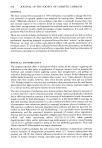
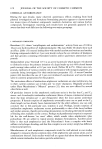
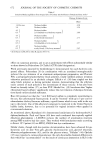
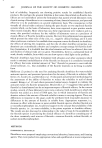
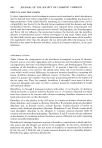
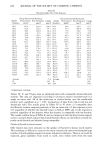
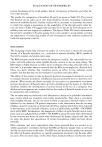
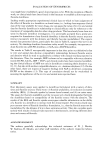
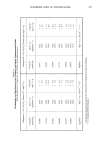
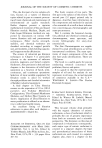
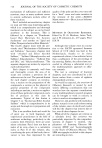
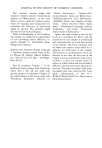
672 JOURNAL OF THE SOCIETY OF COSMETIC CHEMISTS Table V Irritation-Reducing Effects from Topical Use of C8 Fatty Alcohol Esters of Hydroxy Fatty Acids* Primary Irritation Score (Skin) 1.4 Per cent Na lauryl sulfate 4.28 5.0 Na lauryl sulfate 3.56 4.5} Na lauryl sulfate 0.5 2,6-dimethyl~octyl-hydroxy stearate 3.06 4.5} Na lauryl sulfate 0.5 a-ethyl-hexyl-ricinoleate 2.73 4.5} Na lauryl sulfate } 0.5 2,6-dimethyl-octyl-ricinoleate 2.57 4.5} Na lauryl sulfate 0.5 a-ethyl-hexyl- 12-hydroxy stearate 2.45 ½(U.S. Patent 3,906,106 to Otto K. Jacobi (9/16/75). effect on cutaneous proteins, and to act as antiirritants with effects substantially similar to those shown by Polysorbate 20 (Table I)(CTFA label designation). Work previously reported by Goldemberg (1) demonstrated two such hydroxy com- pound effects: Polysorbate 20 (in combination with an acetylated monoglyceride) reduced the eye irritation of an aluminum antiperspirant preparation, and Pluronic F68, a polypropylene/polyethylene block polymer, totally nullified primary irritation otherwise produced by an alcoholic cologne. Edlich eta/. (38) later singled out this same block polymer as having particular interest, demonstrating that the ethylene oxide content of such polyols is the determinant of tissue toxicity. It has also been found to detoxify iodine (57), as does PVP. Henkel Inc. (39) has shown that "higher ethoxylated lauryl sulfates" significantly reduce the eye irritation of shampoo formula- tions based on fatty alcohol sulfonates. Riso (60) pointed out that the 7 mol EtO lauryl sulfate is completely nonirritating to the eye, but unfortunately foams poorly. It can be "boosted" with up to 5 per cent tri- ethanolamine dodecyl benzene sulfonate, a good foamer which is very mild in the eye (up to this level.) Use of this alkyl aryl compound is restricted in the United States in bubble baths, however, due to its potential for vaginal irritation when applied in concentrated solutions. As mentioned above, Kawakami (31) demonstrated antiirritancy for hydroxyethyl-4,5 diphenylimidazole. Peck and Spoor (40) have each confirmed that topically applied dihydroxy-phenylamine (•-DOPA) reduces the number of sensitization reactions among PPD-sensitive hair dye users. They worked with formulations made according to Feier's 1972 patent (41) on PPD/•-DOPA hair dye combinations. Similar claims, though with less positive documentation, have been advanced for ga- lacturonic acid (in aloe Vera gel), glycolic (hydroxyacetic) acid, glyceryl triacetate, allantoin polygalacturonate (42), and for the glucose trimer, "Pullulan" (44). Opdyke (45) once reported a curious phenomenon: the only discernable chemical difference in skin which has "accommodated" (to the insult of continuous immersion in SLS) is the
Purchased for the exclusive use of nofirst nolast (unknown)
From: SCC Media Library & Resource Center (library.scconline.org)