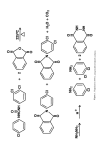
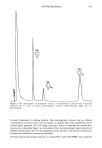
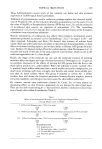
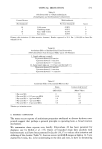
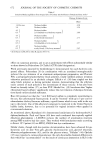
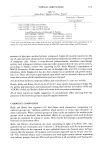
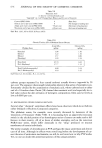
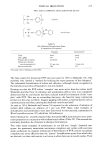
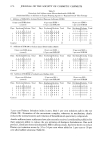
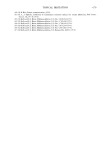
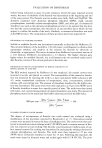
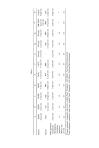
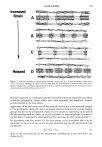
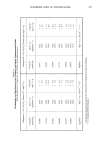
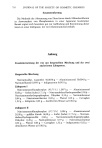
by this method. Investigations in this laboratory with high pressure liquid chromatography and gas-liquid chromatography (GLC) were likewise unsuccessful. The primary purpose of this investigation was to develop a method for the identifica- tion of these compounds. The second part of this investigation involved evaluation of the qualitative method as a technique for the determination of TCC and DCTFMC. Tingle and Brenton (3) reported that alkyl carbamides react with phthalic anhydride to give alkyl phthalimides in high yield. Manske (4) synthesized primary alkyl amines by hydrazine hydrolysis of alkyl phthalimides. These studies form the basis of the method reported here. DCTFMC and/or TCC were isolated from the deodorant bars by solvent extraction. The residue remaining after evaporation of the solvent was reacted with phthalic anhy- dride (see Fig. 1). The reaction mass was hydrolyzed with hydrazine, and the resulting aromatic amines were analyzed by GLC. By comparison of peak retention times with those of standards, the degradation products of DCTFMC were identified as 4- chloroaniline and 4-chloro-3-(trifluoromethyl) aniline (5-amino-2-chlorobenzotrifluo- ride), the expected products. Similarly, TCC yielded 4-chloroaniline and 3,4- dichloroaniline. The procedure was then evaluated as a method for the quantitative estimation of DCTFMC and TCC. Known amounts of each were added to solutions of a commercial deodorant bar. Solutions were then carried through the procedure, and the resulting amines were determined by GLC, using 3,5-dichloroaniline as the internal standard. Initial recoveries of added TCC and DCTFMC varied from 25 to 29 per cent. After the method was modified to eliminate losses during evaporation of the ether extract, recoveries of 85 to 90 per cent were obtained. METHOD APPARATUS A gas chromatograph (Model 810 •) equipped with dual flame ionization detectors and operated under the following conditions was used: column 210 ø C, injection port 250 ø C, detector 260 ø C, carrier gas flow rate (helium), 80 ml/min. The GLC column was glass, 10 ft x 4 mm i.d., packed with Chromosorb W (60 to 80 mesh)•- coated with 5 per cent KOH and 4 per cent PEG 20M.$ The column packing was prepared as follows: dissolve 8 g of PEG 20 M and 10 g of KOH in 150 ml. of warm methanol. After the solution is complete, add methanol to make the volume 200 ml. Pour methanol solution into a 1 liter round-bottom flask followed by 25 g of 60 to 80 mesh Chromosorb W. Mix well and then apply vacuum for ca. 1 min to remove entrained air. Release the vacuum and swirl the flask vigorously rapidly transfer the slurry to a 500 ml sintered glass (coarse) funnel set in a side-arm filter flask. Apply suc- tion to the funnel for 2 to 3 min. Transfer the damp support to a large crystallizing dish or stainless steel pan and dry on the steam bath. Mix (do not stir) the support thoroughly every 5 min. by shaking the dish or pan. After the odor of the solvent has disappeared, pack the dried support into the GLC column. The packed column was conditioned for 24 h at 225 ø C with a carrier gas flow of 10 ml/min. An oil bath (Model 11-48)$ was used only for reaction of phthalic anhydride with preservative. *Hewlett-Packard Co., Palo Alto, CA. tApplied Science Laboratories, Inc., State College, PA. $Fisher Scientific Co., Pittsburgh, PA.

662 JOURNAL OF THE SOCIETY OF COSMETIC CHEMISTS REAGENTS The following reagents were used: 3,4-dichloroaniline (98 per cent, No. D5560-1) ½ 3,5-dichloroaniline (98 per cent, No. D5579-2) ½ 4-chloroaniline (98 per cent, No. C2241-5) ½ 4-chloro-3-(trifiuoromethyl) aniline (99 per cent, No. A-4565-3) ½ phthalic anhydride (ACS, No. 331) -• and hydrazine hydrate (85 per cent, No. H- 318).ñ STANDARD SOLUTIONS Prepare separate standard solutions of 3,4-dichloroaniline, 4-chloro-3-(trifluo- romethyl) aniline, and 3,5-dichloroaniline by accurately weighing ca. 0.2 g of each com- pound into separate tared 50 ml beakers. Dissolve the compounds in benzene quanti- tatively transfer each solution to a 100 ml volumetric flask and dilute to volume with benzene. PREPARATION OF SAMPLE Using a knife or spatula, reduce 2 to 3 g of deodorant bar to powder or fine shavings. Accurately weigh ca. 2 g of shavings into a tared 100 ml beaker. Add 50 ml of warm water and 1 pellet of KOH, and stir to dissolve. Transfer the solution to a 125 ml sepa- ratory funnel rinse the beaker with 1 x 10 ml and 1 x 5 ml portions of ethanol, adding rinsings to the separatory funnel. Extract the solution with 3 x 20 ml of ethyi ether. If a stable emulsion forms during the second or third extraction, add a small amount of ethanol to break the emulsion. Combine the ether extracts and wash with 50 ml of 1 per cent NaC1 solution, 50 ml of water containing 1 ml of HC1, and, finally, 50 ml of 2 per cent NaHCOa solution. Dry the ether extract over anhydrous Sa2804 for 30 min, transfer to a 100 ml beaker, and evaporate on the steam bath to ca. 20 mi. Transfer the extract to a 50 ml centrifuge tube and carefully evaporate to dryness on a steam bath. Add ca. 50 mg of phthalic anhydride to the residue and heat the lower portion of the centrifuge tube in an oil bath at 225øC for 15 to 20 min. Cool, and add 2 ml of ethanol:dimethylformamide (1:1) to dissolve the reaction mass. Add two drops of hydrazine hydrate, warm for several minutes, and then add 15 ml of dilute HC1 (1:10). Transfer the contents of the tube to a 125 ml separatory funnel, extract with 30 ml of ethyl ether, and discard the ether layer. Make the aqueous solution distinctly basic (litmus) by adding 10 per cent NaOH solution and then extract with 2 x 30 ml portions of ethyl ether. Combine ether extracts, wash with 30 ml of water, and dry 30 min over anhydrous Sa2804. Transfer this extract to a 100 ml beaker add 0.5 to 1 ml ofxylene and evaporate to 15 to 20 mi. Transfer to a 50 ml centrifuge tube and evaporate care- fully on the steam bath, leaving only xylene. Stopper the tube and reserve for analysis. If the sample is to be prepared for quantitative analysis, all of the above transfers should be quantitative by rinsing the prior container with several small portions of the appropriate solvent. •Aldrich Chemical Co., Milwaukee, WI. •'Eastman Organic Chemicals, Rochester, NY.
Purchased for the exclusive use of nofirst nolast (unknown)
From: SCC Media Library & Resource Center (library.scconline.org)