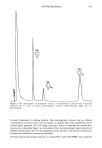
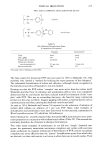
ANTIMICROBIALS 663 IDENTIFICATION Using an initial range and attenuation settings of 102 x 8 as a starting point, inject 2 to 3 /xl of a solution containing 2 to 3 /xg of 4-chloroaniline//xl benzene onto the GLC column. If the initial chromatogram is unsatisfactory, adjust the injection volume and/or recorder attenuation to bring the peak on scale. If the 4-chloroaniline peak does not elute in 4-5 rain, adjust the column temperature accordingly. Record the retention time of 4-chloroaniline. Similarly determine the retention times of 3,4-dichloroaniline and 4-chloro-3-(trifluoromethyl) aniline. The retention times for 4-chloroaniline, 4- chloro-3-(trifluoromethyl) aniline and 3,4-dichloroaniline relative to 3,5- dichloroaniline are 0.30, 0.48, and 1.13, respectively. Inject 3 to 4 /xl of the sample solution onto the GLC column. Record the retention values for the eluted peaks and compare with those obtained for the standards. Identify TCC by peaks corresponding in retention time to 4-chloroaniline and 3,4-dichloro- aniline, and DCTFMC by peaks corresponding to 4-chloroaniline and 4-chloro-3- (trifluoromethyl) aniline. DETERMINATION 3,4,4'-Trichlorocarbanilide (TCC): Pipet 1.0 ml of the 3,5-dichloroaniline (internal standard) solution into the sample that was previously determined to contain 4- chloroaniline and 3,4-dichloroaniline. Inject ca. 5 /xl of this solution onto the GLC column at range and attenuation settings to keep the 3,5-dichloroaniline and 3,4- dichloroaniline peaks on scale. Measure the peak heights and, assuming a linear rela- tionship between the concentration and peak height, estimate to the nearest 1.0 ml how much additional 3,5-dichloroaniline is needed to obtain approximately equal (+_ 10 per cent) peak heights. Pipet the calculated amount of 3,5-dichloroaniline solution into the sample solution. Again inject the sample solution to determine if the peak heights of 3,4-dichloroaniline and 3,5-dichloroaniline are approximately equal. Adjust the volume injected and/or the attenuation to keep the peaks within 50 to 90 per cent full- scale recorder deflection. Prepare a standard solution by mixing 10.0 ml each of the 3,5-dichloroaniline and 3,4-dichloroaniline standard solutions. Using the same range and attenuation settings used for the sample, inject 3 to 4/xl of the standard solution onto the GLC column. From the chromatogram, determine the volume of either 3,4- dichloroaniline or 3,5-dichloroaniline that must be added to the standard solution to obtain peaks of approximately the same ratio as the peaks in the sample. Also de- termine the injection volume of standard needed to give peaks that are about the same height as those in the sample. Using these conditions, alternately inject the standard and sample solutions, making a minimum of two injections of each. 4,4'-Dichloro-3-(trifluoromethyl) carbanilide: Use the above procedure, substituting 4-cholor-3-(trifluoromethyl) aniline for 3,4-dichloroaniline. Prepare the initial stan- dard solution by mixing 5.0 ml of 4-chloro-3-(trifluoromethyl) aniline standard solu- tion with 10.0 ml of 3,5-dichloroaniline standard solution. Mixtures of TCC and DCTFMC: Measure the smallest GLC peak first. Add the necessary additional internal standard to the sample and measure the second GLC peak.

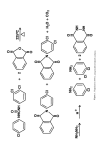
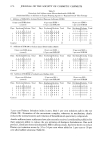
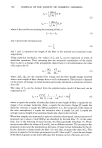
664 JOURNAL OF THE SOCIETY OF COSMETIC CHEMISTS Calculations.' Calculate the weight of amine being determined in the sample as follows: Weight (mg) unknown = (Ru/Rs) x Ks x (ISu/ISs) where Ru is the ratio of the peak height of the unknown in the sample to that of the internal standard added to the sample Rs is the ratio of the peak height of the known standard to that of the internal standard in the standard solution Ks is the weight (mg) of the known standard in the standard solution ISu is the weight (mg) of the internal standard in the sample and ISs is the weight (mg) of the internal standard added to the standard solution. Calculate weight of TCC or DCTFMC by using the following conversions: Weight (mg) TCC = W-3,4 x 1.95 Weight (mg) DCTFMC -- W-4 x 1.79 where W-3,4 is the weight (mg) found for 3,4-dichloroaniline and W-4 is the weight (mg) found for 4-chloro-3-(trifluoromethyl) aniline. RESULTS AND DISCUSSION Before the proposed method was applied to the analysis of commercial deodorant bars, it was necessary to determine conditions suitable for the stepwise degradation of the antimicrobial compounds. TCC and DCTFMC reacted smoothly with phthalic anhy- dride at 225 ø C evolution of carbon dioxide and water ceased after several minutes. The reaction mass, however, was difficult to dissolve in ethanol, the usual solvent. A mixture of dimethylformamide and ethanol was suitable. Hydrolysis of the phthalimides with hydrazine hydrate and hydrochloric acid proceeded rapidly under mild temperature conditions. Aromatic amines were isolated from the reaction mixture by the usual methods. One of our concerns was the possible interference by amines formed by the degrada- tion of other antimicrobials used in deodorant bars. If, for example, tribromosalicyl- anilide reacted analogously, p-bromoaniline would be the expected product. This com- pound has approximately the same GLC retention time as 4-chloro-3-(trifluoromethyl) aniline and is, therefore, a serious interference. Tribromosalicylanilide was carried through the degradation procedure. GLC analysis of the reaction products demonstrated the absence ofp-bromoaniline. The GLC columns used for the analysis of primary amines are usually packed with a nonsilanized support containing several per cent of potassium hydroxide to reduce ad- sorption. Polyester or other liquid phases containing functional groups that react with strong bases must not be used. We found that a 10 ft glass column containing po- tassium hydroxide-treated Chromosorb W coated with PEG 20M gave satisfactory separation. 3,5-Dichloroaniline was selected as the internal standard because of its chemical similarity and the nearly equal specific detector response to those compounds being determined. The extraction procedure used in this study was designed to separate the neutral ether-soluble fraction from the acidic and basic water-soluble com- pounds present in the deodorant bar. Solvent extraction of solutions containing surfactants nearly always results in the formation of emulsions. This problem can be ef-
Purchased for the exclusive use of nofirst nolast (unknown)
From: SCC Media Library & Resource Center (library.scconline.org)