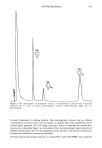
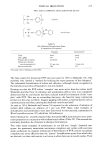
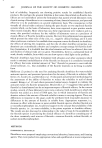
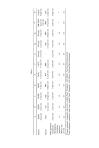
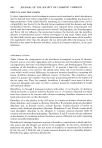
ANTIMICROBIALS 665 NH2 Cl NH2 Cl NH 2 i- • Figure :2. Gas cleodolan[ ba•: in o•de• ooe eludon, 4-chlo•oanil•ne, 4-chlo•o-3-{[•ifluo•ome[hyl) aniline, and 3,4- dichloroaniline fectively eliminated by adding ethanol. Our investigations indicate that an ethanol concentration of 20 to 25 per cent by volume is optimal. The ether-soluble fraction is usually small, generally 20 to 30 mg/g of product. Since occasionally the neutral frac- tion may be somewhat larger, we recommend that correspondingly larger amounts of phthalic anhydride be used for the degradation step. Likewise, the amount of hydrazine hydrate used should be increased accordingly. Several commercial products known to contain TCC and/or DCTFMC were analyzed

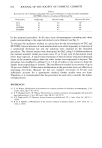
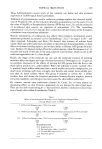
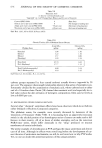
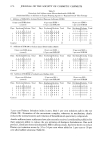
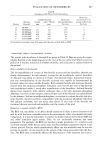
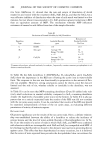
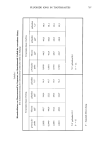
666 JOURNAL OF THE SOCIETY OF COSMETIC CHEMISTS Table I. Recoveries of 3,4,4'-Trichlorocarbanilide (TCC) and 4,4'-Dichloro-3-(trifiuoromethyl) Carbanilide (DCTFMC) Added to a Commercial Deodorant Bar Preservative Added (mg) Recovery (mg) Recovery Per Cent TCC 10 9.0 90 TCC 10 8.6 86 DCTFMC 10 8.9 89 DCTFMC 10 8.5 85 by the proposed procedure. In all cases, clean chromatograms containing only those peaks corresponding to the expected products were obtained (see Fig. 2). To evaluate the qualitative method as a procedure for the determination of TCC and DCTFMC, known amounts of each antimicrobial were added separately to solutions of a commercial deodorant bar and the solutions were analyzed by the described procedure. The isolated amines were determined by GLC, using 3,5-dichloroaniline as the internal standard. Initial recoveries were 25 to 29 per cent of theoretical, much lower than expected. A step-by-step evaluation of the procedure indicated substantial losses of the aromatic amines when the ether extract was evaporated to dryness. The procedure was modified by adding 0.5 to 1.0 ml of xylene to the extract to keep the sample from evaporating to dryness. This modification resulted in recoveries of up to 90 per cent (Table I). Other minor modifications in the procedure were not effective in increasing recoveries. Because we did not consider recoveries of 90 per cent sufficiently accurate for a quantitative method, further studies were not done. Therefore, it is recommended that the procedure be used only to identify the antimi- crobials present. REFERENCES (1) C. H. Wilson, Identification of preservatives in cosmetic products by thin-layer chromatography, J. Soc. Cosmet. Chem., 26, 75-81 (1975). (2) E. P. Sheppard and C. H. Wilson, Preservatives in cosmetics: partition chromatography and ultraviolet spectrophotometry, J. Assoc. Off Anal. Chem., 58,937-40 (1975). (3) J. t3. Tingle and B. J.P. 13renton, Action ofamines on phthalic acid. VI, J. Amer. Chem. Soc., 32,113-7 (1910). (4) R. H. F. Manske, A Modification of the Curtius synthesis of primary amines, J. Amer. Chem. Soc., 1, 1202-4 (1929).
Purchased for the exclusive use of nofirst nolast (unknown)
From: SCC Media Library & Resource Center (library.scconline.org)