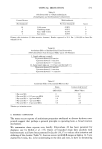
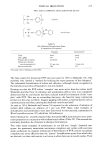
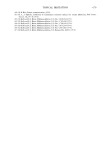
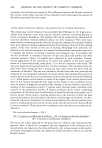
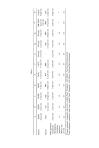
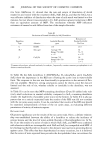
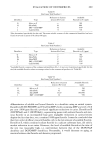
686 JOURNAL OF THE SOCIETY OF COSMETIC CHEMISTS RESULTS AND DISCUSSION In these experiments, model toothpaste systems were formulated in which the abrasive and the fluoride were either compatible or incompatible. Compatibility was shown by a high proportion of the added fluoride remaining in a water-extractable form, and in- compatibility was shown by the fluoride being complexed with the abrasive and being insolubilized thereby. Separate experiments (not reported here) demonstrated very clearly that the humectants (glycerol and sorbitol), binding agent, and foaming agent, and flavor did not influence the interaction between the fluoride and the dentifrice abrasive in formulations typical of those investigated in this study. Other trials, with the silica-SnF2 system, gave results which demonstrated that the nature of the nonfluo- ride ingredients other than the abrasive did not detectably affect the response to the fluoride in the assays for fluoride solubility, reduction of enamel solubility, or rat caries inhibition. DENTIFRICES STUDIED Table I shows the compositions of the dentifrices investigated in terms of abrasive, fluoride source, and other ingredients such as humectant and miscellaneous formulat- ing ingredients, the latter including binding agent, flavor, and foaming agent. The com- positions of the dentifrices were selected (1) to provide a basis for a placebo, i.e. nonfluoride paste, to be used for the animal caries trials, and (2) to provide composi- tions which would reveal differences in response between dentifrices containing dif- ferent dentifrice abrasives and different sources of fluoride. The dentifrices were assayed in groups, the number of products per group being limited by the logistics of the rat caries test. Thus, for example, dentifrices A through F were tested in the rat caries test alongside each other in order to achieve maximum comparability of results and statistical validity. Dentifrices A through F represent products with either (1) no fluoride, (2) abrasives which are known to interact with free fluoride ion, or (3) sources of fluoride ion which have been shown to be reactive with calcium-containing dentifrice abrasives on one hand and nonreactive on the other hand. Dentifrice A is the placebo in the A-F series. It contains as abrasive dicalcium phos- phate dihydrate, and contains no fluoride. Dentifrice B comprises dicalcium phosphate dihydrate and, as fluoride source, sodium fluoride. Sodium fluoride is known to interact with dicalcium phosphate dihydrate. Dentifrices C and D both contain dical- cium phosphate dihydrate as the abrasive C contains stannous fluoride while D contains sodium monofluorophosphate. Dentifrices E and F contain calcium carbonate as the abrasive, E containing sodium fluoride as source of fluoride ion and F containing sodium monofluorophosphate. Dentifrices G through I represent a group of dentifrice compositions in which the fluo- ride source and the abrasive are known to be compatible. In this series, dentifrice G represents the placebo. The last test series of dentifrices is represented by dentifrices G, H•, H2, and J. Both H• and J contain stannous fluoride and a compatible abrasive. Dentifrice G, again, represents the placebo.

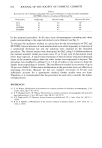
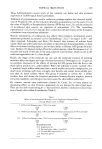
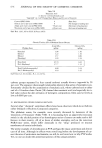
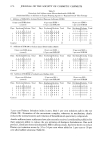
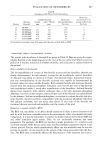
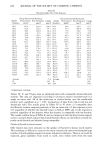
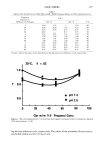
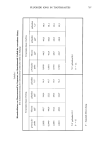
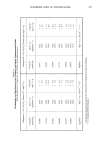
EVALUATION OF DENTRIFRICES Table II Evaluation of DCPD and CaCOa Dentifrices 687 Reduction Available Fluoride Reduction in Carious (B + C) Abrasive/ Initially After 7 Weeks in Enamel Solubility Lesions in Rat Trial Product Fluoride a ppm ppm Per Cent Per Cent A DCPD/ .... 4.2 -- B DCPD/NaF 155 143 15.6 6 C DCPD/SnF2 130 111 23.0 4 D DCPD/MFP 864 888 16.9 44 E CaCOa/NaF 378 354 8.5 27 F CaCOa/MFP 856 844 6.4 51 aAll dentifrices formulated with 1000 ppm added fluoride, as NaF, SnF2, or MFP. "COMPATIBLE" VERSUS "INCOMPATIBLE" SYSTEMS The results with dentifrices A through F are given in Table II. Data are given for water- soluble fluoride at the beginning and at the end of the rat caries trial (which covered a period of 6 weeks), reduction in enamel solubility, and reduction in carious lesions in the rat trial. Water-solubility of the fluoride: The incompatibilities of certain of the fluoride sources and the dentifrice abrasive are clearly demonstrated. In each instance (except for the nonfluoride control, dentifrice A), fluoride was added at a level of 0. !0 per cent (fluoride basis). Substantial interac- tion and insolubilization of the fluoride occurred very rapidly as demonstrated by lowered values for water-soluble fluoride. Both sodium fluoride and stannous fluoride reacted with the dicalcium phosphate dihydrate, and over 85 per cent of the fluoride was insolubilized within 1 week after manufacture of the dentifrice. Sodium fluoride showed less reactivity with calcium carbonate than it did with dicalcium phosphate dihydrate, but even in this instance, almost 60 per cent of the fluoride was insolubilized by the abrasive. Sodium monofluorophosphate, in contrast to sodium fluoride and stan- nous fluoride, showed excellent compatibility with the dicalcium phosphate dihydrate and calcium carbonate, and not more than about 15 per cent of the fluoride ion contained therein was rendered insoluble over the course of the trial. Reduction in enamel solubility (RES).' The RES test, the ability to so affect dental enamel as to make it more resistant to at- tack by acid, has been a valuable criterion for assessing the utility of potential anticaries compounds. It is not the intent here to explore in depth relations between the RES test and other anticaries agent assays. They do not necessarily measure the same parameters. For example, the RES test involves a single parameter, viz., attack by acid on dental enamel, while the rat caries assay involves multiple parameters related to the carious process. Factors which quantitatively affect one test markedly may be less im- portant in another. A case in point is the nature of the cation associated with the fluo- ride. The RES value is markedly affected by the presence of the stannous ion in an ac-
Purchased for the exclusive use of nofirst nolast (unknown)
From: SCC Media Library & Resource Center (library.scconline.org)