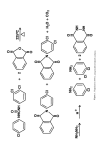
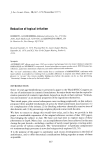
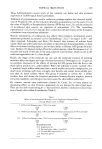
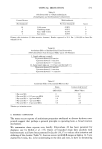
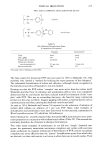
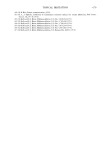
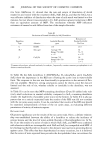
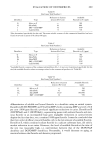
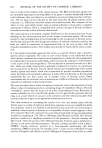
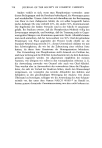
TOPICAL IRRITATION TWO ALKYL DIMETHYL BENZALKONIUM QUATS IR CIH a i• F --•--CH•• I C, Chloride CHa R--N--CH• / \•1 I I II $acchar/na•e 675 Table IX Alkyl Dimethyl Benzalkonium Quats (Comparison of Properties) Chloride Saccharinate • Taste bitter sweet LD.50 (g/Kg) 445 1130 Primary skin irritation moderate 0 Draize eye irritation (non-irritating level) 0.1 per cent 1.0 per cent Phenol coefficient 580 525 (½Onyxide 3300 or Hollichem HQ 3300). The basic patent for detoxicant PVP uses was issued in 1956 to Shelanski (53), who modestly only claimed a "method for reducing the vapor pressure of free halogens." The substantial detoxification of iodine and chlorine--although clearly recognized in the introductory portion of his patent--was not claimed. Pointing out that the PVP iodine "complex" was more active than free iodine itself, Shelanski described how its irritation and sensitization effects were now completely absent and that its oral toxicity had been reduced tenfold by formation of this "com- plex" with PVP. This was an astounding discovery, the basis for many commercial products in the years to follow. Imagine gargling with iodine, a material known only as a potent poison until then, carrying the skull-and-cross-bones label! As early as 1954, Shelanski and Cantor (54) reported on the reduction of irritation of sodium alkyl sulfates via addition of 1 per cent PVP. Many other examples of detoxification and antiirritancy were later discovered for this material, summarized in Wood's excellent review (55) which lists 148 references. Scher Chemical Co. recently reported that Acetamide MEA demonstrates (eye) antiir- ritant properties in conjunction with sodium lauryl sulfate (Table IV). This unusual ma- terial may, therefore, be of interest in shampoo formulations. Two other major examples of antiirritancy do not fall into "simple" chemical cate- gories: the quaternary ammonium saccarinate complexes and certain sulfo-succinate amido surfactants. In a manner reminiscent of the behavior of PVP, cationic saccarinate complexes are more effective than the "parent" benzalkonium quats from which they are derived, yet their 6ral toxicity is so low as to allow their use in mouth washes. Their

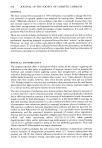
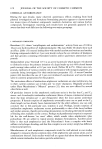
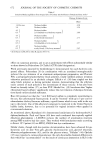
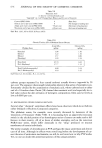
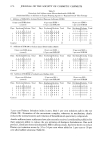
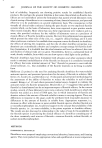
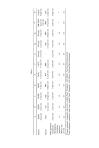
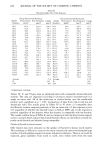
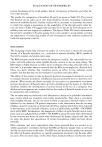
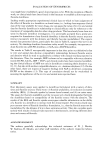
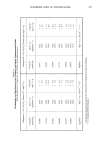
676 JOURNAL OF THE SOCIETY OF COSMETIC CHEMISTS Table X Ricinoleic Acid Sulfosuccinate Monoethanolamide (SS/RAM) (Antiirritant Effect on Addition to Typical Foaming Agents via "Repeated Insult" Skin Testing) I. Addition of SS/RAM to Sodium Dodecyl Benzene Sulfonate (SDBS): 10 per cent SDBS alone 10 per cent SDBS + 10 per cent SDBS + (control) 0.5 per cent SS/RAM 1 per cent SS/RAM Oedema Total Days Erythema 1234 1 0000 2 1021 3 1132 4 1143 Control 1234 0000 0 0020 6 0133 14 0132 15 __ 35 Days Erythema Oedema Total Days Erythema Oedema Total 123411234 123411234 i 000010000 0 1 000010000 0 2 1011[002 0 5 2 210010000 3 3 2 i 211002 I 9 3 2 I 0111101 7 4 10220022 9 4 22 1111101 23 20 II. Addition of SS/RAM to Sodium Lauryl Ethyl Sulfate (SLES): 10 per cent SLES alone 10 per cent SLES + 10 per cent SLES + (control) 0.5 per cent SS/RAM 1 per cent SS/RAM Oedema Total Days Erythema 1234 1 1000 2 1123 3 1224 4 2234 Control 1234 0000 1 1021 11 0112 13 1123 18 43 Days ErythemalOedema Total Days Erythema Oedema Total 12 3 4112 3 4 12 3 4]12 3 4 1 1 O0110000 2 1 100010000 1 2 2222[00 I 1 10 2 111110011 6 3 222 31012 13 3 1122]0203 11 4 2 2 3 3 2 I 0 1 14 4 I 2 2 310 0 0 3 11 39 29 III. Addition of SS/RAM to Sodium Lauryl Sulfate (SLS): 10 per cent SLS alone 10 per cent SLS + 10 per cent SLS + (control) 0.5 per cent SS/RAM 1 per cent SS/RAM Oedema Total Days ErythemalOedema Total Days Erythema 12 3 4112 3 4 12 34 1 0 0 0 010 0 0 0 0 1 0 0 0 0 2 i 2 3 110 02 0 9 2 12 I 0 3 132 3 0102 12 3 0 2 11 4 132 4 0 013 14 4 12 12 Control 35 1234 0000 0 0000 4 000 1 5 0001 7 16 Days ErythemaOedema Total 123411234 1 000010000 0 2 000010000 0 3 110110000 3 4 11000001 3 6 5 per cent Primary Irritation index is zero, their 1 per cent solutions safe in the eye (Table IX). Formation of the saccarinate complex, whatever its mechanism, clearly reduces the normal toxicity and irritation of benzalkonium quaternary compounds. Amido-sulfosuccinate surfactants have also recently received considerable publicity for their apparent ability to reduce the eye irritation of shampoo formulations. One such product, disodium monoricinoleamido MEA sulfosuccinate, has been shown to reduce Draize eye irritation scores by 32 to 54 per cent when added at 1 per cent to 10 per cent alkyl sulfate solutions (Table X).
Purchased for the exclusive use of nofirst nolast (unknown)
From: SCC Media Library & Resource Center (library.scconline.org)