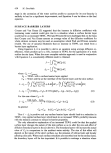
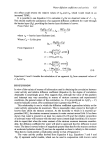
608 E. M. Staal and A. C. Noordzij Until now, all methods described are applied and are only suitable on a smooth skin surface, e.g. the skin of the underarm or forehead. Together with the abovementioned, the problem is raised that the known methods are not easily applicable for those areas of our body which are important for cosmetic treatment. Our experience was that in these areas, like the axilla, scalp and feet all methods failed for the quantification of the micro-organisms. The known methods can roughly be divided into two basic techniques (5). 1 Excision technique With the excision method (6) the upper layer of the epidermis is removed with a sharp knife. After that the micro-organisms are carefully separated from this part of the skin, collected and counted. The method is of course very accurate, but is not suitable to human subjects. 2 Direct sampling techniques With these methods the micro-organisms are more or less effectively removed from the intact skin of the subjects. This can be done in the following ways. (a) Dry sampling with a contact plate, tape stripping or velvet pad (7, 8, 3, 9, 10). Generally the yield of micro-organisms with this type of method is rather low, so the method is less suitable for a good quantitative investigation. (b) Wet sampling with mechanical scrub or swab. With this method micro-organisms are separated from the skin by applying a detergent solution and rubbing on a restricted area of the skin. The yield is relatively high, but demands an accurate standardisation of liquid volume and applied rubbing force (11, 12, 13, 14, 15, 16, 17, 18). (c) Wet ultrasonic sampling. This method was recently described by Stringer and Marples (15) and uses ultrasonic waves in a liquid phase to harvest micro-organisms from the skin. In fact, this method is a modified wet sampling technique with a well standardised quantity of applied energy. The advantage of this method is, therefore, its high accuracy, but the disadvantage is that the ultrasonic waves give a lot of discomfort to the subjects. Until now, the most frequently. used sampling method is the scrub method with a 'cup template' (13, 19, 20). Generally the washing liquid used with this method is a solution of the detergent Triton X 100. This solution is selected among sixteen other solutions of nonionic detergents after an extensive investigation by Williamson and Kligman (21). Considering the advantages and disadvantages of the described methods an optimal sampling technique has to meet the following demands: (1) sampling must be easy to standardise (2) the yield has to be reproducible (3) the sampling may not produce discomfort to the subjects (4) the method has to be suitable for hairy areas of the body and (5) the method has to be suitable for vertical or upside down areas of the body. Obviously none of the mentioned methods meets the demands of the ideal test method. This article describes a new method in which almost all mentioned advantages are collected. For this we used a 'Water-Pik ©' spray device. This instrument is a consumer product and is constructed to remove micro-organisms and food debris from the teeth with a fast pulsating, powerful water jet. Through these characteristics this instrument is, in fact, ideal for the separation and quantification of micro-organisms from the skin.

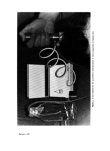
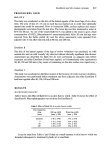
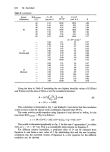
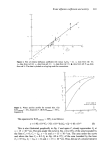
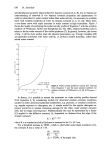
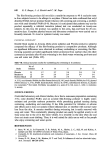
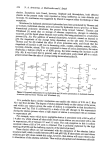
Micro-organisms on human skin 609 For application on the skin the Water-Pik was connected to a sampler with a silicone rubber sealing and a handle. The device has a volume of 1 ml and has a construction to permit application on every part of the body. The micro-organisms separated from the skin by the waterjet in the small sampler are collected through a closed system in a sterile bottle. This washing liquid is used afterwards to determine the number of viable micro-organisms. It appeared that the sealing of the sampler was so good that applica- tion on even hairy parts of the body could be done without water leakage. MATERIALS AND METHODS A Water-Pik © spray device is connected with a teflon tube to a sampler (Fig. 1). The outlet of the sampler is connected to a sterile collecting flask by means of a silicon rubber tube. Plastic •____._•_• Bross • •--Inlet from WCer Pik © Silicone rubber Bross mould Figure 1. Samples attached to a Water-Pik spray device. Scale The Water-Pik (model 49 EX) has a pulse frequency of 1200 pulses per minute and a discharge rate of 500 ml per minute. The sampler is built up by a brass body with a plastic handle. The body has a silicone rubber foot, so that a spray chamber is formed with a volume of about 1 ml. The rubber foot is prepared by mixing Sylastic 9161 RTV base* with Siliconoil F 128' with 1% of the catalyst N 9162' in a brass mould (Fig. 1). For sterilisation the equipment was flushed with 750 ml of a 0.3% Chloramine T•' solution or 750 m170% ethanol. To remove rests of chloramin or ethanol the apparatus is * Trade mark of Dow Coming. '• (N-Chloro-p-toluene sulphonamido) sodium.
Purchased for the exclusive use of nofirst nolast (unknown)
From: SCC Media Library & Resource Center (library.scconline.org)