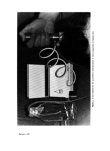
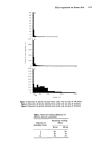
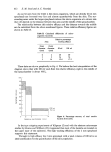
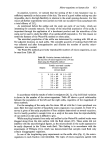
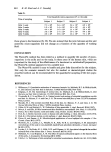
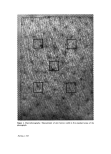
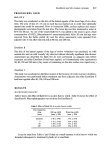
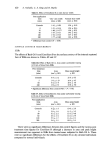
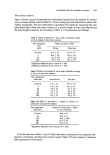
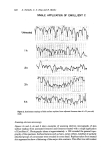
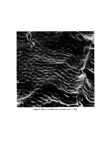
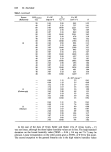
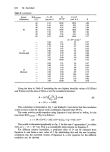
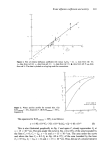
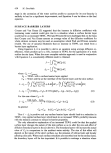
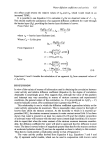
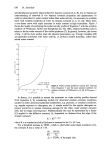
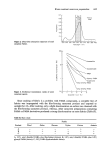
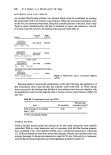
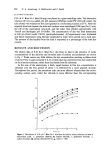
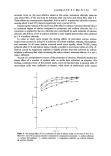
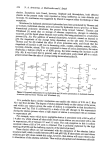
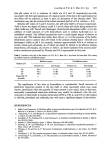
610 E. M. Staal and A. C. Noordzij rinsed with approximately 1000 ml of sterile 0'1•o Triton X 100' solution in 0.067 M phosphate buffer (pH 7.9). Sterile Triton X 100 is prepared by filtering the solution through a 0-22 pm membrane filter. For operation the sampler is firmly pressed on the skin and the Water-Pik is started (range 5). The collected Triton X 100 solution is, if necessary, diluted with sterile 0.855/0 saline. The dilution grade depends on the expected number of micro-organisms. Samples from the forehead, axillae and the scalp normally give high counts and a dilution of a hundred thousand-fold is needed (12). Sampling of the scalp is demonstrated in Fig. 2. Trypticase soy agar (BBL) with 0'5•o glucose was used as a general medium for aerobic organisms counts were made after 72 h incubation at 32øC. For anaerobic growth the trypticase soy agar medium accord'mg to J. A. Troller (22) is used incubation was carried out during 6 days in a Brewer jar (23) at 37øC in an atmosphere of 90% nitrogen and 10•o carbon dioxide (Gaspak BBL). EXPERIMENTAL AND DISCUSSION The investigation was started with the construction of the above mentioned sampler. The rubber foot of the headpiece has an opening with a diameter of 14 mm and thus an area of about 1-5 cm 2 is sprayed with this model. A large number of orientating experiments were carried out in the axillae of twenty adult subjects. It was shown that fairly reproducible numbers of viable micro-organisms could be harvested, although these numbers were highly dependent on the quantity of the washing solution. Generally a similar pattern was found between the obtained micro-organisms as a function of the wash volume. Figure 3 shows this pattern, averaged over twenty experi- ments. After washing the skin with 3 1 of the washing liquid hardly any micro-organism could be found. The figures found for the density of the microbial population in the axillae agreed with figures from recent literature (13, 24, 21, 1). Figure 3 shows that the number of micro-organisms in the first 100 ml is very high. The number of bacteria in the fraction from 100 to 1000 ml are not, however, negligible. We assumed that the micro-organisms in the first 100 ml originated from that part of the skin which was directly hit by the water jet from the spray nozzle. The micro-organisms in the 1000 ml fraction should possibly come from the surrounding area under the sprayhead and not from places deeper in the skin. To confirm this assumption two plastic headpieces were constructed, with an opening of 2 and 5 mm respectively. In Figs 4 and 5 the washing patterns of these sprayheads on the axillae skin are shown. Comparison of the diagrams with the various sprayheads leads to the following conclusions. (a) If the exposed area of the skin is diminished by applying a smaller sprayhead, the quantity of washing fluid necessary for removal of all micro-organisms is also diminished. This means that the efficacy of a sprayhead increases when the opening decreases. (b) The efficacy diagram of the 2 mm sprayhead shows that with 100 ml washing liquid almost all available micro-organisms are harvested. With this sprayhead the complete exposed skin is directly hit by the water jet and the micro-organisms are loosened very fast from the skin. In Table I the washing efficacies of the three sprayheads are given for practical reasons only wash volumes of 50 ml and 100 ml are considered. * Octylphenoxypolyethoxy ethanol, Rohm and Haas Co.

Facing p. t710
Purchased for the exclusive use of nofirst nolast (unknown)
From: SCC Media Library & Resource Center (library.scconline.org)