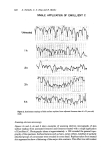
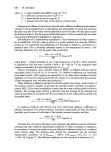
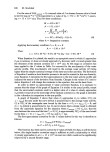
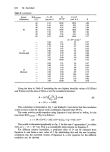
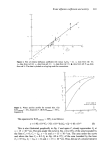
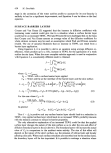
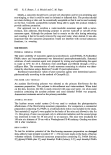
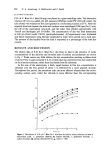
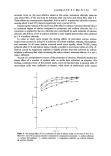
634 M. Stockdale stage in the correction of the water activity profile to account for its non-linearity is unlikely to lead to a significant improvement, and Equation 8 can be taken as the final equation. SURFACE BARRIER LAYERS Cooper and Van Duzee (5) suggested that the increase in diffusion coefficient with increasing water content could give rise to a situation where a surface barrier layer could lead to an increased TEWL. Weil and Princen (6) have challenged this on the basis that Cooper and Van Duzee assume an average value of the diffusion coefficient for whole stratum corneum may be used, an assumption which Well and Princen consider invalid. The use of calculus illustrates that no increase in TEWL can result from a barrier layer application. Using Equation 6, it is possible to derive an equation using average diffusion co- efficients, which predicts up to a 10% increase in TEWL for the application of a weak surface barrier layer. When the more complete calculus approach is used in conjunction with Equation 6, a c•nsiderably different result is obtained. fCo J = 7 dCe D(Ci) dCi 1 fCo D(G) dCi where CE = Cexternal JB = TEWL with a surface barrier layer applied Cn = Water activity at the interface of the barrier layer and the skin surface. Do E Co 1-0'46) dCi J-JB 5-' (.0'175 DofCo{O'175CoFo.46) = Co-C, -Td Do J- d• = •- { 0'46(C•- CE)--0.175 Co[In(Co- C•)-In (Co- CO]} (12) For the case where C E = 0: 0.46 CBDo CoDo J- J• -- -- 0.175 [ln (Co- C•)- In Co] (13) t t In general: Ca CE ln(Co-C•)ln(Co-COO Thus J - Ja is positive and any surface barrier layer should lead to a reduction in TEWL. Any applied surface layer which leads to an increased TEWL probably interacts with the stratum corneum to reduce its barrier properties. The only alternative explanation of an increased TEWL could be that the applied surface layer changes the nature of the skin surface so as to alter the size and effect of diffusion boundary layers in the air above it. The boundary layers will increase the actual value of CE in comparison to the ambient water activity. The size of this effect will depend on the nature of the skin's surface, e.g. the presence of yellous hairs and loosely adhering skin cells. Where such surface structures are smoothed out by the surface layer, the boundary layers will be less important. It is possible to envisage a situation where

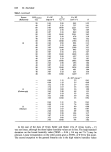
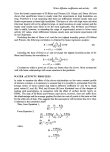
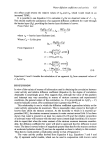
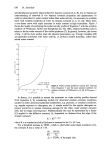
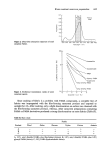
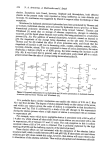
Water chJfusion coefficients and activity 635 this effect could reverse the relative values of CB and C•,, which would result in an increased TEWL. It is possible to use Equation 13 to calculate Ca for an observed value of J - Ju- This should enable the calculation of an apparent diffusion coefficient for water through the barrier layer (Du), providing the barrier layer thickness is known. From Ficks' law: O(C0 - Ca) t D}3( C• - C•) where t• = barrier layer thickness (cm). Where CE = 0, this gives From Equation 6 Thus D B • OtB(Co-C•) t% D Ir0'175Cø -t-0'46) o = C = 0.7C0+0.3 C• / 0.58C0 -t-0.54) D = DOkc--•-•_C• l'04taDoCo 0-46 Dotu D• = (14) t C s t Equations 13 and 14 enable the calculation of an apparent D• from measured values of J, Js and rs. DISCUSSION In view of the variety of sources of information used in obtaining the correlation between water activity and relative diffusion coefficient (Equation 6), the degree of correlation obtainable is surprisingly good. This suggests that, although the value of the gradient and intercept may vary according to source of stratum corneum and experimental conditions, the general nature of the correlation, i.e. D is proportional to Col(Co - C) must be basically correct. (The confidence limit is greater than 99'9•o.) This relationship is one in which the diffusion coefficient approaches infinity as the water activity approaches its maximum. This is reasonable when viewed in the light of known facts about the stratum corneum. As the humidity to which it is exposed ap- proaches 100•o, the stratum corneum increases its water content several fold. It has been shown that water is present in at least two states (16-19) and the relative proportion of unbound water will increase with the total water content (high humidity). It is reason- able to expect that when the water content of the stratum corneum increases consider- ably, the diffusion coefficient for water will tend to approach that for diffusion in pure water. The latter is several orders of magnitude greater than that for the stratum corneum at moderate hydration levels (7) and can be regarded as close to infinity in this context. Thus theory would predict a relationship similar to that of Equation 6. The water activity profiles derived from Equation 6 (e.g. Equations 7 and 8 and Fig. 2) represent useful models, which can be used in conjunction with known water
Purchased for the exclusive use of nofirst nolast (unknown)
From: SCC Media Library & Resource Center (library.scconline.org)