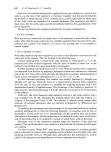
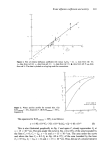
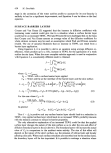
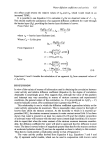
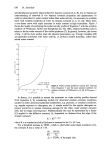
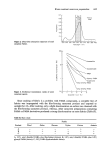
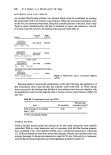
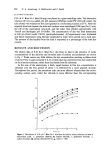
636 M. Stockdale activity/physical property relationships for stratum corneum (2-4, 20, 21), to extend our understanding of observed in vivo stratum corneum properties and appearances. In order to relate them to water content rather than water activity, it is necessary to combine them with sorption isotherms of water on stratum corneum (1, 2, 21, 22). These show a non-linear curve with rapid increases in water content at high humidities. Figure 3 shows the results of combining the model activity profile of Equation 7 with the sorption isotherm of Wildnauer, Miller and Humphries (2). The 100•o relative humidity point is taken to be the water content of the viable epidermis (7). In general, however, the curves of Fig. 2 will be more useful, since the physical parameters, e.g. Young's modulus (20) are generally correlated with water activity, or ambient relative humidity, rather than actual water content. 9C 8O 7O 6O • 5o ,• 40 2o IO / / / edge of .__•/ stratum corneum i i i i I i I 1 4 8 12 16 X x IO 4 (cm) Figure 3. Water content profile for normal skin. Derived from Equation 7 and the water sorption isotherm for stratum corneum of Wildnauer et al. (2). R.H.external = 0Yo. In theory, it is possible to extend the treatment on water activity profiles derived from Equation 6, by considering models for abnormal stratum corneum conditions caused by either abnormal epidermal metabolism, e.g. psoriasis, or external conditions, e.g. regular exposure to detergents, etc. A simple model for the regular detergent ex- posure would be to assume increasing damage for the older, outer stratum corneum cells, due to longer total exposure. Mathematically this may be represented by a factor (F•) applied to the diffusion constant, Di, dependent on distance from the edge of the stratum corneum: Fi = Kos- where K is a constant and skin thickness is assumed to be 15 x 10 -4 cm. For a threefold increase in TEWL, which is observable under these conditions (15), the constant K has a value of 1.24. dx RiFiD o -- dCi Jr Jn = TEWL of damaged skin.

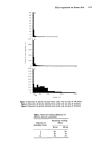
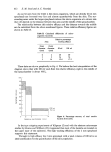
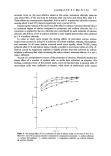
Water diffusion coefficients and activity 637 The above equation may be integrated, incorporating the functions for Fi and R. For the condition-of external relative humidity--0% and assuming again J (un- damaged) = 0.22 mg cm -• h -x, and K = 1.24, the following equation results: 1.84x 10 -5 1.24•ønx = 5.13x 10 -a Ci-8.73x 10-Sln(C0-Ci)-2.54x 10 -• (9) This equation is illustrated in Fig. 4 and the resultant profile of water content, incor- porating the water sorption isotherm, in Fig. 5. The usefulness of models such as this must be assessed in relation to their ability to explain observed properties of skin. In the case of the above model, the area of skin concerned had a dry, flaky, opaque appearance and had a hard and rough texture. This Figure 4. Model water activity profile for skin damaged by regular exposure to detergents derived from Equation 9. R.H.external = 0•o. 'E Go r / edge of stratum • corne•m • I i i I • , ,1 4 8 I 16 X x 10 4 (cm) Figure 5. Model water content profile for detergent damaged skin derived from Equation 9 and the water sorption isotherm of Wildnauer et al. (2). R.H.extema I = 0•. 9O 8O 7O GO E 50 o ,_40 30 2O Inneof / edge / stratum • corneum .- , ' ' x , 10 4 (cm)
Purchased for the exclusive use of nofirst nolast (unknown)
From: SCC Media Library & Resource Center (library.scconline.org)