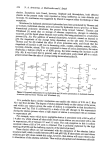
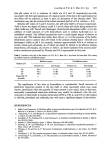
J. $o½. Cosmet. Chern. 29 651-655 (1978) The leaching of F.D. & O. Blue No I dye from its lake by eleotrelytes N. A. ARMSTRONG, A. BIALKOWSKA and J. SMITH The Welsh School of Pharmacy, University of Wales Institute of Science and Technology, Cathays Park, Cardiff Presented at the Symposium on 'Product Formulation' 11 October 1978 at Harrogate Synopsis The effect of electrolyte solutions on the alumina lake of F.D. & C. Blue No 1 dye has been studied. Monovalent anions and cations cause a fairly rapid leaching of the dye for a period of about 1 h, fol- lowed by a much slower elution process. Multivalent cations cause a slight increase in leaching, but a more marked effect is obtained with salts of multivalent acids, where the dye is virtually completely removed from its substrate in 2-3 h. The results are explained by reference to the postulated structure of the alumina substrate of the lake, and the effects of pH on and ionic penetration into this structure. INTRODUCTION Though the use of water soluble dyes is common in cosmetics and pharmaceuticals, any process which involves. the use of a moving solvent front may give rise to uneven colour distribution as the dye travels with the solvent. Thus, on drying for example, dye will be transferred progressively to the surface from which evaporation is taking place, resulting in an excess of dye at that point, whilst leaving a deficiency elsewhere [Jaffe and Lipp- mann (1) Armstrong and March (2)]. The use of the lake of the dye, in which the dye is adsorbed on to an insoluble substrate, is often recommended to avoid this problem, and was used with some success by Armstrong and March in an attempt to produce uniformly coloured tablets containing F.D. & C. Blue No 1 dye. It was noted, however, that under certain conditions, for example when the tablets contained calcium phosphate, no reduction in dye migration took place. Goodhart, Everhard and Dickcius (3) found a similar effect using F.D. & C. Red No 3 dye lake in the presence of calcium sulphate, implying that ionic species presence in the system may remove the dye from its insoluble substrate. Accordingly, the role of electrolytes in displacing F.D. & C. Blue No 1 dye from its substrate has been investigated. EXPERIMENTAL MATERIAL S F.D. & C. Blue No 1 dye Batch X7663 D. F. Anstead Ltd, F.D. & C. Blue No 1 lake Batch X8432, D. F. Anstead Ltd, pure dye content, 13•o. Both substances were used without further purification. All other reagents were of Analar or laboratory reagent quality, and solutions were prepared from water which had been distilled from glass subsequent to deionisation. 0037-9832/78/1000-0651 $02.00 ¸ 1978 Society of Cosmetic Chemists of Great Britain 651

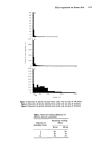
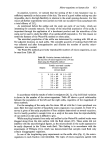
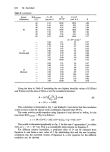
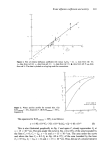
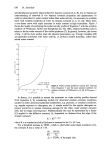
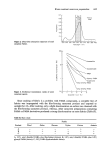
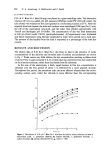
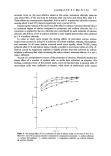
652 N. A. Armstrong, A. Bialkowska and J. Smith ELUTION STUDIES F.D. & C. Blue No 1 lake (50 mg) was placed in a glass centrifuge tube. The electrolyte solution (20 ml) was added, the pH measured (Phillips model PW 9418 pH meter), the tube closed with waterproof film and agitated in a horizontal position at 27øC. After the requisite time had elapsed, the tube and contents were centrifuged (3300 rpm) for 15 rain, the pH of the supernatant measured, and the latter then diluted appropriately with Teorell and Stenhagen pH 5.0 buffer. The concentration of dye was then determined at 628 nm (Cecil model CE272 spectrophotometer). All experiments were triplicated and blank experiments using the lake suspended in water were carried out in each case. The amount of dye leached from the lake is expressed as a percentage of the total dye present. RESULTS AND DISCUSSION The elution data of F.D. & C. Blue No 1 dye from its lake in the presence of molar concentrations of the chloride and bromide salts of sodium and potassium are shown in Fig. 1. Water causes very little elution, the dye concentration reaching a plateau level of about 0'3•o in approximately 6 h. It is likely that this represents free dye unadsorbed on the alumina substrate, rather than dye eluted from the substrate. In the case of the electrolytes, a fairly rapid increase in free dye concentration is obtained over the first period of about 1 h, followed by a more gradual increase. Throughout this period, the potassium salts are more effective eluents than the corres- ponding sodium salts, whilst the chloride is more effective than the corresponding I00 - 6O 4O 20 0 2 4 6 8 Time ( h ) Figure 1. The elution of F.D. & C. Blue No 1 dye from its lake by molar solutions of salts of monovalent acids. x, potassium chloride O, sodium chloride O, potassium bromide [], sodium bromide m, calcium chloride (0.5 M) ,, water (x 100).
Purchased for the exclusive use of nofirst nolast (unknown)
From: SCC Media Library & Resource Center (library.scconline.org)