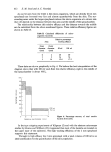
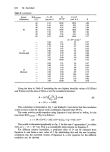
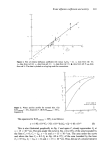
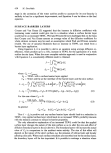
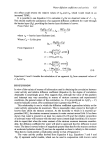
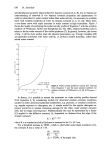
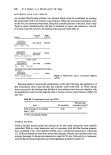
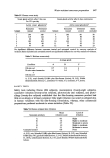
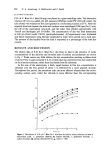
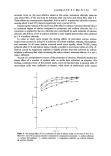
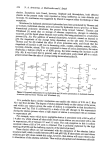
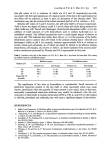
Leaching of F. D. & C. Blue No 1 dye 655 (the pH values of 0.5 M solutions of which are 12.2 and 3'1 respectively) are both associated with the rapid appearance of a large amount of the dye in the supernatant, but this effect will be acheived, at least in part, by disruption of the alumina itself. This mechanism may also be involved with sodium succinate (pH of a 0.5 M solution = 8.9). Between pH values of 3 and 9, however, the pH value itself is of minor importance. Table I shows the degree of elution at pH 4, 6 and 8, these pH values being achieved by either buffering with Teorell and Stenhagen citrate-borate-phosphate buffer, or by the addition of small amounts of •/10 hydrochloric acid or sodium hydroxide (i.e. an unbuffered system). The buffered suspensions show a much higher degree of elution at any given pH. This indicates that rather than pH per se, it is the presence of the buffer electrolytes used to achieve that pH which is the primary eluting factor. (Teorell and Stenhagen's buffer at pH 4 for example, contains approximately 0.06 M of sodium as borate, citrate and phosphate, all of which are stated by Mutch to be effective eluting electrolytes). pH changes, also shown in Table I, are those expected if the anionic pene- tration mechanism proposed by Thomas and Tai is appropriate in this case. Table I. Variation with pH of the elution of F.D. & C. Blue No 1 dye from its lake after 24 h, using (a) buffered and (b) unbuffered systems Original pH Buffered system Unbuffered system Elution (•o) pH change Elution (•o) pH change 4.0 98.4 4-1.35 4.4 4- 0'9 6.0 96.2 4-1.00 7.9 -0.85 8.0 94.0 +0.50 9.3 - 2.55 Water pH 7.0 -- -- 1.08 - 1.65 (control) The significance of this data in formulation is considerable. Small amounts of electrolyte impurities present in the dye itself or other associated solids may cause elution, particularly when the quantity of water present is also small, since in that case, reasonably concentrated electrolyte solutions may readily be achieved. Also the con- centration of electrolytes in human perspiration (0.03 M, 0'02 M, and 0.07 M with respect to chloride, phosphate and sulphate), may well cause a significant degree of dye elution. REFERENCES 1 Jaffe, J. and Lippmann, I. Inhibitory effect of gums and adsorbants upon the migration of F.D. & C. Blue No 1 in lactose. J. Pharm. $ci. 53 441 (1964). 2. Armstrong, N. A. and March, G. A. Quantitative assessment of surface mottling in colored tablets. J. Pharm. $ci. 63, 126 (1974). 3 Goodhart, F. W., Everhard, M. E. and Dickcius, D. A. Stability of certified dyes in tablets. J. Pharrn. $ci. 53 338 (1964). 4 Mutch, N. Dried alumina. Quart J. Pharrn. Pharrnacol. 19 490 (1946). 5 Thomas, A. W. and Whitehead, T. H. Ion interchanges in aluminium oxychloride hydrosols. J. Phys. Chern. 35 27 (1931). 6 Thomas, A. W. and Tai, A. P. The nature of aluminium oxide hydrosols. J. Am. Chern. Soc. 54 841 (1932). 7 Whitehead, T. H. The complex compound theory of colloidal oxides. Chern. Rev. 21 113 (1937). 8 Armstrong, N. A. and Clarke, C. D. The adsorption of crystal violet by kaolin. J. Pharrn. Pharrnacol. 23 955 (1971).

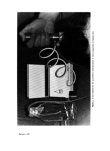
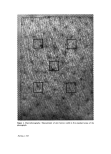
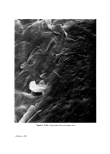
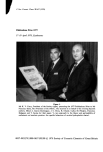
J. $oc. Cosmet. Chem. 29 657 (1978) Publications Prize 1977 17-19 April 1978, Eastbourne Figure 1. Mr K. V. Curry, President of the Society (right), presenting the 1977 Publications Prize to Mr Francisco Serra, Past President of the IFSCC, who received it on behalf of the winning Spanish authors, Messrs J. Garcia Dominguez, J. C. Parra, R. Infante, Carlos M. Pelejero, Francisco Balaguen and T. Sastue for their paper, 'A new approach to the theory and permeability of surfactants on keratinic proteins: the specific behaviour of certain hydrophobic chains'. 0037-9832/78/1000-0657 $02.00 ¸ 1978 Society of Cosmetic Chemists of Great Britain
Purchased for the exclusive use of nofirst nolast (unknown)
From: SCC Media Library & Resource Center (library.scconline.org)