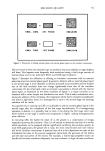
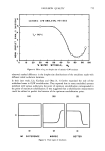
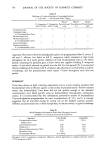
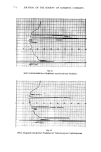
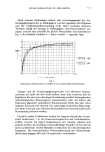
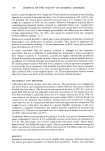
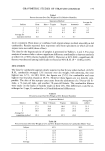
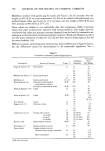
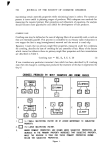
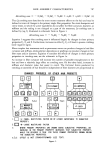
756 JOURNAL OF THE SOCIETY OF COSMETIC CHEMISTS When LEE is carried out for O/W emulsification in a high c• H region, the amount of the initial water in the emulsion concentrate will be relatively small. It is probable that at some point corresponding to a certain c•H value, the mechanism mentioned above will function most effectively, resulting in a formation of very fine emulsions. In summary, the effect of c• varies greatly depending on the emulsion system, but may be roughly classified into the three categories shown in Figure 9. The emulsion (A) shows little or no difference in the emulsion droplet size with respect to c•. Emulsion (B) becomes coarse at a certain c• value due to a phase inversion. In some systems such a degradation of the emulsion is not due to a phase inversion, but rather to the excessive viscosity build-up of the concentrate in high c• region making mixing and first-stage emulsification ineffective. Emulsion (C) illustrates a sharp improvement of emulsification in higher c• range. In some systems, optimum points were observed at a high c• value, which may be regarded as a variation of the type (C). CONCLUSIONS It has been demonstrated that LEE can be applied effectively in commercially processing a wide variety of emulsions. An investigation of the qualities of emulsions made by such a technique revealed that not only the initial emulsification temperature is an important factor, but also the amount of the diluting phase withheld and the extent of mixing. A proper control of these variables will enable one to process a desired emulsion by LEE with a definite economical advantage. The finding of a marked reduction of droplet size in high c• region opens an intriguing possibility of making a very fine emulsion with LEE while conserving a great deal of energy and reducing considerably the required processing time. REFERENCES (1) T.J. Lin, Process engineering for cosmetic emulsion, part III, semi-cold processing of emulsion, Amer. Perfum. Cosmet. 80, 35-9 (1965). (2) T.J. Lin, Low-energy emulsification, J. Soc. Cosmet. Chem., 29, 117-126 (1978). (3) T.J. Lin, H. Kurihara and H. Ohta, Effects of phase inversion and surfactant location on the formation of o/w emulsions, J. Soc. Cosmet. Chem., 26, 121-39 (1975). (4) T. J. Lin, H. Kurihara and H. Ohta, Prediction of optimum o/w emulsification via solubilization measurements, J. Soc. Cosmet. Chem., 28 457-79 (1977). (5) W. R. Markland, Aqueous solubilization and phase inversion in o/w emulsification, Norda BriejS, No. 480, April-May, 1977.

j. Soc. Cosmet. Chem., 29, 757-766 (December 1978) Imidazolidinyl urea activity against Pseudomonas PHILIP A. BERKE and WILLIAM E. ROSEN Sutton Laboratories, Inc., 459 East First Avenue, Roselle, NJ 07203. April I4, 1978. Presented at Annual Scientific Meeting, Society of Cosmetic Chemists, December I977, New York, New York. Synopsis Pseudomonas contamination of cosmetics is a major concern in the cosmetic industry because pseudomonads are so widely distributed in nature, so adaptable, and so resistant to most antimicrobials. Eleven ATCC-type pseudomonads, representing ones of concern for contaminating cosmetic products, and seventeen "wild" pseudomonads, isolated from a variety of contaminated cosmetic products, were screened and were found to differ in their vulnerability to IMIDAZOLIDINYL UREA • alone or in combination with parabens. Screening experiments were carried out to study variables such as incubation time, incubation temperature and pH with the purpose of learning how to design and interpret Pseudomonas screening experiments. Experimental data are presented contrasting inadequate or marginal preservation of cosmetic lotions and shampoos with adequate preservation of these products. It was found, for example, that the parabens alone provided inadequate protection AGAINST PSEUDOMONAS growth in several creams, lotions, and shampoos. Addition of Imidazolidinyl Urea to these formulations is shown to enhance the range of effectiveness and to give adequate protection against Pseudomonas contamination. INTRODUCTION Pseudomonas contamination of cosmetic products continues to be a serious problem in the cosmetic industry (1, 2). Essentially all types of water-containing products are vulnerable to this versatile, adaptable, sometimes pathogenic, gram-negative bacterium (3). Because its nutritional requirements are minimal (3), it often survives and multiplies under conditions where other microorganisms cannot. Even in distilled water, Pseudomonas has been reported to grow to counts of one million per ml or more (4, 5). Contamination with the single species Pseudomonas aeruginosa has alone accounted for numerous recalls of products from the market (6). Pseudomonads are difficult to avoid because they are widely distributed in water and soil (3) and are commonly found on the skin and on particles of dust in the air (6). The solution to the problem of Pseudomonas contamination of cosmetics is good manufacturing procedures plus the incorporation of an effective preservative system, but the choice of a preservative system is complicated by several factors: most commonly used preservatives are not effective against Pseudomonas preservatives are frequently inactivated by other •GERMALL 115, registered trademark of Sutton Laboratories, Inc., Roselie, NJ 07203. 757
Purchased for the exclusive use of nofirst nolast (unknown)
From: SCC Media Library & Resource Center (library.scconline.org)