778 JOURNAL OF THE SOCIETY OF COSMETIC CHEMISTS protein cannot be ignored (8-9). Singer and Vinson showed a decrease in water binding capacity in corneum of neonatal rats after 17 hr of water immersion (10). At 93% rela- tive humidity they found water immersed corneum had a 47% increase over its dry weight as compared to 60% for the control. However Scheuplein reported that in comparing heat-separated stratum corneum to cantharidin blister tops, "neither tech- nique measurably damages the membrane. Some protein denaturation and dissolution must indeed occur but if this changed permeability, the differences are within the average experimental error, viz 20%, and cannot be isolated from the variations between different samples." (11) Polano et al. studied the effect of heat plus trypsin preparation of stratum corneum by measuring in vitro penetration of methyl nicotinate. They found no significant dif- ference in penetration utilizing 1-16 min immersions in 60øC water and concentra- tions of trypsin up to 0.1% (12). It seems reasonable that the stratum corneum is damaged by the separation procedures but due to difficulty in quantifying the denaturation, many investigators have chosen to ignore it. A sensitive, accurate and highly reproducible gravimetric method for studying the uptake of water vapor by stratum corneum samples from at- mospheres of controlled humidity and temperature has recently been developed (13). By studying hygroscopicity with this device, stratum corneum specimens prepared by several of the more commonly used methods described above have been compared. Anderson, Cassidy, Hansen et al. have recently shown that in vivo evaluation of dry skin correlates with in vitro hygroscopicity (14). Thus hygroscopicity seems a reason- able way to assess one factor in the normaIcy of stratum corneum samples. MATERIALS AND METHODS Abdominal skin from autopsy cases was collected. The specimens were refrigerated, but never frozen, until separation procedures could be effected. Each piece of skin was divided into four pieces. The first piece was separated by heat at 56øC for 3 min in a water bath. The second was separated as the first, then placed in 3% trypsin for 24.hr. The third was floated, epidermis down, in a 3% trypsin solution for 24 hr. (The 3% concentration was chosen to maximize any trypsin related effect.) And the fourth was removed by the ammonia fume method. All specimens were stored over a disiccant until ready for use. A 4-mm punch was taken from each specimen for comparison. The weight of each 4-mm piece was taken in a special chamber containing a Cahn elec- trobalance, controlled temperature and relative humidity regulated by saturated salt solutions (13). The per cent increased over dry weight of each sample was noted at 62 and 90% relative humidity and 20øC. Cantharidin blisters were prepared by placing a 2-cm by 2-cm piece of moistened filter paper containing 0.5 mL of a 0.2% cantharidin solution on the backs of volunteers for 3-4 hr. The filter paper was covered sequentially with Saran wrap © , Mystic tape © , Reston foam © and finally Micropore tape ©. After removing the occlusive dressing, the blister was allowed to fill overnight before removal of the top. Blister tops were stored over a desiccant and measurements were taken as above. RESULTS Separation techniques proved to be more variable than reported. Ammonia fumes did not always give good separation of dermis from epidermis. Trypsin was somewhat

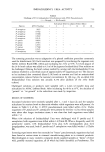
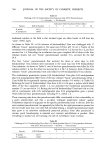
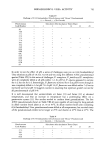
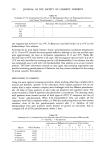
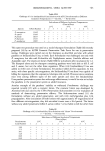
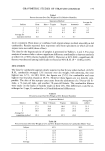
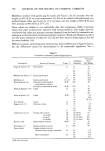
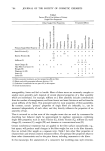
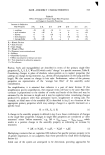
GRAVIMETRIC STUDIES OF STRATUM CORNEUM 779 Table I Percent Increase Over Dry Weight at 62% Relative Humidity Separation Method Subject Heat Heat + Trypsin Trypsin Ammonia Average for subject 1 5.4 5.4 4.8 4.95 2 4.6 2.3 4.2 6.9 3 8.1 10.0 8.1 8.3 Average for separation method 6.0 5.9 5.7 6.7 5.1 4.5 8.6 more consistent. Heat alone or combined with trypsin always worked smoothly as did cantharidin. Results reported here represent only those specimens in which all tech- niques were successful (three of five). The data for the hygroscopicity of samples is presented in Tables 1, 2 and 3. Two-way analysis of varience fails to show a significant difference attributable to harvest methods at either 62 or 90% relative humidity (R.H.). However at 62% R.H. a significant dif- ference was detected among individuals not found at 90% R.H. (F = 10.06 p 0.05). DISCUSSION The data for cantharidin appears clearly superior to that for any other method. At 62% R.H., cantharidin averaged 12% increase over dry weight with ammonia, the next highest was 6.7%. At 90% R.H., the figures are 35.5% for cantharidin and next highest was heat plus trypsin at 28.5%. However these figures are not directly com- parable. The skin of the autopsy cases came from the abdomens of a 70-year-old fe- male, a 72-year-old male, and another 70-year-old female. The cantharidin blisters were made on the backs of healthy males in their 20's. The differences could be at- tributged to 1) age, 2) cantharidin or 3) back/abdominal differences. Table II Percent Increase Over Dry Weight at 90% Relative Humidity Separation Method Average for Subject Heat Heat + Trypsin Trypsin Ammonia subject 1 17.5 21.9 18.0 27.3 2 21.9 28.5 26.0 25.2 3 18.0 35.0 23.6 20.4 Average for separation method 19.1 28.5 22.5 24.3 21.2 25.4 24.2 Table III Percent Increase Over Dry Weight at 62% and 90% Relative Humidity by Cantharidin Blister Tops Subject 62 % 90% 1 12.8 36.3 2 10.9 41.3 3 11.5 36.2 4 12.1 31.3 5 12.5 32.6 Ave rage 12.0 35.5
Purchased for the exclusive use of nofirst nolast (unknown)
From: SCC Media Library & Resource Center (library.scconline.org)