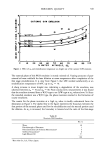
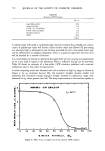
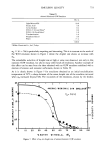
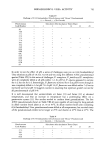
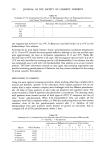
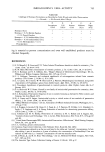
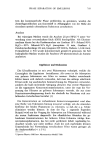
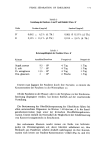
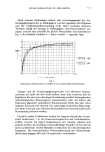
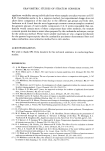
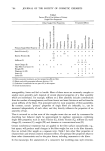
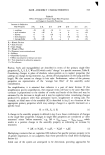
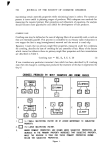
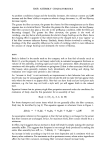
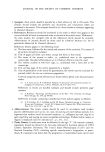
752 JOURNAL OF THE SOCIETY OF COSMETIC CHEMISTS Table III Nonionic O/W Emulsion Wt. % Light Mineral Oil 10.0 Stearyl Alcohol 3.0 P.O.E. (5.5) Cetyl Ether 1.2 P.O.E. (10) Cetyl Ether 2.0 Propylene Glycol 5.0 Water 78.8 100.0 A turbine mixer will handle a moderately high viscosity emulsion but probably not a heavy cream. A paddle-type mixer will handle a fairly viscous cream and allows LEE processing at a relatively high oz, although the rate of shear provided by such a low-speed mixer may not be sufficient for an adequate dispersion. Thus, in a practical operation, the limit of oz will be decided by a number of factors. It is, nevertheless, of interest to determine the upper limit of oz by carrying out experiments up to a very high oz region in the laboratory where a sufficient mixing can be provided. Table III shows an example of a low-solids, O/W emulsion stabilized with nonionic surfactants used in this series of experiments. A rather surprising result was obtained with this emulsion at high oz H range as shown in Figure 6. As ozH increased beyond 50%, the emulsion droplets became smaller and extremely fine emulsions having averaged droplet diameter in submicron range were obtained for oz• values greater than 70%. The sharp improvement in the emulsion quality at z o o z o o I I I I [ I I I I' NONIONIC O/W EMULSION - ß , • , , I , i •'0""--.-0-0 I0 20 :50 40 50 60 7'0 80 90 O0 % WATER WITHHELD, O• H Figure 6. Effect of o• H on droplet size of the nonionic O/W emulsion

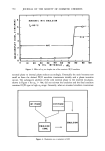
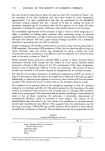
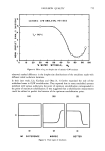
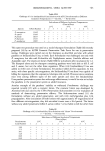
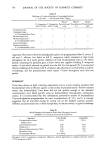
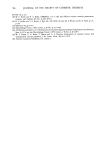
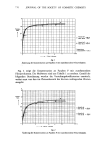
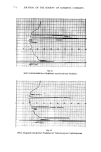
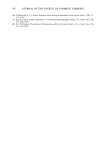
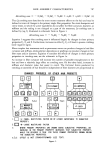
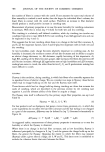
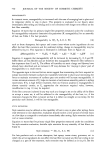
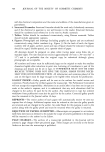
EMULSION QUALITY 753 Table IV Anionic/Nonionic O/W Emulsion Wt. % Light Mineral Oil 10.0 Stearic Acid 5.0 Cetyl Alcohol 0.2 P.O.E. (5.5) Cetyl Ether a 0.6 P.O.E. (10) Cetyl Ether a 1.0 Triethanolamine 1.0 Propylene Glycol 5.0 Water 77.2 100.0 Nikko Chemicals Co., Ltd., Tokyo. all -- 50 "-- 70% is particularly surprising and interesting. This is in contrast to the result of the W/O emulsion shown in Figure 3 where the droplet size shows an increase with •O' The remarkable reduction of droplet size at high a value was observed, not only in this nonionic O/W emulsion, but also in many other kinds of emulsions. Another example of this effect can be seen from the data obtained with an O/W emulsion stabilized with a mixture of anionic and nonionic surfactants, shown in Table IV. As it is clearly shown in Figure 7 for emulsions obtained at an initial emulsification temperature of 70øC, a sharp decrease of the mean droplet size of the emulsion occurred when a. increased beyond 50%. The viscosities of the emulsions, shown by the broken Zõ [ • ] [ ] I [ ] ' NIC/NONIONI•O/300•-'EMULSIøC70T. .......... .. % % o z 0.5 I 20,-, o o i o 20 30 40 50 60 70 80 90 o ioo % WATER WITHHELD, •1• H Figure 7. Effect of a u on droplet size of anionic/nonionic O/W emulsion
Purchased for the exclusive use of nofirst nolast (unknown)
From: SCC Media Library & Resource Center (library.scconline.org)