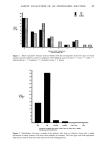
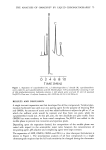
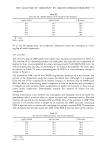
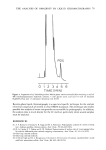
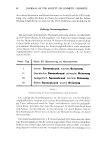
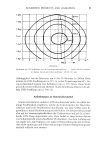
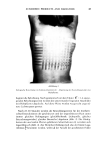
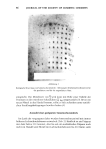
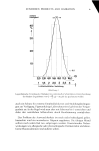
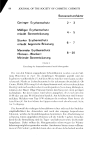
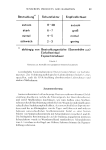
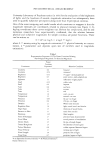
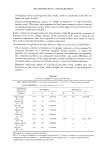
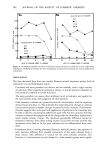
THE ANALYSIS OF OMADINE © BY LIQUID CHROMATOGRAPHY 77 Table III Recovery Of 2-Pyridinesulfonic Acid 1-Oxide In Clear Shampoo mg/kg Added mg/kg Found % Recovery 68.4 68.9 100.8 58.7 59.2 100.9 58.9 58.4 99.2 58,8 58.3 99.1 58,6 58.9 100,5 57.4 56.7 98.8 X = 99.9 RSD = 0.95% IV at the 60 mg/kg level, are unaffected. Detection limits are estimated at a few mg/kg of both compounds. 2MP AND PDS The recovery data of 2MP spiked into blank clear shampoo are presented in Table V. The analysis of 2,2'-dithiobis-pyridine, the least polar and thus the last component of interest to elute, is accomplished by using a stronger eluent (50:50 MeCN/H20, etc.) to reduce analysis time and also, by decreasing k', to enhance detectability. Recovery data are shown in Table VI, and a chromatogram of PDS in a clear shampoo sample is shown in Figure 2. The analysis of OM, one of the OMDS degradation products of most interest, has proven to be impractical using the system described here. Although it is separated from the rest of the compounds of interest, having a k' between that of OMSA and PSA, its ability to form strong metal complexes, its ease of oxidation and its tendency to adsorb on solid surfaces makes quantitation at higher levels erratic at best and, at lower levels, impractical. Polarography remains the method of choice for this compound. Several interactions occur between the mercaptans and disulfides which are cause for precautions which must be taken to assure accurate and consistent results. The first reaction of concern occurs between OM and PDS. One of the products is 2MP. This reaction is of concern when a sample to be analyzed for 2MP, and also containing OM, is injected onto a column still containing the strongly retained PDS. The reaction will obviously lead to high results for 2MP, if the PDS is near the head of the column. Table IV Recovery Of 2-Pyridinesulfonic Acid In Clear Shampoo mg/kg Added mg/kg Found % Recovery 66.8 66.8 100.0 57.4 56.3 98.2 57.6 56.5 98.1 57.4 57.9 100.9 57.3 58.3 101.8 56,0 56.0 100.0 x = 99.8 RSD = 1.47%

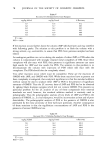
78 JOURNAL OF THE SOCIETY OF COSMETIC CHEMISTS Table V Recovery Of 2-Pyridinethiol In Clear Shampoo mg/kg Added mg/kg Found % Recovery 53.7 52.8 97.2 54.5 53.7 98.5 56.5 56.2 99.5 53.3 52.5 98.5 53.6 52.8 98.6 53.3 53.0 99.4 x = 98.6 RSD = 0.83% If the reaction occurs further down the column 2MP will elute later and may interfere with following peaks. The solution to this problem is to flush the column with a strong solvent, e.g., acetonitrile, to assure that PDS from previous samples has been eluted. An analogous problem can occur during the analysis of either 2MP or PDS when the column is contaminated with strongly retained metal complexes of OM. Since these complexes will also react with PDS, their presence in significant amounts can cause high results for 2MP and low results for PDS. The solution to this problem is to decontaminate the column with injections of PDS which will react with the complexes. The PDS should then be completely eluted. Two other reactions occur which must be considered. These are the reactions of OMDS with 2MP, and OMDS with PDS. While these reactions have at present not been completely investigated, their analytical significance is that the standard addition method cannot be used to analyze either 2MP or PDS in the presence of significant amounts of OMDS. Thus the LC recovery data of 2MP and PDS had to be obtained by spiking blank shampoo samples which did not contain OMDS. This presents no particular problem for the LC analysis of any of these compounds since external standards are used however, the standard addition method is routinely used in polarography. Thus the polarographic analysis of low levels of 2MP and PDS in the presence of OMDS, i.e., in clear shampoos, would be inconvenient at best and of poor detectability. The polarographic analysis of PDS in the presence of OMDS is also precluded by the close proximity of their half-wave potentials. Another consequence of these reactions is that the equilibrium concentrations of 2MP and PDS in the presence of excess OMDS are low. Table VI Recovery Of 2,2'-Dithiobis-Pyridine In Clear Shampoo mg/kg Added mg/kg Found % Recovery 59.1 60.2 101.8 51.7 52.0 100.5 52.0 52.0 100.0 51.8 52.4 101.2 51.9 52.6 101.4 52.0 52,7 101.4 X = 101.1 RSD = 0.67%
Purchased for the exclusive use of nofirst nolast (unknown)
From: SCC Media Library & Resource Center (library.scconline.org)