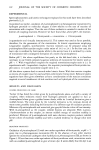
BENZENE DERIVATIVES IN OXIDATIVE HAIR DYEING 193 NH • -I-- 2 Fe(CN)63- --• 0 ],/N H 3,,• N H2 HO I. 4- -'1"' 2 Fe(CN) 6 O III IV i +1 ii oxidn H 0 ,j•• NH-•O'•• .,•OH v Figure 1. Oxidation ofp-amino-phenol. analogue of Bandrowski's base (5). It is formed by self-coupling to give (IV) which reacts with a further molecule of the monoimine to give a product which, on oxidation, gives the trinuclear compound (V). The structural assignment is supported by the observation that hydrolysis of the dye in acid gives a mixture of 2,5- dihydroxybenzoquinone and p-aminophenol. The mass spectrum gives m/e at 323, which we believe to be an M q- 2 peak such as is commonly found with quinonoid compounds (5), including Bandrowski's base (7), and is believed to result from reduction of the quinonoid ring in the heated inlet system of the mass spectrometer. Elemental analysis (C -- 63.2 H = 4.8 O = 19.0 N = 12.3%) is consistent with the formula C•8H•sN303 ß H20 i.e., the hydrate of (V). The n.m.r. spectrum (Table I) is consistent with the structure (V). Table I n.m.r. Spectrum of the Trinuclear Compound (V) r No. of H Assignment 0.07 2 OH (benz.) 2.82 2.92 8 CH (benz.) 3.15 (J = 8 cps) 3.28 3.30 ] 4.05 4.502 6.70 2 NH2 (quin.) 1 CH (quin.) 1 CH (quin.) 1 OH (quin.) ]Ortho to amino group. 2Ortho to hydroxy group.

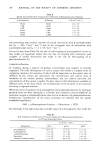
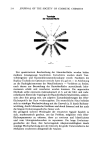
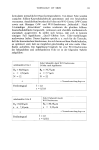
194 JOURNAL OF THE SOCIETY OF COSMETIC CHEMISTS .055 Figure 2. Formation of indophenols. Reaction of p-aminophenols with monohydric phenols under oxidative conditions (8) produces indophenols, as shown in Figure 2. Many of these dyes have been isolated and fully characterized (8). When a mixture of p-aminophenol and resorcinol is oxidized at high pH, an intense blue color develops. By analogy with indophenols, this is believed to be due to the formation of 2-hydroxyindophenol (VI). Attempts to isolate such products have been unsuccessful due to their poor stability. HO HO VI Reaction ofp-aminophenols with m-aminophenol involved oxidative coupling para to the hydroxy group to give 2-aminoindophenols (VII, R = H). Attempts to isolate the parent compound have been unsuccessful. However the products from oxidative coupling of p-aminophenols with 4-amino-2-hydroxytoluene (VII, R = Me) are easily isolated and have been used to establish the identity of this class of dyes. Acid hydrolysis of the dye (VII, R = Me) gives a mixture of p-aminophenol and 2-amino-5-methyl-p-benzoquinone. Elemental analysis (C = 68.4 H = 5.4 N = 12.1%) is consistent with structure (VII, R = Me), as is the n.m.r. spectrum (Table II). Table II n.m.r. Spectrum of 2-Amino-5-Methylindophenol No. of H. Assignment 0.02 ! OH (benz.) 3.12 4 CH (benz.) 3.27 ! CH (quin.) 3.30 2 NH 2 (quin.) 4.40 ! CH (quin.) • 8.20 3 CH 3 •Ortho to NH2 group.
Purchased for the exclusive use of nofirst nolast (unknown)
From: SCC Media Library & Resource Center (library.scconline.org)