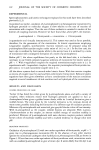
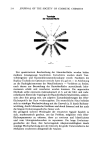
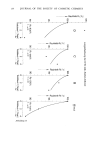
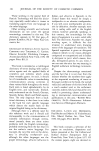
BENZENE DERIVATIVES IN OXIDATIVE HAIR DYEING 207 IH + (I x) + 02 - H20 2 H•N XVI Figure 7. Decomposition of 2-aminoindophenols. xv reveal any characteristic features. Apparently, cyclization and hydrolytic fission occur slowly, but the products decompose as they are formed. Table XlII gives rate data for the cyclization and hydrolytic fission of some 2-aminoindophenols. For the cyclization reaction the specific first-order constant k c is expressed as kobs = kc oz where kob s is the measured rate constant, and oz is the fraction of indophenol present as the anion at the pH to which kob s pertains. From the table it can be seen that chloro Table XlII Rates of Cyclization and Hydrolytic Fission of 2-Aminoin_dophenols Indophenol 104kc(s (79øC) kh (J• mol -• rain -1) (30øC) Parent 3-chloro 3-methyl 3'-chloro 3'-methyl 3'-methyl-3-chloro 3-methyl-3'-chloro 2.57 7.27 0.55 1.50 7.00 15.3 0.54 0.039 -- -- __ --

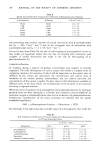
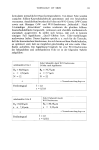
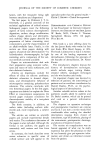
208 JOURNAL OF THE SOCIETY OF COSMETIC CHEMISTS A I 1 7 11 pl'-I Figure 8. Variation with pH of the rate of reaction of dye (XX, R=H, X=Me) in aqueous solution at 30 ø . The circles represent the experimental points and the solid line the overall rate calculated from the theoretical equation. Broken lines represent contributions to the total rate from A-acid hydrolysis, P-cyclization to the phenazine and H-alkaline hydrolysis. substitution of the quinonoid ring and methyl substitution of the benzenoid ring facilitate cyclization and vice versa. This is in accord with the proposed mechanism for the cyclization involving electrophylic attack of the imino-nitrogen of the ortho- quinonoid form of (XlII) on the benzenoid carbon ortho to the azine bridge. The products of oxidative coupling of p-aminophenols and m-phenylenediamines are
Purchased for the exclusive use of nofirst nolast (unknown)
From: SCC Media Library & Resource Center (library.scconline.org)