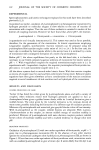
BENZENE DERIVATIVES IN OXIDATIVE HAIR DYEING 195 It is quite possible that in reactions with m-aminophenol, a tri-nuclear dye such as (VIII) is produced. This would account for the drabber colors produced from mixtures ofp-aminophenol and m-aminophenol. The product from oxidation of a mixture ofp-aminophenol and m-phenylenediamine was first isolated by Ullmann and Gnaedinger (9) and was assigned structure (IX). This has been confirmed by unambiguous synthesis by reaction of p-aminophenol with 2,4-dinitrochlorobenzene, reduction of the resulting diphenylamine and oxidation of the product (9) and by the cyclization of the indo-dye (IX) to 2-amino-8-hydroxyphen- azine. SPECTRAL PROPERTIES OF INDO-DYES The colors produced on hair by various p-aminophenol/coupler combinations have been mentioned above and it is pertinent at this point to consider their visible spectra and the effects of pH thereon. Table III gives spectral data for a variety of indophenols formed by coupling p-aminophenol with monohydric phenols. Above pH 9 the dyes exist in solution as the blue anionic form. At lower pH values the solutions become red as the neutral form becomes the predominant species. The color produced on hair is reddish indicating Table III Spectra of Simple Indophenols •kma x (log Anion Neutral Indophenol 637 (4.50) 496 (3.83) 3-methyl 622 (4.38) 485 (3.92) 2-methyl 640 (4.40) 501 (3.83) 3,3'-dimethyl 648 (4.52) 495 (3.97) 3'-chloro 630 (4.45) 504 (3.91) 2'-chloro 630 (4.35) 501 (3.76) 2',3,6'-trichloro 654 (4.35) 513 (3.84) 2,3-benzo 588 (4.33) 480 (4.09)

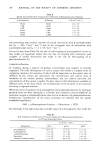
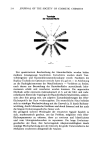
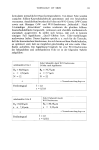
196 JOURNAL OF THE SOCIETY OF COSMETIC CHEMISTS the dye to be in the neutral form. The effect of methyl and chloro substituents on the spectrum of indophenol has been studied (8) and it has been shown that an indophenol with a single methyl group exists as the tautomer in which the methyl group is on the quinonoid ring and produces a shift of between +4 and -34 nm. If a second methyl group is introduced on the same ring its effect is similar and additive. However if it is introduced into the unsubstituted ring its effect is to produce a large shift (+12 to + 48 nm) to longer wavelengths. Chloro substituents have an opposite effect to methyl groups. It is noteworthy that the indophenol formed from 1-naphthol absorbs at shorter wavelengths than that formed from phenol. Table IV gives spectral data for a number of 2-aminoindophenols formed from Table IV Spectra of 2-Aminoindophenols X max (log Anion Cation Indophenol 637 (4.50) 496 (3.83) 2-amino 574 (4.23) 470 (3.92) 2-arnino-5-rnethyl 555 (4.21) 462 (3.92) 2-arnino-3'-rnethyl 605 (4.25) 482 (3.90) 2-amino-2'-methyl 600 (4.11) 480 (3.85) 2-amino-3'-chloro 558 (4.19) 468 (3.84) 2-amino-5-chloro 585 (4.27) 475 (3.91) coupling p-aminophenols with m-aminophenols. By comparison with the spectra of indophenol itself it can be seen that the introduction of the 2-amino group results in an hypsochromic shift of 63 nm for the anion and 26 nm for the neutral species. As with indophenols, introduction of a methyl group into the quinonoid ring or a chloro into the benzenoid ring of 2-aminoindophenol results in an hypsochromic shift, while a methyl on the benzenoid ring or a chloro on the quinoid ring produces a bathochromic effect. The products of oxidative coupling of p-aminophenols and m-diamines exist in the tautomeric form (IX) in which the hydroxy bearing ring is benzenoid. There is no unsubstituted analogue of this since simple indoanilines exist in the alternative tautomeric form. In solution the N'-(p-hydroxyphenyl)-2-aminobenzoquinone di- imines exist as a red anion at pH 11.5, a blue zwitterion (X) between pH 8 and pH 11.5 and a red cation below pH 8. The color on hair suggests that the dye is in the cationic form in hair. Spectral data for some derivatives of the di-imine (IX) are given in Table V. N 0 H2 NH 2 At pH 9 the hydroxyindophenols, formed by oxidative coupling ofp-aminophenols and resorcinols, exist as dianions. Below pH 9 the monoanion is the major species.
Purchased for the exclusive use of nofirst nolast (unknown)
From: SCC Media Library & Resource Center (library.scconline.org)