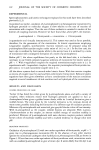
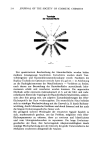
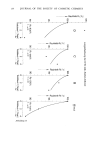
TRANSEPIDERMAL MOISTURE LOSS 183 with deionized water and the other side is in contact with the air stream. The film is allowed to come to equilibrium with a 0% RH. The dew point of the air stream is monitored and the trans film moisture loss rate (TFML) is determined by calculating the rate at which water appears in the air stream as mg of water/cm2/hr. If desired, the relative humidity of the gas stream can be varied and the TFML determined for any % RH. The base rate for the film is designated as TFML-B. The product to be evaluated is loaded onto the surface area of the polymeric film on the side exposed to the air stream. A weight (W) in grams is coated onto the cell area (A) to give a product thickness (on a whole product basis) of 0.025 mm according to equation (1). 0.025 mm -- W x 10 (1) Where W = Weight in grams 10 = 10 mm/cm A = Area in cm 2 G = Specific gravity in g/cm 3 AxG The sample is then allowed to come to equilibrium with the specified air stream and the trans film moisture loss rate (TFML-S) of the sample is determined. 2.5 2.0 1.5 1.0 0.5 0 10 20 30 40 50 60 70 80 90 100 % RELATIVE HUMIDITY Figure 2. The Trans Film Moisture Loss rate (TFML) for three samples of the experimental polymeric substrate. Beginning (&), middle (©), and end (I) of roll.

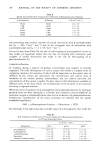
184 JOURNAL OF THE SOCIETY OF COSMETIC CHEMISTS The percentage of reduction in TFML is then given by equation (2). Percentage of reduction in TFML = [(TFML-B) -- (TFML-S)] x 100 (TFML-B) Where (TFML-B) the trans film moisture loss of the polymeric film (TFML-S) the trans film moisture loss of the product and polymeric film (2) 2.5 2.0 1.5 1.0 27 r=0.79 t • i | 28 29 30 31 TEMPERATURE øC A, 0% RH 2.5 ß ß 2.0 * 1.5 1.0 27 r=0.75 I I I I 28 29 30 31 TEMPERATURE øC B, 20% RH Figure 3. The effect of temperature on the Trans Film Moisture Loss rate A. at 0% relative humidity and B. at 20% relative humidity. r = correlation coefficient.
Purchased for the exclusive use of nofirst nolast (unknown)
From: SCC Media Library & Resource Center (library.scconline.org)