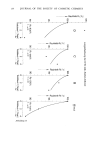
BENZENE DERIVATIVES IN OXIDATIVE HAIR DYEING 211 These results show that the inclusion ofp-aminophenols in oxidation dye formulations contributes significantly to the color produced on hair and the resultant dyes have comparable stability to those formed from p-phenylenediamine. REFERENCES (1) j. F. Corbett, The role of meta difunctional benzene derivatives in oxidative hair dyeing. I Reaction with p-diamines,J. Soc. Cosmet. Chem., 24, 103-134 (1973). (2) J. F. Corbett, Benzoquinone imines, part I,j. Chem. Soc., B, 1%9, 207-212. (3) J. F. Cotbert, Intermediates and products in oxidative hair dyeing, Proc. Joint Conf Cosmet. Sci., Washington, D.C., 159-178 (1%8). (4) H. H. Tucker, Hair coloring with oxidation dye intermediates, J. Soc. Cosmet. Chem., 18, 609-628 (1%7). (5) J. F. Corbett, Benzoquinone imines. III The structure of Bandrowski's Base, J. Soc. Dyers and Colourists, 85, 71-73 (1%9). (6) R. T. Aplin and W. T. Pike, Mass spectra of 1,4-dihydroxybenzenes and p-benzoquinones, Chem. and Ind., 48, 2009 (1966). (7) K. C. Brown, Unpublished data. (8) J. F. Corbett, Benzoquinone imines. VIII,J. Chera. $oc. B, 1502-1509 (1970). (9) F. Ullmann andJ. Gnaedinger, Indamines, Bet., 45, 3437 (1912). (10) J. F. Corbett, Benzoquinone imines. V,J. Chera. $oc., B, 823-835 (1%9). (11) J. F. Corbett, Benzoquinone imines II, Ibid., 213-216 (1%9). (12) J. F. Corbett, Benzoquinone imines VII, Ibid., 1418-1427 (1970). (13) K. C. Brown and j. F. Cotbert, Benzoquinone imines XVI, In press. (14) K. C. Brown andJ. F. Corbett, Benzoquinone imines XIII,J. Cbera. $oc., Perkin II 1125-1131 (1977).

J. $oc. Cosmet. Chem., 30, 213-239 (July/August 1979) Topologie der Hautoberflache UDO HOPPE' Synopsis • A mathematical and statistical description of the relief structure of b. pman stratum comeum requires a large number of measurements. In order to generate such•,O,ata and on the basis of previously describedprocedures, a semi-automatic apparatus was developed which permitted quantitative estimation of changes in the structure of stratum comeurn. The following parameters were derived: 1. signal inversion and analog/,&'gital conversion for roughness measurements 2. radial measurements { 12 at 3,0•i•mtervals} an a circular skm surface replica of silicone rubber 3. transformation of all machine generated data points, storage, and sorting of data 4. analysis of the frequency distribution of the data and occasional graphical representation 5. determination of significance of the available distribution functions and analysis of variance 6. superposition of "not-significantly different" frequency distributions as well as mathe- matical/statistical evaluation and descnption of sigrd[icantly different data. Data on swelling by externally applied agents and a correlation with effects due to age are also presented. Genaia besehn Wq.nn mati das zierlichste N/ischen Von seine? liebsten Braut Dutch em Vergr/3tgerungsgliischen N'fiher beschaut, Dann zeigen sich haarige Berge, Datg einem graut. Joachim Ringelnatz In der makroskopischen Welt hat es sich schon lange eingebiirger•, bei der genauen Beschreibung dreidimensionaler Strukturen [z. B. bei • einem Strukturvergleich der Alpen reit dem Schwarzwald} topologische und topographische Verfahren mitemander zu verknfipfen. Die Topologie beschreibt die Lage und Anordnung geornetrischer Gebilde im Raum und die Topographie gibt eine genaue {in der Regel zweidimensionale} Lagebeschreibung einzelner Organe zueinander wieder. * Beiersdod AG, Forschung und Entwicklung cosreed, Unnastr. 48, 2000 Hamburg20 Nach einem Vortrag, gehalten auf dem Symposium: Das Stratum comeum/Struktur und Funktion {Freie Universit•it Berlin} 3. und 4. Dezember 1976 213
Purchased for the exclusive use of nofirst nolast (unknown)
From: SCC Media Library & Resource Center (library.scconline.org)