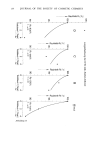
TRANSEPIDERMAL MOISTURE LOSS 189 lOO 80 I:J 60 c -I o :• 4o l • 2o o ro=0.90 Go =0.97 -20 -20 0 20 40 60 80 100 % REDUCTION IN VlVO Figure 7. The per cent reduction determined at 0% RH (©) and 20% RH (&) in vitro as a function of the percent reduction determined at 0% RH in vivo. R = correlation coefficient. CONCLUSIONS We have described an in vitro method for evaluating the occlusivity of materials, and have shown its temperature and relative humidity dependency. In our hands, this has proved to be a useful screening tool to be used before attempting in vivo experimenta- tion with a product. The method appears to correlate well with in vivo studies results suggest, however, that moving the in vivo test site to a true dry skin site such as the hand could be advantageous in evaluating the real occlusive potential of products and materials. We have also shown that products can respond differently under the influence of different relative humidities. REFERENCES (1) G. R. Berube and M. Berdick, Transepidermal moisture loss. II. The significance of the use thickness of topical substances. J. Soc. Cosmet. Chem., 25,397-406 (1974). (2) D. Spruit and K. E. Malten, Water vapour loss and skin barrier. An evaluation of some new findings, Trans. St. John's Hosp. Dermatol. Soc., 57 167-176 (1971). (3) D. Spruit and H. E. Herweyer, The ability of the skin to change its insensible perspiration, Dermatologica, 134, 364-70 (1967). (4) K. A. Grice, H. Sattar, M. Sharratt and H. Baker, Skin temperature and transepidermal water loss,J. Invest. Dermat., 57, 108-110 (1971).

190 JOURNAL OF THE SOCIETY OF COSMETIC CHEMISTS (5) A. B. Goodman and A. V. Wolf, Insensible water loss from human skin as a function of ambient vapor concentration, J. Applied Physiology, 26, 203-7 (1969). (6) D. Spruit and K. E. Malten, Humidity of the air and water vapour loss of the skin. the changing permeability, Dermatologica, 138, 418-26 (1969). (7) K. Grice, H. Sattar and H. Baker, The effect of ambient humidity on transepidermal water loss, J. Invest. Dermatol., 58, 343-6 (1972). (8) T. Higuchi and A. Aguir, A study of permeability to water vapor of fats, waxes, and other enteric coating materials,J. Am. Pharm. Assoc., 48, 574-83 (1959). (9) M. M. Rieger and D. E. Deem, Skin moisturizers. I. Methods for measuring water regain, mechanical properties, and transepidermal moisture loss of stratum corneum, J. $oc. Cosmet. Chem., 25, 239-52 (1974). (10) R. M. Handjani-Vita, B. Randot and F. LaChampt, Measurement of the moisturizing effect, Cosmet. and Toilet., 91, 25, 26, 28, 30 (November, 1976). (11) G. R. Berube, M. Messinger and M. Berdick, Measurement in vivo of transepidermal moisture loss,J. $oc. Cosmet. Chem., 22, 361-8 (1971). (12) H. Baker and A.M. Kligman, Measurement of transepidermal water loss by electrical hygrometry, Arch. Dermat., 96, 441-52 (1967). (13) F. Tranner and G. Berube, Mineral oil and petrolatum: reliable moisturizers, Cosmet. and Toilet., 93, 81-82, (March 1978).
Purchased for the exclusive use of nofirst nolast (unknown)
From: SCC Media Library & Resource Center (library.scconline.org)