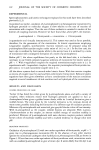
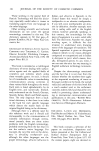
TRANSEPIDERMAL MOISTURE LOSS 187 We have long felt that 0% RH, which was originally a limitation in our in vivo and in vitro experiments, was an unrealistic condition. While relative humidity can be low in the winter, it generally does not achieve 0%. We have recently concluded that confining our experiments to 20% RH is expeditious and more representative of occlusivity under general winter-dry conditions we have, however, chosen for the purpose of this paper to show results at 0% and 20% RH to illustrate differences in performances due to changes in relative humidity. Table I shows the results achieved for USP Petrolatum, creams, lotions and raw materials. We have found the reproduci- bility of this method to be + 4% reduction. THE EFFECT OF RELATIVE HUMIDITY ON THE % REDUCTION OF PRODUCTS AND RAW MATERIALS Figure 6 shows a scattergram of the percentage of reduction at 20% RH plotted vs. the percentage of reduction at 0% RH for many of the samples which we have evaluated in our laboratories. The diagonal line is the "no effect line" or the points where the per- centage of reduction in TFML at 0% RH and 20% RH are equal. Most samples fall above Table I The Percentage of Reduction in Trans Film Moisture Loss Rate (TFML) for Several Products and Raw Materials at 0% RH and 20% RH Reduction 0% RH 20% RH USP Petrolatum, Brand A Cream • A B C D E F Lotion 2 A B C D E F Mineral Oil (Heavy) Mineral Oil (Light) Lanolin Turtle Oil Lanolin Oil Avocado Oil Sweet Almond Oil Safflower Oil Isopropyl palmitate Glycerin, anhydrous Brand B Brand C 99 98 99 98 96 98 29 38 19 9 38 57 3 41 7 21 0 12 15 26 -3 9 11 6 -5 7 17 28 30 31 23 29 76 83 34 38 42 31 39 59 31 37 12 17 --9 7 -- 26 -- 19 •Creams are emollient creams which are commercially available. 2Lotions are oil-in-water emollient lotions which are commercially available.

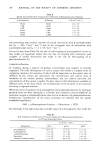
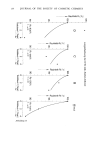
188 JOURNAL OF THE SOCIETY OF COSMETIC CHEMISTS O O 'r lOO 90 80 70 60 50 40 30 20 lO o -lO -2o -30 -30 -20 -10 ß ß ß ß ß ß ß ***** , / * * ! I I I I I [ I I ! I I i 0 10 20 30 40 50 60 70 80 90 100 % REDUCTION AT 0% RH Figure 6. A scattergram of per cent reduction in Trans Film Moisture Loss rate at 20% plotted against the rate of 096 for the same samples. this line such that the percent reduction in TFML at 209/0 RH is greater than that at 0% RH. This is most likely due to the effect of relative humidity on the untreated film and decreasing gradient on the product. The net combination of effects could explain this result. A few samples fall quite far below the line, indicating an increase in the percentage of reduction of trans film moisture loss with increased relative humidity. This may be due to plasticization of the product film by the water in the air stream. CORRELATION OF IN VIVO AND IN VITRO RESULTS To date, we have evaluated a few products both in vitro and in vivo [measured as in (1)]. Figure 7 shows the correlation observed. We do feel that ultimately, even though this correlation is quite high, a good in vitro performer should be evaluated in vivo. In the past, our in vivo measurements (1, 11) have been made on the medial forearm which normally has a rate of 0.2 to 0.4 mg/cm2/hr. Figure 3 shows that these results correlate with the in vitro results there is a much lower % reduction, however, in the case of the in vivo results. We feel that this is most likely due to the lower base rate in this area. In addition, we have never seen dry skin in this area. We feel that movement of the in vivo test to a higher rate area such as the back of the hand, which is also a dry skin area, may provide a better test site.
Purchased for the exclusive use of nofirst nolast (unknown)
From: SCC Media Library & Resource Center (library.scconline.org)