EDITORIAL ANNOUNCEMENT Letters to the Editor and Preliminary Communications To encourage more active participation in the Journal of the Society of Cosmetic Chemists, we are initiating a new section entitled "Letters to the Editor," which will commence by the end of 1980. Comments on Journal articles are invited, as well as brief contributions on any aspect of cosmetic or related science that does not warrant the publication of a full-length paper in one of our regular categories (see J.S.C.C. Directions for the Preparation of Manuscripts). Letters may include figures and/or references, but we must emphasize brevity. Readers are also reminded of the Journal's other short category of contribution, the Preliminary Communication, which is intended to provide for rapid dissemination of novel concepts and new findings. Such articles may not exceed four printed pages (approx. 10 double-spaced typed pages) and should otherwise conform to Journal style. Preliminary Communications are subject to review, but the time for editorial action will not exceed three weeks and the manuscripts will be published ahead of those submitted for regular processing. Copies of Directions for the Preparation of Manuscripts are available from the Editor's office or from the office of the Society of Cosmetic Chemists. Leszek J. Wolf ram Editor, J.S.C.C. 163

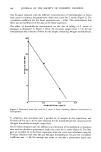
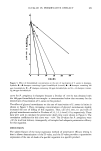
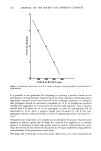
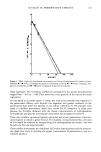
J. Soc. Cosmet. Chem., 31,165-172 (July/August 1980) Establishing cosmetic preservative efficacy by use of D-values D.S. ORTH, The Andrew.Jergens Company, Cincinnati, OH 45214. Received October 22, 1979. Presented at Society of Cosmetic Chemists Annual Scientific Meeting, December 1979. Synopsis The decimal reduction time (D-value) is the time required for inactivation of 90% of the population of test organisms subjected to a lethal agent. The D-value is calculated from the plot of the log number of surviving organisms/g as a function of the time after inoculation into the product. This value provides a quantitative expression of the rate of death of specific test organisms in a particular product. COSMETIC PRESERVATIVE EFFICACY is established by determining the D-VALUES for several test organisms used to challenge the cosmetic products, and seeing if these values meet the acceptance criteria of D-values _4 hr for pathogens (Staphylococcus aureus and ?seudomonas aeruginosa) and _28 hr for non-pathogenic bacteria, yeasts and molds. Examples are provided to show how the method is used to establish preservative efficacy in lotions and shampoos preserved with parabens, formaldehyde or glyceryl monolaurate. INTRODUCTION Aqueous cosmetic products are subject to microbial spoilage. Preservatives are added to cosmetics to inhibit growth of bacteria, yeasts and molds while the product is in trade channels and in the hands of the consumer. The type of preservative used in a product and the concentration needed to prevent microbial growth is determined by preservative efficacy testing. Preservative testing is extremely important to consumer acceptance of the product for the following reasons: 1) use of too little preservative will result in microbial growth, which may alter product attributes (i.e., color, odor, viscosity, etc.) and which may •ender the product injurious to the user 2) use of too much preservative may cause skin irritation (i.e., rash, burning, redness, itching, etc.), which causes consumer dissatisfaction and 3) use of too much preservative increases the cost of the product, which is passed on to the consumer. Thus, preservative efficacy testing •is instrumental in determining the concentration of preservative needed to protect the product and make it safe, on one hand, and to reduce the likelihood of skin irritation and unneeded costs, on the other hand. Preservative efficacy testing methods usually follow the guidelines published by the United States Pharmacopeia (1) or the Cosmetic, Toiletry and Fragrance Association (2). Recently, a method of preservative efficacy testing was developed which allows quantitation of the rate of inactivation of specific test organisms in cosmetic products (3). The method enables preservative efficacy to be determined in 48 hr for bacteria and in 7 days (d) for molds. The rate of inactivation of selected test organisms in a product is given by the decimal reduction time (D-value), which is calculated from the 165
Purchased for the exclusive use of nofirst nolast (unknown)
From: SCC Media Library & Resource Center (library.scconline.org)